
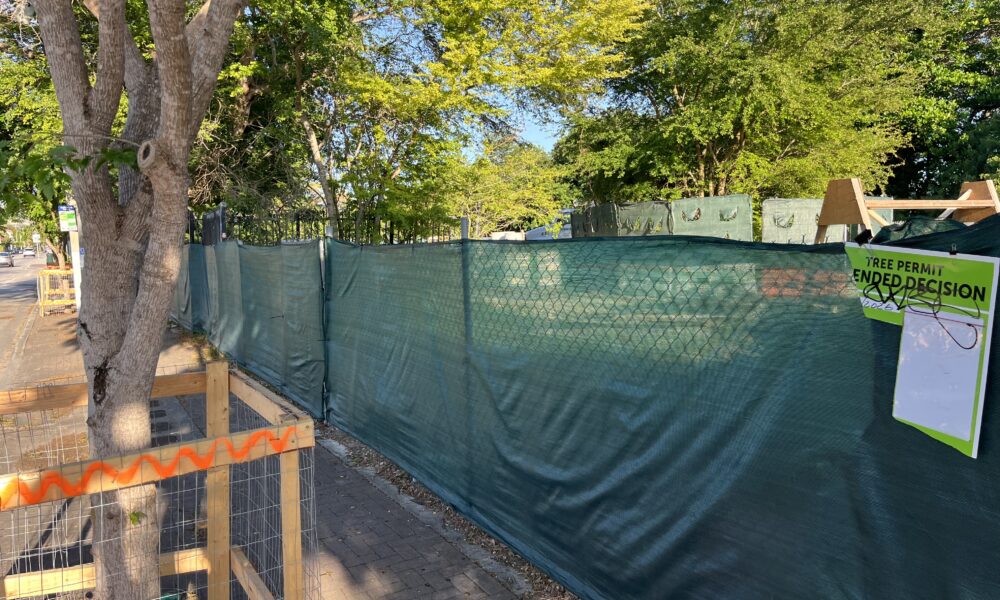


A hearing before a citizens’ advisory board next Tuesday will reconsider a city-approved plan to remove dozens of trees in West Grove — including some already cut without approval — for a short-term racquet sports facility.
A city-backed plan by Coconut Grove-based developer Silver Bluff to remove 57 trees at a West Grove site for a pop-up sports facility — including 15 already cut without a permit — is facing a formal appeal ahead of a May 5 hearing before Miami’s Historic and Environmental Preservation Board.
The appeal questions whether city officials stretched their own tree protection rules to allow permanent canopy loss for a short-lived racquet sports complex proposed on a tract of mostly vacant land at 3520 Grand Ave.
Early last year, city commissioners approved a special events permit for the facility as a way to temporarily activate the long-dormant parcel while Silver Bluff readies plans for a future mixed-use project at the site. That permit will expire at the end of 2026.
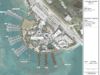
The facility would include 12 pickleball courts, six padel courts, one tennis court and a clubhouse.
Read more: A Pop-Up Sports Facility for Grand Avenue
In March, city officials approved plans to remove the trees in advance of construction.
But Miami-Dade resident Nicole Gazo appealed that decision, arguing that city rules allowing tree removal when they interfere with a “buildable area” were intended for permanent development — not temporary uses like the proposed facility.
“A Temporary Event Permit… in no way justifies the permanent destruction of a mature tree canopy,” Gazo wrote in her appeal of the city-issued tree removal permits, arguing that once removed, the trees “cannot be replaced in kind.”
Gazo could not be reached for comment.
The appeal is one of three to be heard Tuesday by Miami’s Historic and Environmental Preservation Board (HEPB) challenging city-issued tree removal permits, which some local activists say are being approved with increasing frequency and decreasing oversight.
Read more: Tree Policy Delayed as Removal Permits Rise, Advocates Warn
Under city rules, residents may appeal tree removal permits to HEPB, with its rulings subject to review by the City Commission.
Officials from Miami’s Building Department, which oversees tree removal permitting, are recommending a denial of the appeal, city records show.
Silver Bluff’s plans call for the removal of a variety of native and nonnative trees — including several classified as “specimen” due to their size and age — as well as the relocation of others.
The application also seeks retroactive approval for trees already cleared from the site. As mitigation, the applicant has proposed planting 18 trees ranging in height from 10 to 16 feet and contributing $119,000 to the city’s tree trust fund.
Silver Bluff founder Grant Savage and Director of Design Jimmy Sinis, listed as the city’s point of contact for the removal application, did not respond to the Spotlight’s requests for comment.
A report prepared for the developers and filed with the city argues that a significant portion of the site’s 97 trees are invasive species, structurally unsound or in declining health — often the result of storm damage, prior trimming and years of unmanaged growth.
Some trees were found to have hollow trunks, exposed roots or severe lean, while others are classified as prohibited species that must be removed under local code, the report states.
The report concludes that while not all trees require removal, many pose safety risks or conflict with the proposed layout of the courts and related improvements. In some cases, relocation or maintenance is recommended, but in others, removal is described as the most practical option given the trees’ condition and location.
Gazo’s appeal counters that many of the trees slated for removal are mature, including specimen-designated trees afforded the highest level of protection under city code, and that their environmental value — from shade to stormwater absorption — cannot be replicated through mitigation plantings or financial contributions.
Gazo also raises procedural concerns, alleging that required public notice of the permit was not properly posted on the property.
According to the appeal, the notice sign was not visible for most of the 10-day appeal window following the city’s March 10 decision. The sign was only installed the day before the deadline — and just hours before it expired — after a resident contacted the city to raise concerns, Gazo contends.
The delay, the filing argues, deprived neighbors of a meaningful opportunity to review the project and respond.
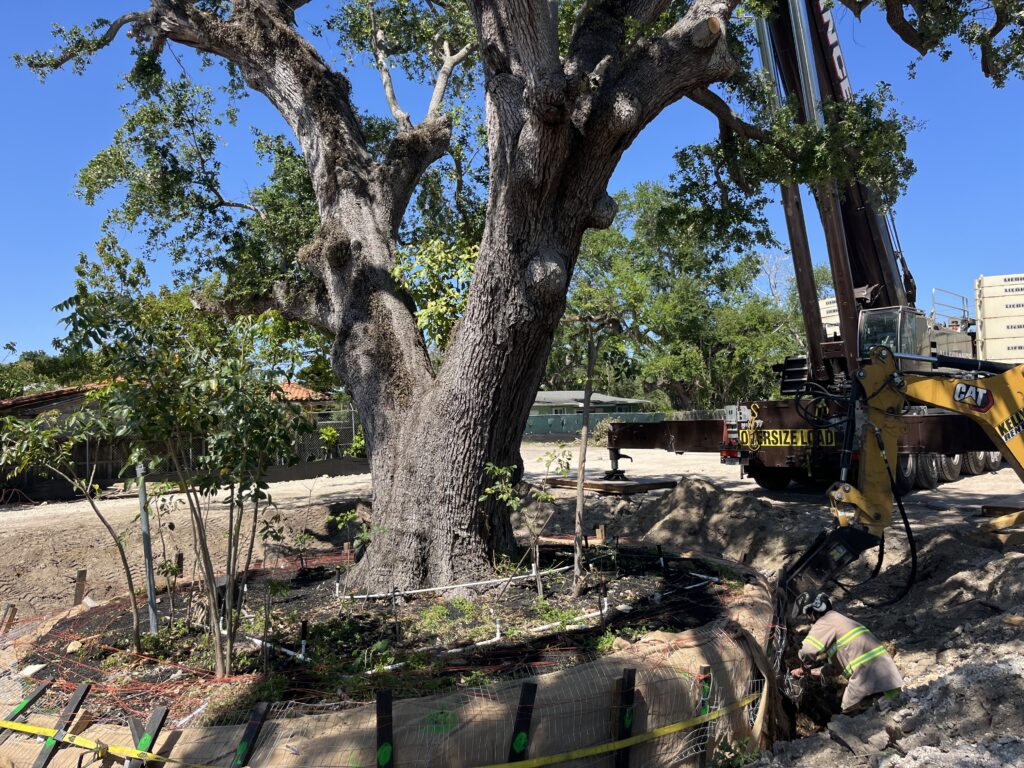
The property is not the only one in West Grove where Silver Bluff is preparing land for development. Earlier this week, just steps away on the north side of Grand Avenue, a massive oak tree — after months of root pruning and preparation — was lifted by crane and relocated from the front to the rear of the property.
The move will clear the way for 3443 Grand, a four-story mixed-use project featuring 80,000 square feet of Class A office space and ground-floor retail, scheduled for completion in late 2027.
Read more: More Development Coming to Grand Avenue










This is EGREGIOUS. Where is the City – and Commissioner Pardo specifically – in ensuring the laws are upheld, and that our communities are protected?
We truly hope he stands up, and lives up to, the commitment he made when running as a candidate: To protect Coconut Grove and its neighborhoods. 👍