

Miami-Dade County says its open-campus plan for a revived Coconut Grove Playhouse will heal the past sin of segregation, but neighbors say they would prefer a barrier to prevent commerce and traffic from overwhelming their quiet community.
Of all the differences laid bare by the bitter dispute over the Coconut Grove Playhouse, there is one point of contention that drips with irony.
Should a new playhouse surrounded by shops, offices and a cafe be open and accessible to the historically Black community that borders it from behind?
County officials insist that it should – to redress the past sin of segregation.
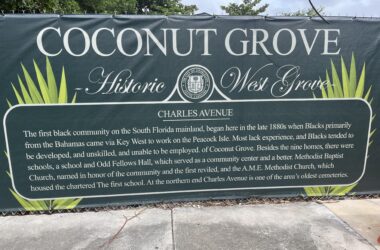
Coconut Grove’s Black residents helped to build the original playhouse in 1926, but then were barred from attending its performances.

“I feel firmly that there has to be access,” Miami-Dade Commissioner Raquel Regalado said two weeks ago during a briefing on the playhouse project. “No wall.”
But West Grove residents say the lack of a barrier between the new, proposed playhouse and their quiet community poses a direct threat to their neighborhood.
“We feel that our communities are under threat. They are under threat from commercialization that is seeping through on every side of us,” Courtney Berrien, a member of Preserve the West Grove, said on Saturday.
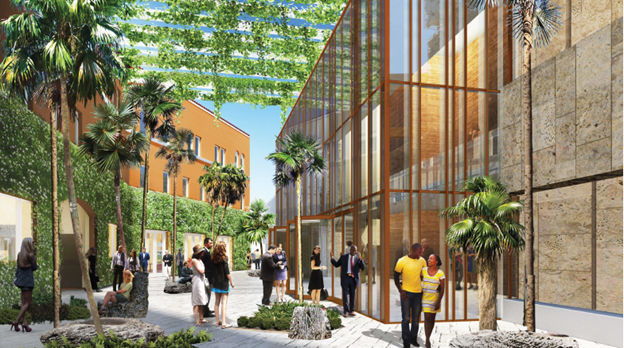
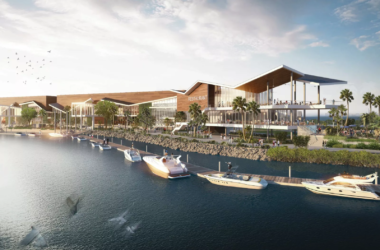
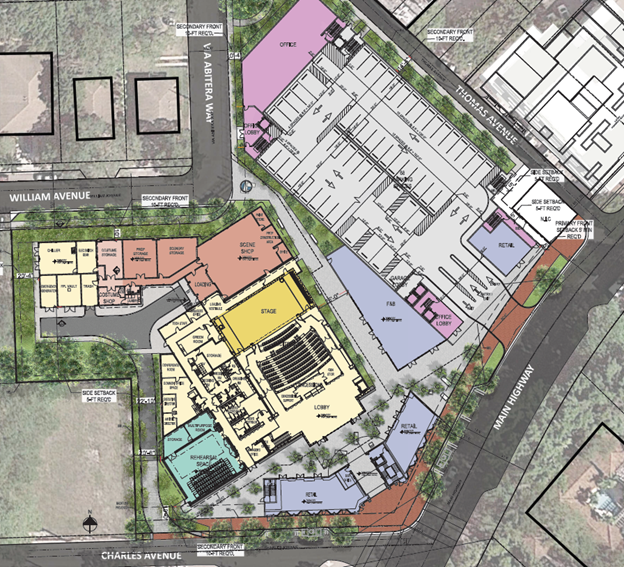
Berrien and others object to the county’s plan for a 300-seat theater complex that includes retail shops, a restaurant, a parking garage, office space, and pedestrian promenades that open directly onto their quiet neighborhood streets.
County officials describe the proposed development as a “cultural campus.” Berrien and others describe it as a shopping mall. “They don’t like it when we say that, but it still looks like a mini-mall to us,” Berrien said.
Four community organizations that speak collectively for West Grove residents, including Berrien’s group, released an open letter on Sunday urging City of Miami officials and the county to protect the residential community that borders the playhouse.
The organizations are seeking to rally support in advance of a public hearing on Wednesday when the county will ask the city’s Planning, Zoning and Appeals Board (PZAB) to bless its playhouse plan. The county’s request was deferred last month.
Read more: Another Bite at the Playhouse Apple
“There should be no commercial development facing directly onto Charles, William and/or Thomas Avenue,” the open letter states.
Instead, the organizations want the county to build “a tree-lined natural barrier” between the playhouse and the West Grove.
The four organizations – GRACE (Grove Rights and Community Equity), Village West Homeowners and Tenants Association (HOATA), the Ministerial Alliance, and Preserve the West Grove – also want the county to develop a “clear traffic mitigation plan.”
Otherwise, playhouse neighbors fear their residential streets will be overrun with theater patrons seeking to park or hail ride-share services like Uber.
Those protections should be secured by a “community benefits” agreement that also includes employment opportunities, discount tickets and youth programming for residents, and public acknowledgement of and investment in the neighborhood’s rich cultural history.
Berrien has been trying to get the county to address these issues for over a year. “Unfortunately, not a lot has changed,” she said.
Read more: Playhouse Neighbors Fear the Loss of their Community
Should PZAB approve the county’s plan on Wednesday, county officials say they plan to apply for a building permit, advertise for a contractor, and begin to build.
As part of the project, the county plans to restore the playhouse’s historic façade – which opened in 1927 with street-level shops, second-floor offices, and third-floor apartments – and build a 310-seat theater behind it, where the playhouse’s former auditorium once stood. The county demolished the auditorium last year, much to the dismay of preservationists.
The county also plans to partner with the Miami Parking Authority to build a parking garage next door to the new playhouse. County officials say the parking garage and planned commercial space will allow the playhouse to operate without taxpayer subsidies.
“The retail and the parking is a revenue (source) that allows the theater to operate,” said Ashlee Thomas, interim director of the county’s Department of Cultural Affairs, which is spearheading the project.
“We are making sure this project doesn’t become a burden to the taxpayer.”
The county hopes to open a portion of the playhouse project next year, in time to celebrate the 100th anniversary of the landmark theater. The playhouse first opened its doors on January 1, 1927 as a silent movie house with a public screening of the “The Sorrows of Satan.”
The PZAB meeting is scheduled to begin at 6:30 p.m. on Wednesday at Miami City Hall. The county’s playhouse application is first on the agenda.