



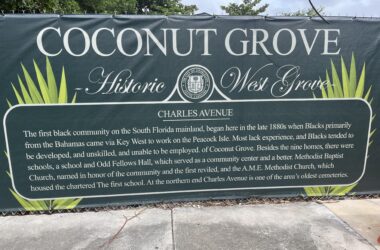

A group of playhouse neighbors came together this week to voice concerns about the plans for the Coconut Grove Playhouse and the impact on their neighborhood.
There’s another battle brewing over the fate of the Coconut Grove Playhouse, and it has nothing to do with historic preservation.
Families who live behind the playhouse are fighting to save their neighborhood from the commerce and congestion that could overwhelm their quiet corner of Coconut Grove once the playhouse is rebuilt and reopened to the public.
Like the activists who have battled for years to save every inch of the historic theater, the families who formed the Preserve the West Grove organization to defend their neighborhood feel their concerns have been ignored by Miami-Dade County.

“We have reached out to the county many, many times,” said Anthony Vinciguerra, who lives on Charles Avenue. “We have had a very difficult time getting a response.”
Vinciguerra and his neighbors presented a united front and a list of five concerns to city and county officials on Wednesday night at United Christian Church of Christ on Charles Avenue. The meeting was well attended, but the outcome remains uncertain.
The families are seeking to negotiate a binding “community benefits” agreement with the county before the City of Miami issues a building permit for the proposed project, which includes a new theater, a parking garage, shops, offices and a restaurant.
“What our concern is right now is the expansion of the commercial into the residential,” said Williams Armbrister, a resident on Thomas Avenue.
“We don’t need restaurants. We don’t need more traffic,” said Theresa Ann Chormanski, another homeowner. She and her family live on Thomas Avenue, behind the restaurant Cotoletta. Her children play basketball in the street. Traffic is already a problem.
“We didn’t sign up for this,” said her husband, Scott Chormanski.
The city and county officials who attended the meeting pledged to work with Preserve the West Grove to address neighborhood concerns about commercial intrusion, traffic and other issues.
“There are a lot of things here, and it’s not easy, but we will definitely work with the community,” said Anthony Escarra, chief of staff to Miami-Dade District 7 Commissioner Raquel Regalado, a strong advocate for the county’s playhouse plan.
“I feel the passion. I feel the concern,” added Ashlee Thomas, the newly-appointed interim director of the county’s Cultural Affairs Department, which is spearheading the redevelopment plan. “We will start the dialogue and see where it goes.”
Courtney Berrien, a Charles Avenue resident who led the meeting, was looking for a stronger commitment from county officials as well as Miami District 2 Commissioner Damian Pardo, who represents Coconut Grove.
“We are really relying on you as our commissioner to advocate for our community,” Berrien told Pardo. “Will you agree to work with us?”
Absolutely, Pardo said, before tossing the question to David Snow, director of planning for the City of Miami. Snow in turn suggested a point of leverage that residents could pursue to compel the county to negotiate a binding agreement.
The county will need to apply to the City of Miami for a zoning exemption to replace the former playhouse auditorium, which was demolished in August, Snow said. A previous exemption granted by the city has expired, he said.
To win neighborhood support for the new exemption, the county may feel obliged to address some or all of the concerns aired Wednesday.
Preserve the West Grove said any binding agreement with the county should address five neighborhood priorities:
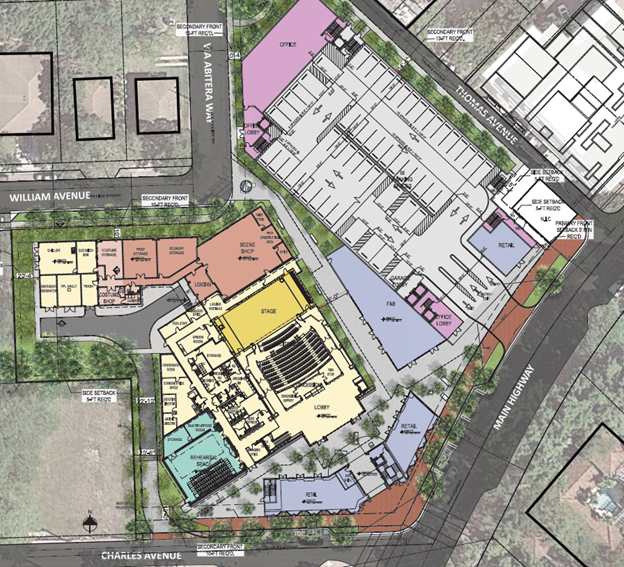
Commercial Intrusion: Neighbors say the playhouse development should include no commercial development – shops, restaurants, offices – that faces Charles, William and Thomas Avenues (follow this link to see renderings of the proposed playhouse).
The county’s open campus plan has two promenades or “paseos” that connect the playhouse to the historically Black neighborhoods behind it – a conscious design decision that county officials say was made to remedy the past wrong of segregation.
Neighbors want the opposite. They are asking the county to erect a barrier or a wall, to limit access and prevent playhouse activity from spilling into their neighborhood.
“We feel that is reasonable,” Vinciguerra said.
“That is something we will talk about,” said Alejandra Argudin, chief executive officer at Miami Parking Authority, which will build the playhouse parking garage.
The design for the four-story garage includes 5,500 square feet of restaurant space, 1,500 square feet of retail space, and 33,000 square feet of office space, she said.
Design drawings for the playhouse project place that office space on the backside of the garage, overlooking William and Thomas Avenues.
Argudin told neighbors on Wednesday that plans have changed. “We are moving all of that to the front” of the garage on Main Highway, she said.
Argudin also said her agency is seeking to address neighborhood concerns about traffic. “There is never an intention for traffic to flow into the community,” she said.
Cut-Through Traffic: Neighbors want the county to develop a “clear traffic plan” that directs theater patrons and commercial traffic onto Main Highway and away from residential streets.
The promenades (paseos) that open onto the West Grove are an open invitation for ride share services, neighbors say. “You know what that paseo looks like to me. It looks like the perfect drop-off for Uber,” Scott Chormanski said.
Three Community Benefits: Neighbors say the playhouse plan should include three community benefits:
- Job and business opportunities for residents of West Grove
- Enhanced access for area churches, organizations and youth groups
- Neighborhood enhancements that highlight the rich history of West Grove.
Berrien said she and her neighbors don’t agree on everything when it comes to the playhouse – she and Vinciguerra are named plaintiffs in a lawsuit against the county that seeks to halt the project – but she said everyone agrees that the five concerns outlined Wednesday should be a starting point for discussions with the county.
In addition to the playhouse lawsuit filed by Berrien and others, the county is facing a potential challenge to its playhouse plan in Tallahassee.
On Tuesday, State Rep. Fabian Basabe (R-106) told the City of Miami’s Historic and Environmental Preservation Board that he plans to introduce legislation to wrest control of the playhouse away from the county.
The playhouse is owned by the State of Florida and leased to the county.
“The playhouse is state-owned land and the county is only a tenant. They have not honored their obligations of preservation, transparency, nor accountability. That is why (at) this upcoming legislative session… I am filing legislation to reassign this lease to another municipality ready to act in good faith,” Basabe said.
“I am doing this with the support of leadership and my colleagues, that serve in the super-majority Republican legislature. Some of you may not know me, but I am quietly very effective, and I have great partners in this legislative process, and I will not stop until accountability is restored.”
The Spotlight invited county officials to comment on Basabe’s statement, but did not hear back.


















This was a very productive meeting. So many times City and County officials are up on a platform and do almost all of the talking and hardly any of the listening. This time the meeting was conducted by the leaders of the group of citizens most affected by the redevelopment of the Playhouse site, those who live within 500 feet of it.
Here’s just one example of the difference true dialogue can make. When politely given the floor to speak, Commissioner Regalado’s representative, who acknowledged that for decades the West Grove community was separated from the Playhouse by a barbed-wire fence, said that was the reason the County’s plan “opened up the site with no barricades.” He said he was perplexed that this group of citizens now seemed to want barricades.
“No,” the citizens told him. “What we want is protection from construction and service trucks, ubers and lyfts, speeding at all hours down our residential streets where our kids play.” That protection could be in the form of a low and inviting coral rock wall, with pedestrian access only — different from both an 8-foot barbed-wire barricade and also from open access to both cars and trucks through their neighborhood.
As another member of the citizen group said, what the County’s plan suffers from is “a lack of imagination.” She was right. Imagination requires an open mind and ears willing to listen, really listen, to all citizens and especially to those who will be most affected.
I hope for the day when I can read an article in this paper that shows the City and County actively listening to what their constituents want. It seems asking for SAFE streets is a bridge too far for those in power. Residents have been asking the County to review their throughput of traffic through the Grove, via South Bayshore, for two years. Zero response. Residents and visitors to Coconut Grove take their lives into their hands – daily! Pardo is as useless as the crosswalks we are told are safe! The County and City need to work together to help combat the outsized influence of developers. They are destroying the Grove. I fear they won’t rest until Coconut Grove looks like Brickell. Very sad.
The voices of residents and supporters have been silenced for years. The real crime is the demolition of the Playhouse — part of a larger plan to take over the West Grove residential area. This is a genuine and devastating blow to the neighborhood and a national landmark, causing immense suffering for the Black community of West Grove.
This ongoing gentrification is a profound injustice. New townhouses are constantly being built, and property taxes are reaching exorbitant levels. The community’s pain is compounded by the county’s continued neglect, which many believe is an intentional strategy to justify demolition.
Amidst this tragic situation, there is a glimmer of hope. State Representative Fabian Basabe has stepped forward, promising to help the community reclaim the Playhouse and its legacy. After years of pleading with the Department of Environmental Protection and the County — which has proven to be an irresponsible steward — the true agenda of demolition through neglect has been revealed. The destruction of the Playhouse is a devastating blow to the West Grove community, affecting the very heart of the West Grove and its Bahamian heritage.