

The former Coconut Grove Chamber of Commerce president is turning his knack for networking into a for-profit venture. For the Grove’s burgeoning business class, is this the future of community life?
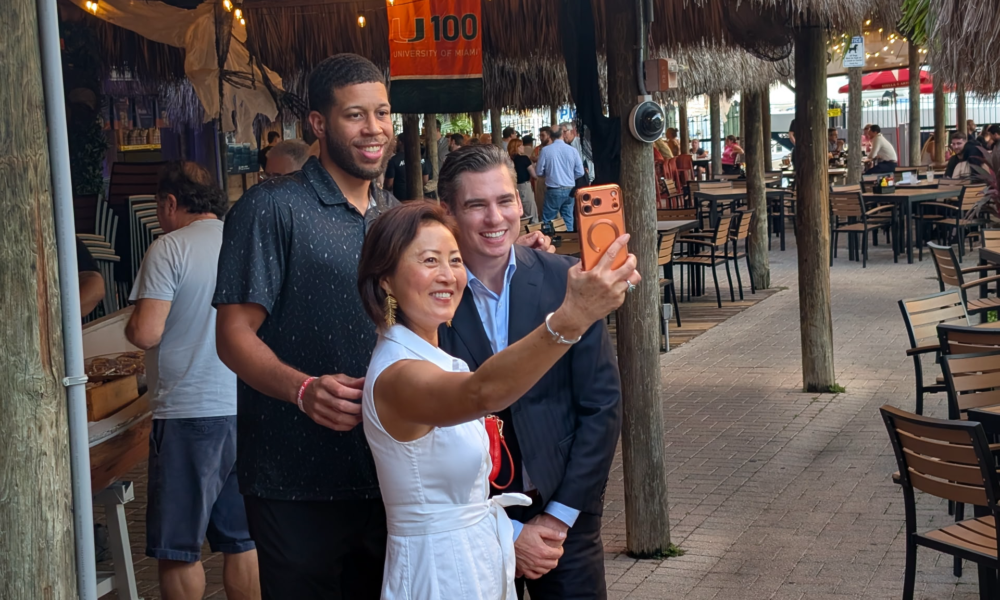
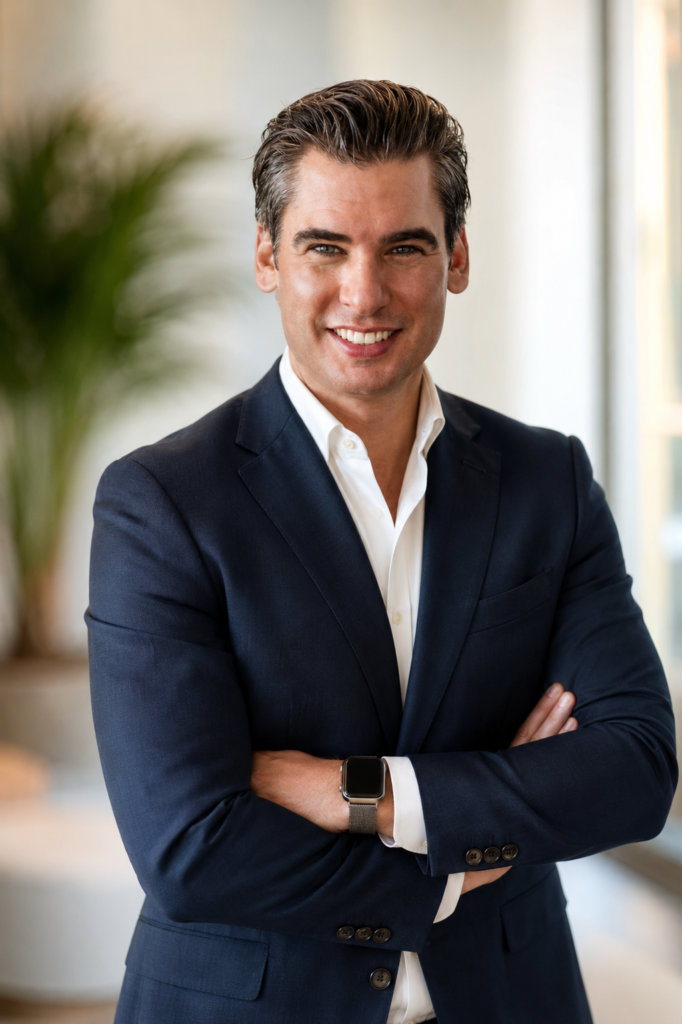
On a muggy Wednesday night in late October, Rhys O’Connell is in full host mode at Monty’s Raw Bar, the venerable open-air restaurant and bar on Coconut Grove’s waterfront. Dressed in a sharp dark blue suit and crisp button-down shirt, the Australian native works the room, greeting guests, making introductions and handing out free drink tickets.
About 60 people have gathered for an evening of food, drinks and conversation, including business owners, neighborhood residents and figures from Coconut Grove’s arts community. The featured speaker is local playwright William Hector, discussing next spring’s Coconut Grove Theatre Festival.
For O’Connell, who arrived in the Grove three years ago to run the Mayfair House Hotel and Garden, bringing people together has become something of a specialty. Now he’s trying to turn those connections into a business.
Despite its civic-sounding name, the Coconut Grove Neighborhood Association is a for-profit networking and events company founded by O’Connell. Its pitch is straightforward: Pay an annual membership fee and gain access to social gatherings, local business leaders, public officials and discounts at participating merchants.
Whether enough people will pay for that access is another question, particularly in a neighborhood already served by a chamber of commerce, a business improvement district and numerous civic organizations.
“There was really nothing in the neighborhood offering this type of access to business owners and residents in an intimate setting,” O’Connell told the Spotlight. “People are more approachable.”
So far, the association has attracted 61 paying members: 27 residents at $99 annually and 34 businesses at $199, according to O’Connell. That represents $9,439 in annual membership revenue before expenses.
Members attend regular mixers for free and receive a digital Grove 33 card offering discounts of at least 10 percent at participating businesses — a benefit some merchants already extend to Grove residents without a membership.
Some special events carry additional charges. Nonmembers pay $33.13 per event — a playful reference to the Grove’s 33133 ZIP code — which generally includes food and drinks.
O’Connell’s approach extends to how he promotes his gatherings. An Instagram announcement for his next event says the location will be disclosed only after attendees register.
O’Connell says an August town hall featuring Miami Commissioner Damian Pardo at Level 6 Rooftop Restaurant sold out. He also points to a mailing list exceeding 2,000 people as evidence of interest.
But a full room and a profitable business are different measures.
For now, O’Connell keeps expenses relatively low. He has no employees and handles the association’s marketing, scheduling and event hosting himself. Some venues provide complimentary space, food and beverages, while the association pays those costs when necessary.
“In order for it to work, it needs to be blended with both businesses and residents,” he said.
His next scheduled event, on Dec. 9, will feature Miami Police Chief Edwin Lopez discussing public safety in Coconut Grove. The location has not yet been announced.
O’Connell’s professional background is in hospitality. He arrived at the Mayfair in October 2023 after managing a hotel in Montauk, New York. A year later, he became general manager of the Arya Hotel & Suites Coconut Grove. Earlier this year, he took a general manager’s position with KW Property Management and Consulting.
Along the way, he became increasingly involved in the neighborhood’s business community, serving as the unpaid president of the Coconut Grove Chamber of Commerce from February 2025 through February 2026.
After leaving the chamber, O’Connell and former chamber marketing coordinator Silvana Massolo briefly launched Hive House, another for-profit networking and events company, before O’Connell established the Coconut Grove Neighborhood Association on his own.
That transition — from leading a nonprofit civic booster organization to running a for-profit spinoff of one of its activities — has created some friction.
Bob Fitzsimmons, an attorney and the chamber’s current president, said O’Connell offered to produce and manage networking events for the chamber after launching Hive House.
“It seemed like it was just a business model for him,” Fitzsimmons said.
Chamber board member Sue McConnell said O’Connell had raised the possibility of compensation while serving as chamber president, an unpaid position. O’Connell said he never sought a salary and that compensation was not discussed when he later proposed managing the chamber’s networking events, apart from a photographer’s fee.
O’Connell also said he was eligible for a 20 percent commission on memberships he recruited but declined to accept it. Fitzsimmons said he did not recall specific discussions about membership commissions and confirmed that O’Connell never asked him for payment.
O’Connell also credits himself with increasing chamber membership by 300 percent and event attendance by 400 percent during his presidency.
Fitzsimmons questioned those figures, although he credited O’Connell and Massolo with invigorating the chamber’s networking activities.
“With regards to membership, his percentages sound a little high but he and Silvana definitely increased the membership and got the networkers more active, no question,” Fitzsimmons said.
The chamber now has about 100 members.
Despite the overlap between the two organizations, Fitzsimmons stopped short of describing O’Connell as a competitor.
“Rhys is trying to run a business,” he said. “I don’t think I am competing with him for members.”
He was more skeptical about whether networking events could generate substantial profits. “An event may make a couple hundred bucks, but there is no money to make doing this,” Fitzsimmons said.
O’Connell largely agreed that ticket sales alone were unlikely to sustain the enterprise.
“I agree that networking events alone are not necessarily significant revenue generators,” he said. “However, they are valuable relationship building platforms. The real opportunity is building an ecosystem around those relationships rather than relying solely on ticket sales.”

Part of that strategy involves assembling an advisory board of prominent Grove residents and business leaders whose connections could help attract members and speakers.
The most recognizable name is developer David Martin, whose Terra Group has played a major role in reshaping Coconut Grove.
O’Connell said Martin plans to speak at an association event in 2027. But a spokesperson for the developer said no speaking engagement has been confirmed and Martin has not attended any association events.
Martin agreed to serve as a community stakeholder after being introduced to O’Connell by longtime Grove businessman Monty Trainer, the spokesperson said. Trainer has confirmed that account.
Other advisory board members include Marshall Steingold, founder of Miami Maps; Ransom Everglades Head of School Rachel Rodriguez; cardiologist Allan Stewart; and Rosa Tamajon, manager of The Ritz-Carlton, Coconut Grove.
O’Connell said the board provides suggestions for event topics and potential speakers but has no decision-making authority.
Steingold, who met O’Connell during his time at the Mayfair, said he joined because he believes the concept fills a neighborhood need.
“I am a big fan of Rhys,” he said. “He has always had his heart in the Grove.”
Trainer, who also serves on the Coconut Grove Chamber of Commerce board, believes O’Connell’s association can coexist with established neighborhood organizations.
“I think Rhys is a dynamic go-getter,” he said. “I think he has the right thing in mind on what he is trying to accomplish.”
But O’Connell is careful to distinguish his organization from the traditional neighborhood associations that advocate for residents on zoning, development and other civic issues.
“There’s no activism,” he said. “That is not something that this organization would encourage.”
He acknowledges that the association’s name could suggest otherwise.
“However, our vision is broader,” he said. “We want to create a platform that connects the neighborhood socially, professionally and economically.”
At Monty’s Raw Bar, that distinction seemed less important to attendees than the opportunity to meet people.
Camille Marchese, executive director of the Coconut Grove Arts Festival, said she had already met a shop owner she didn’t know and someone who suggested a location for her organization’s holiday party.
“The Grove can appear to be a little clicky from the outside so I think anything that brings people together is great,” she said.
Chandler Rowe, owner of ABC Home & Commercial Pest Control Services, attended hoping to meet potential customers. He wasn’t yet a member but said he planned to join. Christian Hernandez, a creative director for two nonprofit organizations, also expressed interest in signing up.
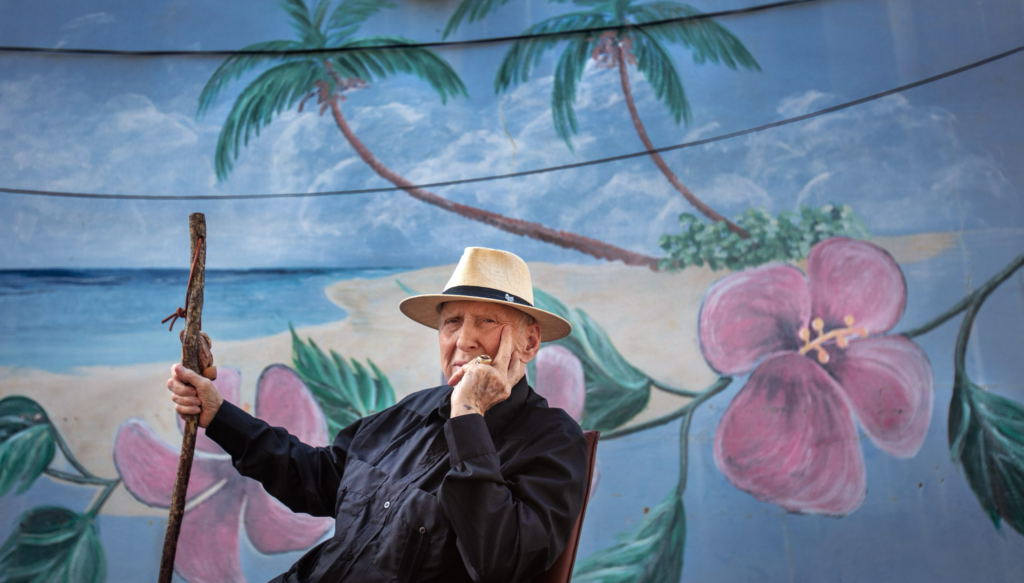
Vinny Larios, owner of Fade Masters of Miami barbershop, had already joined. O’Connell first approached him while recruiting for the chamber, later became a customer and friend, and eventually brought him into both Hive House and the neighborhood association.
Such connections illustrate what O’Connell hopes to build. They also underscore the challenge: Turning casual interest and occasional attendance into a reliable stream of paying members.
Marchese sees value in bringing residents and business owners into the same room, regardless of which organization makes the introductions.
“I think there’s always room for more socialization,” she said. “I think it’s nice that Rhys’ association includes more than just business owners.”
In a Coconut Grove increasingly defined by an influx of wealth — and the business opportunities that come with it — O’Connell’s venture may be another sign of a changing neighborhood: Even the simple act of bringing people together has become a business opportunity.