



American crocodiles are a common sight at Dinner Key Marina these days. People can chill, experts say. Pets, not so much.
As a boy growing up in the King’s Bay community nine miles south of Coconut Grove, Robert Shelley saw American crocodiles from time to time.
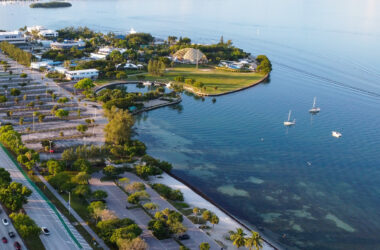
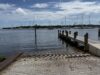
These days, from his sport fisherman berthed at Dinner Key Marina, he occasionally sees a crocodile swimming along the seawall and assumes it’s the five-footer known to sunbathe in the vicinity of the nearby public boat ramp.
“The croc hangs out in the sunshine on a flat rock at low tide,” says Shelley. “He minds his own business. I haven’t heard of any issues and don’t see anyone feeding him.

“When I lived in Deering Bay Country Club,” he adds, “they had to fence off a little beach because residents were walking their dogs there and crocodiles would come out of the water and grab the dogs.”
Wildlife ambassador Ron Magill of Zoo Miami says people have little to fear from American crocodiles, but respect is key and dog owners who allow their pets to swim from the Dinner Key boat ramp each morning should take note of Shelley’s words.
“The biggest problem with crocodiles and alligators is that they don’t discriminate between a dog and a raccoon. All they see is dinner,” says Magill.
“No American crocodile is going to run you down, but remember they are a large predator so don’t tempt fate by walking your pet beside the shoreline and certainly don’t swim in the water with them.”
For decades, American crocodiles have called South Florida home, mostly in the farthest reaches of the Miami-Dade County toward the Monroe County line.
More recently, crocodiles as large as seven or eight feet have begun showing up at Dinner Key Marina, often draped across a flat rock near the Seminole Boat Ramp.
(Alligators favor fresh water, so the crocodilians you’re likely to see at Dinner Key are crocodiles, not alligators. See a video of a Grove croc here, courtesy of Eric Lindeman, dockmaster at the Coconut Grove Sailing Club.)
Crocodiles were listed as an endangered species until 2007, when their status was downgraded to “threatened” due to a rebound in population. They are still protected under the Endangered Species Act, which makes it a crime to harass or feed them.
According to the Florida Fish and Wildlife Conservation Commission, there are between 1,500 to 2,000 crocodiles in Florida today, up from about 300 in 1975. As their population has grown, the reptiles have expanded their range to Biscayne Bay and points north in search of new food sources. They can grow up to 13 feet in length.

Dr. Frank Mazzotti, a professor at the University of Florida and a member of the university’s Croc Docs team, wants people to know how fortunate we are to have a crocodile to admire from a distance.
“Florida is the only place in the world where you can see an alligator and a crocodile in the same place. The American crocodile is one of the least aggressive crocodilians, actually shy, unlike the African and Indonesian crocs which stalk humans” he says.
“Driving around Coconut Grove poses far more danger to you than the Coconut Grove crocodile.”
Opinions differ about whether the croc that now frequents Dinner Key is the area’s only toothy reptilian resident.
“There are lots of crocs… definitely more than one,” says Eric Lindeman, who has served as dockmaster at the Coconut Grove Sailing Club for the past eight years.
“About every year, usually in the spring, we see a baby croc about 18 inches long in the mud by the mangroves. The biggest croc I’ve seen was about seven feet long. I’ve certainly seen a lot more crocs in the last five years. Their population is doing good.”
Asked whether he’s aware of any issues involving the reptiles, Lindeman shakes his head.
“There’s never been an incident. We have divers here in the water clearing boat bottoms every day. The crocs swim right up to the dock. But of course, some people are scared of them.”
To the question of whether crocodiles can be removed, Dr. Mazzotti has a ready answer.
“They will come right back. There’s no reason to remove it, and if we did, another would just take its place. We moved one from Turkey Point to Tampa and it ended right back at Turkey Point. That trip is well within their ability.”
And that scary look they have when their jaws are open, showing all of those sharp teeth?
“During the heat of the day, crocs often remain motionless with their mouths agape. It’s because they’re thermoregulating. Taking in the sun. It’s their normal behavior; they’re not being vicious or aggressive,” explains Magill.
That said, Raene Bello, a boat captain for Miami Water Sports concession at Dinner Key, worries about crocs every time he rents a flyboard, a water-propelled recreational device that allow people to hover and maneuver.
“People use the flyboards right here, really near where the croc lies on his rock,” says Bello. “I’m always a little scared that something might happen. Maybe someone will land on him.”
Tony Sanchez, a supervisor with Florida Commercial Divers who spends hours in Coconut Grove cleaning boat hulls, has a practical philosophy when it comes to crocodiles.
“When I see one,” he says, “I get out of the water.”

















If you’re in New York City at the American Museum of Natural History, you can see a 14 foot taxidermied American crocodile on display in the reptile section. It’s from Biscayne Bay, a gift from Commodore Ralph Munroe, from over 100 years ago. Cool!
Very cool. And this is a very good article… not alarmist but rather just informative about a topic that could be seen as very alarming!
These crocs have been there for as long as I can remember, no issues, we have all coexisted. Grove has an astronomical number of people moving in or passing by, and all want to make changes to our Grove. Please just let them be.