


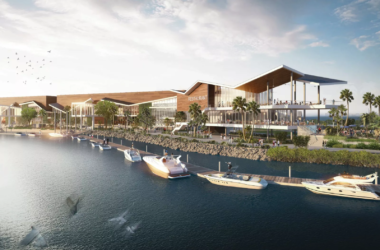
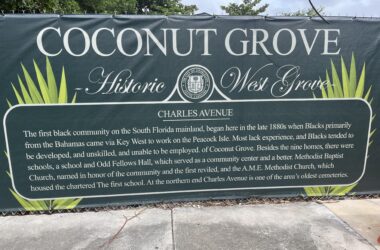

A proposed redevelopment project on Douglas Road in the West Grove is fueling neighborhood concerns over gentrification, a loss of privacy and green space, and a shortage of available parking.
West Grove residents had a chance this week to voice their concerns about a massive affordable housing project on Douglas Road that will transform their neighborhood by replacing 24 two-story homes with a high-rise tower and 450 rental apartments.
Chief among those concerns: a loss of privacy and green space, spillover parking and a rental process that doesn’t favor West Grove residents, despite a documented history of displacement in a Black neighborhood experiencing rapid gentrification.
“The neighborhood has severely changed, and the current residents may not necessarily be our legacy residents – those that were born and raised in the community,” Kimberly Davis, president of the Coconut Grove Optimist Club, said Tuesday during a virtual community meeting on the proposed Eviva housing project.

“What are we going to do to ensure that those who were displaced prior to those current residents, that they also have equal opportunity to come into this development?”
Eviva is one of two redevelopment projects approved by Miami-Dade County this year for the Douglas Road corridor between Grand Avenue and South Dixie Highway.
Both projects will be built on public land, both will replace low-rise public housing with mixed-income residential towers, and both will be leased through a lottery system open to all county residents, with no preference given to Grove residents.
The $159-million Eviva project will straddle Percival Avenue on the east side of Douglas Road, with a high-rise tower to the north and a smaller building to the south.
More than half of the 450 apartments – 253 in total – will be market-rate rentals. The remaining 197 units will be priced within reach of low-income and working families.
Tuesday’s community meeting was hosted by Miami-Dade Commissioner Raquel Regalado, whose district includes Coconut Grove.
“I’m excited about the community we are going to be building here,” she said at the top of the meeting. She also promised West Grove residents more opportunities to participate in the development process.
“This is just the first of many meetings as we prepare for what is coming,” she said.
But residents suspect that many key elements of the Eviva project have already been worked out between the county and the developer, leaving residents with little to no say over how the project will impact their neighborhood.
“You said you want to keep the history of the West Grove with the new development. Honestly, you are not keeping the history of the West Grove,” Leudra Thomas-McLean, a West Grove resident who lives in one of the 24 publicly-owned homes targeted for redevelopment, told county officials and Integral Florida, the developer.
“As for this development, I know that the county and real estate got together and had a conversation, but the conversation was never brought to the residents of the West Grove,” she added.
The county and Integral Florida have responded by saying, essentially, trust us.
“We have been delivering affordable housing for a long time,” Kareem Brantley, a principal at Integral Florida, told participants. “We have ingrained ourselves into the community. We will be responsive to the community.”
The 450 apartments will be built in two phases, Brantley said. Integral Florida expects to begin construction in the first half of 2027 and complete the project in 2029 or 2030.
The families that are living in the 24 existing residences will be guaranteed housing in the new development, and the project will be staged to minimize any displacement of those families during construction, Brantley said.
Still, some residents are not happy.
“You guys are taking away single-family homes with yards, what we’re used to, to put up apartments that we are not used to. I mean, you are taking away our freedom for having family gatherings, but now we would have to have it in a designated area,” Thomas-McLean said.
“I understand that change is sometimes good, but it’s not always good, when you guys are changing to things that some of us really don’t want. You are taking away our privacy, in so many words, to put us in apartment complexes, which is semi-private. I don’t really think that is fair.”
Regalado said the decision to build high-rise apartments was driven by the need for more affordable housing – something the community has previously said it wanted.
“One of the first meetings we had, what we were told is that there was a desire to have more units because there were very few places to live in the West Grove because of overdevelopment” Regalado said.
The county sought to balance that decision by adding amenities to the two Douglas Road projects – a new library, for instance, and swimming pools.
“You are going to be losing some privacy,” Regalado acknowledged.
“But, at the same time, you are going to be getting a pool… there’s going to be a public library. There’s going to be community space. It’s going to be safer. There’s going to be a security system, there’s going to be designated parking. So, we really tried to balance what we were giving up with what we were providing.”
Regaldo also told Thomas-McLean that she and other residents will have options – to move into the new development or choose other subsidized housing.
“As part of this process, we will be sitting down with all the residents. You do not have to stay at this building. There are other options, if you choose those other options, we will be walking through that with each one of you. But we hope you stay in this redevelopment,” Regaldo said.
“I do understand what you are trying to do,” Thomas-McLean responded. “I am not knocking it (but) all I see is every community that you guys are redeveloping losing a lot of the people from the neighborhood.”
Not true, Regalado said. “We just did South Miami. Everyone who was there returned there,” the commissioner said.
“We’ll see, we’ll see, but I respect that you were nice enough to answer my question. I appreciate you addressing it, but we’ll see how this goes,” Thomas-McLean said.
West Grove residents who attended the meeting also expressed concerns about the number of parking spaces in the development, and whether there would be enough parking for residents and their guests.
Brantley said Eviva’s parking plan was still a work in progress, but he promised that the final development design would address that concern.
“The idea is not to have a development that has so few parking spaces that parking is flowing out onto the street and it’s a nuisance to the neighborhood,” he said. “We will not do that.”


















“One size fits all.” Except it never does, not for shoes and definitely not for neighborhoods.
Yes, there is a housing crisis. Everyone needs a roof over their head. But the primary reason almost all new “affordable housing” is high-rise rental apartments is because, in the short-term, it is the fastest, easiest and cheapest way to build the most roofs. And it must be built by BIG developers.
But what about the long-term? Think about it. When you get in an elevator in a big rental apartment building, most likely nobody says hello or even looks at each other. In West Coconut Grove, now Little Bahamas, all the original houses had front porches where people sat and waved to their neighbors walking with their families or pets. They might not have had indoor plumbing but they had a neighborhood. And they loved it!
It’s 2025. Times have changed. There’s a place for high-rise rental apartments and it is right next to major public transportation. There’s also lots of places, called vacant lots, where new 3-story apartment buildings can happen, and many single-family homes and duplexes can be refurbished by SMALL developers. It is doable with the will to do it.
In the long-term, a proper and varied mix of shelter will be cheaper and a whole lot better for everyone. One size never fits all.