


The City of Miami has partnered with a private developer to redesign Kirk Munroe Park, a popular after-school gathering spot in Center Grove for students. Parents hope the new design doesn’t result in a “stay-off-the-grass” vibe.
At 3:05 p.m. the final bell rings at Coconut Grove Elementary. The school day is over, and play time is just beginning across the street at Kirk Munroe Park.
For the kids who play here, the small City of Miami park – with five tennis courts, two hitting walls, a playground, and open stretches of patchy grass – is a welcome retreat.
Neon green tennis balls sail through the air – smacked over the hitting wall by mistake – and scooters roll through the center lawn while the toddler crowd races up and down the small playground’s slide.
Kids roam free, while parents watch from picnic tables and benches nearby.
“All the kids here, they have a playdate, and we have a playdate,” said Val Ritter, one of the parents whose children have been coming here since pre-K.
Ritter says the park has been an important resource for her family, helping to fill the time between the end of school for pre-K and first-grade students (who are dismissed at 1:50 p.m.) and the upper grades.
“The kids love it. We hope we are not going to lose it,” Ritter said.
Ritter is referring to a City of Miami plan to redevelop Kirk Munroe Park and nearby Fuller Street with help from the Allen Morris Company, whose Ziggurat development is slated to rise on the block sandwiched between the park and Fuller Street.
Under a development agreement approved by the City Commission this month, the city will contribute $3 million toward improvements to the two public spaces, while Allen Morris will add $2 million and oversee the design and construction process.
Read More: City Taps Developer to Redesign Two Public Spaces
The developer is now expected to engage local stakeholders – residents, businesses and organizations – in a public process that produces a proposed design for the two public spaces. Both designs will require final approval by the City Commission.
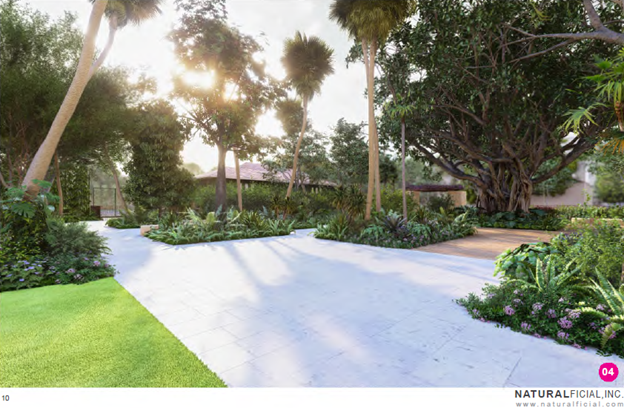
In the meantime, preliminary design work has begun. In the case of Kirk Munroe Park, those early design drawings, although far from final, shift the playground and hitting wall to the west end of the park, clearing the way for an uninterrupted central lawn.
An elevated stage is proposed for one end of the lawn, creating a performance space, with water features sprinkled throughout the park.
Other proposed improvements include new surfaces for the park’s tennis courts, a renovated tennis building, decorative fencing around the park’s perimeter and wooden decking under the park’s massive banyan tree.
Carlos Santamaria, whose Neighborhood Tennis organization offers lessons in the park every weekday from 2 to 5 p.m., said he would be thrilled to see the park’s courts restored. The improvements, he said, will be a major motivator for his students.
“They see the cracks in the court as much as you and I do,” he said.
Not everyone is a fan of the proposed refresh, however, or the city’s decision to allow Allen Morris to lead the design process.
Read More: Fuller Street Makeover: Public Upgrade or Private Land Grab?
City officials and company representatives insist the collaboration is meant to accelerate long-awaited upgrades to the park, something parents have long sought.
“Kirk Munroe Park is across the street from our school and it is in dire need of a makeover,” one parent wrote in a Change.org petition addressed to former City Commissioner Ken Russell in 2021.
“It has been renamed “dirt park” by many of my son’s friends who gather at the park regularly after school,” she added.
But now that city officials are moving forward to address those concerns, some residents are wary of the chosen approach.
Attorney and longtime Grove resident Danielle Villoch said she has followed the deal from its earliest discussions and remains uneasy.

“The city is contributing $3 million versus their $2 million, and somehow we’re ceding all design control and construction control when Allen Morris is not even putting up 50% of the capital,” Villoch said. “They get to credit the design fees they’ve already spent toward their share. It just feels very opaque.”
In response to that criticism, Allen Morris attorney Javier Fernandez has framed the company’s role as logistical rather than decisive.
“We are just using the development agreement as a vehicle to avoid having the city go out to get a separate solicitation for design services,” he said. “It’s a workaround to bring on the designer, pay those costs, and contribute that value to the city. This won’t give us any operational control of the park.”
Santamaria welcomes the outside help, saying Allen Morris’s assistance will speed the much-needed improvements. “I think the city has done what it can and it’d be nice to have someone help the city and do this in the fastest way possible,” he said.
Villoch’s bigger concern, however, is that the redesign could subtly repurpose the park into what she described as “an amenity” for the company’s Ziggurat development.
“Kirk Munroe Park sits opposite an elementary school and should be in the service of the children of this community,” she said. “Residents don’t want a concession stand, and we certainly don’t want alcohol being sold across from a school.”
The construction of a new concession building was a component of the design rendering last pitched to residents.
After residents voiced concerns, however, a reference to that component was dropped from the development agreement – tentative validation, perhaps, that Allen Morris is willing to listen to public feedback on its design plans.
Joseph Vergara, a resident who lives near Kirk Munroe, described the park as a crucial community hub — “an extension of the school and the residential neighborhood” — and said the process so far has left him uncertain about whether those roles will be preserved.
“If people are shown the designs first instead of being asked first, it feels like putting the cart in front of the horse,” he said. “That creates antagonism. People feel like the developer decided what’s convenient to their bottom line before asking us what we wanted.”
Allen Morris executives reject the suggestion that the company is steering the outcome in its favor. Company CEO Spencer Morris said the design work began with extensive public feedback gathered by Javier Gonzalez, the City of Miami’s District 2 community liaison.
“Javier held a few meetings in the park where he asked people what they wanted to see and not see,” Morris said. “He created a spreadsheet from 100 to 200 participants. That was the basis of design — it didn’t come from us.”
Gonzalez confirmed that initial outreach meetings were held in 2024, and additional workshops will be scheduled before any final design is approved.
“It’s important to note that only the development agreement was passed,” Gonzalez said. “That agreement just outlines how the improvements will be paid for. The design phase requires further meetings with residents, and nothing allows the developer to bypass the city’s parks standards or the community’s input.”
Still, residents like Villoch and Davey Frankel, a member of the Coconut Grove Village Council, want the city to commit to a more structured public planning process before any shovel hits the ground.
Frankel said he would prefer a formal public design charrette for each site — a series of planning sessions open to residents, rather than what he characterized as a closed process directed by the developer.
“The development agreement says they ‘shall work with stakeholders,’ but all that’s really required is City Commission approval,” Villoch said. “That’s not the same thing as community control.”
The next step is expected to come at the second City Commission meeting of the new year on Jan. 22, when the Commission will review a proposed development management agreement detailing how the work will proceed.
Until then, frustration over who really controls the future of Kirk Munroe Park will continue to simmer in Coconut Grove.
















Thanks for the informative article. As we live next door to the park, the implementation of these changes will make a big difference. One comment re the proposed budget: the article includes a quote stating the process so far feels opaque because the developer gets to credit the design fees they’ve already spent toward their share of the budget they’re splitting with the City. I checked and found that only the design fees incurred after the final Development Management Agreement is signed will be credited like that. The lawyer for the developer clarified this on a call. The designs, in my understanding, will continue to be modified as input is taken into account, and the Commission will have to vote on the final plan.
I hope a “new facelift” comes as something that fits into what our Grove truly is, what the West Grove wants, and not pandering to new transplants which are changing everything that makes this enclave so special in Miami – while squeezing life long residents out. Grove has been a desired neighborhood of tree canopy, artsy & culturally interesting individuals, dogs, small/cool shops and restaurants for ever. But new special interest and developers are taking it apart with concrete, unregulated overdevelopement, large chains, transplants and changing the vibe. All while making developers (and few city officials) richer and the rest of us that call this place home, miserable.
Please expand and enhance the playground for the children, as it is right across from our local public school. Also a dedicated dog park or dog walking area would be so nice, with some seating areas to read books. Please don’t make it so high end so that it loses the organic Grove vibe and isolates local long term residents.
They’ve already shown us how they plan to “share” amenities.
If you go to fuller st right now, there are 4 sets of outdoor seating from Barracudas, Chuggies, Grove Grover and Ziggurat.
Ziggurat’s outdoor seating is chained up and often covered with a tarp so it is unusable by the public — all the others are unrestricted and open to any passerby.
I expect this will be their approach. Additionally, the seating they’ve put out is trying to force luxury into a decidedly casual street and honestly looks out of taste and cluttered.