


A proposed deal between the City of Miami and a private developer could reshape one of Coconut Grove’s most popular gathering spaces – leaving some residents to wonder who will control Fuller Street when the dust settles.
In recent weeks, outdoor seating options have exploded along Fuller Street, a tiny, pedestrian-only promenade in the heart of Coconut Grove’s village center.
Along with the longstanding row of pink picnic tables placed there by the venerable Barracuda Taphouse & Grill, there is now seating for the newly opened Chuggie’s burger joint, Grove Grocer and the cheese and sandwich shop Chèvre.
For many Grove residents, those tables are less welcoming than foreboding — a disquieting harbinger of things to come.
What has long been a casual, come-as-you-are hangout — open to anyone, where rich or poor, young or old could grab a table day or night — now feels, they say, more like a food court annexed to the surrounding storefronts.
“Fuller Street is basically the Roman Forum of Coconut Grove,” said resident Josh Abril. “It’s everyone’s street, and what happens with it (now) is being dictated by the people who own the buildings around it.”

Fuller Street, the short block between Grand Avenue and Main Highway, was closed to automobile traffic in 2020.
Since then, it has become a kind of community commons, equal parts shortcut and meeting place, where you might find local school children eating brown-bag lunches; early-morning chess club gatherings; high-octane block parties hosted by the Coconut Grove Business Improvement District (BID); or an afterparty for the King Mango Strut.
But such uses may be coming to an end.
On Dec. 11 the Miami City Commission will be asked to approve a development agreement between the city and a private developer to remake Fuller Street into a landscaped, redesigned “paseo” that would be a centerpiece of Center Grove commerce and street life.
Abril, and some of his neighbors, are suspicious – of more than just the new tables.
“Miami has a pattern. Something’s perfectly functional, and then they try to beautify it,” Abril said. “And once the beautification process is done, they restrict access to it.”
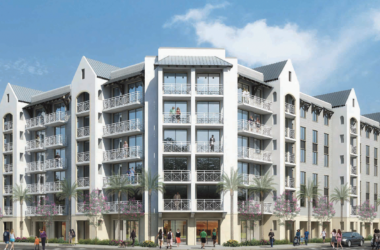
Driving the makeover effort is Coral Gables-based Allen Morris Company, the developer behind Ziggurat, a luxury, mixed-use project to rise along Grand Avenue between Fuller and Kirk Munroe Park.
The development calls for 19 luxury condos ranging in price from $2.5 to $8 million, 100,000 square feet of class A office space, and 40,000 square feet of retail.
At its heart is a pedestrian “paseo” running between two buildings and connecting to Fuller, creating a continuous, walkable spine from Main Highway through to the park, which borders Matilda Street across from Coconut Grove Elementary School.

Ziggurat’s newly opened sales center — where it shares space with Chèvre — is on Fuller, next to Barracuda.
The goal, Allen Morris CEO Spencer Morris told the Spotlight, is simple: “Engage the pedestrian.” The question in the Grove is more nuanced: “Engage the pedestrian, but for whose benefit?”
To make the paseo vision work, the city development agreement would allow Allen Morris to propose a redesign of Fuller and Kirk Munroe Park.
Under the agreement, which passed on first reading on Nov. 20, the city will contribute $3 million toward improvements, while the developer kicks in $2 million. A final vote on the agreement is scheduled for Dec. 11.
That math doesn’t add up for Coconut Grove Village Council member and Fuller Street-regular Davey Frankel.
“It seems terribly odd to me,” Frankel told the Spotlight. “The city is ponying up a majority of the money for development of the park and Fuller Street, but yet has no actual control over it or design of it.”
Frankel says the city appears to be “cutting the public out” at the exact moment Fuller is evolving into the Grove’s open-air civic square.
He worries about both substance and process. With the Village Council and other groups hoping to formalize Fuller as a space for holding community meetings and sharing public information, Frankel worries what will happen “if developers have all the right to design and carry out their plan.”
Frankel also takes issue with an initial design, floated to residents earlier this year, that steers pedestrians through Ziggurat’s retail promenade: “What they have done is instead of inviting you to walk down… to the park, they have a paseo that runs you through their retail gauntlet.”
Attorney and neighborhood activist Danielle Villoch sees the deal as part of a bigger trend: turning basic public upgrades into “amenities” for private projects.
“From the get-go, it’s just been apparent that both the renovations of Kirk Munroe Park and Fuller Street are being marketed as an amenity to this private development,” she said, pointing to the way Ziggurat’s marketing materials emphasize the park and new pedestrian street as design extensions of the project.
(Indeed, one late afternoon last week, a team of more than a half dozen Allen Morris executives, including Spencer Morris, occupied a long wooden table, laden with laptops and papers, outside the Ziggurat sales office on Fuller Street).
“By extending Fuller Street to match their project, they’re driving foot traffic from Fuller and Main Highway over to their commercial tenants on the bottom floor, which they obtain a percentage rent from,” Villoch said.
She also noted that Allen Morris’ attorney had a hand in drafting the development agreement with city officials. “So obviously it’s going be favorable to them,” Villoch said.
Abril, who lives a block from the Ziggurat site, is not opposed to modest upgrades.
“A little beautification sounds great,” he said. “But usually when developers have meetings where they get the public’s opinion, what they mean is that they’re going to explain to the public what’s going to happen, and then say, ‘Have a nice day.’”
Frankel suggested the city start over with a true public design exercise.
“Why don’t we have a charrette to request ideas for these public spaces as opposed to giving it to a private developer,” he asks.
Not all Fuller stakeholders see the arrangement as a hostile takeover.

Barracuda owner Lee Kessler, whose bar has long anchored Fuller, came away cautiously optimistic about Allen Morris’ plans and intentions after attending a meeting of Center Grove business owners and a gathering of residents last April at the Coconut Grove Sailing Club.
“I was pretty happy with the fact that they are including and listening to the community,” Kessler said. “At the end of the day, it is Allen Morris that’s going to really be presenting the designs. And I feel like they did spend the time listening to what myself, the BID and other businesses in the Grove have to say.”
Steve Capellini, co-owner of Atchana’s Homegrown Thai a block from Fuller on Commodore Plaza, echoed that guarded optimism. He praised Spencer Morris as “approachable and forthcoming,” and that he is hopeful Allen Morris will deliver a “first-rate job.”
But, he adds, community stakeholders need to be involved.
“I just hope Allen Morris can maintain some Grove character, and I think they want [it] to,” Capellini said. He notes that the development agreement is clear on that mandate — consultation with neighbors, business owners and the BID.
Spencer Morris insists fears about a land-grab are misplaced. He points out that the BID and neighboring property owners had been pushing for a pedestrian-friendly Fuller Street long before Ziggurat was announced. His design team, he adds, took a “blank slate” and worked with input from the two community gatherings they’ve organized.
In fact, he says, pushback over the general design aesthetic has prompted changes.
“A few people said: ‘Fuller Street looks a lot like [Ziggurat] and we don’t like that.’ So, we’ve actually gone through another design iteration… It doesn’t have any core resemblance to the building at all.”
The latest design features a simpler pedestrian layout that “maintains the feel of Fuller Street today,” he said, with more shade structures and “activated spaces” prioritized by residents.
Crucially, Morris stresses that the development agreement does not lock in a design or give Allen Morris operational control over Fuller or Kirk Munroe Park. He frames it as a legal mechanism that allows the company to pay for design services and proceed to permitting with the city, with multiple checkpoints still ahead.
“If we can’t come to a resolution on the design,” Morris said, “then the construction is not going to happen until there’s some sort of collective agreement.”
Morris also pointed out that he is a Grove stakeholder. “I live in the Grove, just a few blocks away,” he said. “We’re moving our offices here. We want everybody to be excited about this. We don’t own these public spaces. We don’t have any exclusive rights to them.”
From City Hall’s side, the Fuller deal is being sold as a pragmatic way to upgrade parks and streets — faster and cheaper than the city could manage alone.
Miami District 2 Coconut Grove liaison Javier Gonzalez said the “overarching sentiment” is to “leverage the private sector” so projects like Fuller don’t languish unfunded and unbuilt. The agreement, he said, “only outlines and formalizes the financial contribution” and leaves design approval to future public processes and a final city commission vote.
“It’s VERY IMPORTANT to note that this Development Agreement in no ways finalizes any drafts / concepts that have been presented / released on how Kirk Monroe Park or Fuller Street will be realized,” Gonzalez wrote on Saturday to concerned residents. “Provisions in the Development Agreement specify that all public improvements SHALL be finalized by resident stakeholder, organizations, and the City Commission.”
In the case of Fuller Street, the agreement stipulates that the final design must be approved by both the BID and the City Commission.
Miami District 2 Commissioner Damian Pardo, who has touted similar public-benefit negotiations elsewhere in his district, argued that getting developers to help fund basic infrastructure is how Miami closes budget gaps.
“We have fought really hard to get developer funding for things the city would normally pay for,” he told the Spotlight. “Saving money and accelerating timelines goes hand-in-hand.”











If the City had a good track record in stewardship of these projects, residents wouldn’t be worried. One only has to read the article about the Hangar to know what direction the Fuller Street and Kirk Munroe Park will take. The bright light many thought Damian would bring to helping residents of D2 has burnt out. In the same way Marc Sarnoff did a song and dance routine to convince residents of Regatta Park’s promise, Damian is now tap dancing to the Allen Morris tune. Frankly, at this point the Espinoza Family should come forward and become guardian angels. The park is right across the street from the elementary school and the park is a buffer between the outrageous growth arch of the grove and the residents of central Grove. My appeal is to the Espinoza family to leave a lasting and appropriate public good, and not the potential money maker for greedy politicians and developers. Show up at the Dec. 11th commission meeting, residents voices need to be loud and clear! Shame on you Damian and Javier!
Why does Fuller St have to be developed at all? Just leave it alone. People can walk through now, they can sit and have a meal or a drink or just hang out. That’s the Grove!!!!
I’m sorry, but our lawyers (for the City) suck. Whether this is by design or not, I have no idea. But no company or high-net-worth individual would put up with a legal team (including our Commissioners), who make such bad deals over and over again. The developers have teams of the highest paid lawyers on the planet. How are we as residents supposed to compete? And we’re on a giveaway spree to give away the only leverage we have, which are our last remaining open spaces!
Developers can say they’re our partners all they want, but when they pony up paltry amounts compared to what we’re handing over, they’re acting more like leeches than anything else. They have no right to be upset that the public is reacting to the fact that they’re driving around in Bentleys we paid for, throwing parties in restaurants we subsidized and can’t afford. The bill is coming due and they need to act like real partners and first, stop trying to grab all our stuff, and secondly, give the frick back without whining. They know darned well none of these deals they’ve gotten have been fair.
Our District 2 Commissioner Damian Pardo is quoted here as saying “Saving money and accelerating timelines goes hand-in-hand.” This has a similar saying well known to all developers: “Time is Money.” Our Commissioner should also remember other words to the wise: “Haste makes waste.”
Those who seek a way to balance the interests of politicians and developers–and the majority of citizens who will be affected by decisions allowing public land to be even partially used for private purposes– often suggest a “Charette.”
Having been involved with several of these “Gatherings of all the interested parties together to brainstorm for the best solution,” I suggest the following:
1. Select a respected town planner to run the Charette.
2. Announce a budget in 2026 dollars based on the sq. ft. cost of similar completed projects (e.g., Giralda Street in Coral Gables). There should be a low figure and a not-to-exceed high one to which all agree at the outset.
3. Whichever plan is proposed and agreed upon is the one that gets built with minimal changes thereto.
4. When the project gets delayed for any reason there is a funded/bonded escrow to pay for the overruns, and not the taxpayers.
Without these agreed-upon guidelines, citizens usually end up massively disappointed and disillusioned, as happened with the “Grand Avenue Charette” over two decades ago. I don’t know if there was a Flagler Street Charette, but that disaster is still ongoing after 4 years.
The community values will be ignored in the developers planning for Fuller Street, unless, we can provide a clear set of guidelines or plans for what the community wants. The plans do not have to be full blown architect drawings. But we need something to capture the community’s values.
To get to that end I suggest running a sort of beauty contest to gather a range of “best” ideas. This actually happened in a less rigorous way already months ago on the CGN WhatsApp chat site. The exchanges and competition between different ideas led to some really good thoughts surfacing. That needs to be done again with a broader community involvement.
I would suggest CGN run it as a two stage contest. First it invites ideas. Then it would select among all the entries no more than four ideas to be put to an open vote. That said, perhaps one of the four options should be default option — minimal changes or no changes at all to Fuller Street as it exists today. The other three selections would reflect the CGN committee’s beauty contest decision. I am strongly opposed to simply saying this developer is a good guy — let’s let him design the future Fuller Street. If we allow that, it will be our loss. Hopefully CGN will be more active in trying to ensure Fuller Street remains a community meeting area reflecting traditional Grove community values.
Redesigning Fuller Street sounds like a solution in search of a problem.
Unfortunately, there is a precedent in Coconut Grove for the handing over of our public park space to a private entity for the benefit of a privileged few. A few years ago, after an allegedly rigged charrette, the City Commission handed over the northwest corner of Peacock Park to Saint Stephen’s Episcopal Day School to create an outdoor athletic facility for the private school’s physical education program—displacing skateboarders, roller hockey teams and neighborhood camaraderie.
Preceding Saint Stephen’s clergy sold-off the remaining land surrounding the school’s campus, and the growing private school had no place except for our adjacent public park to hold their P.E. classes. Now the general public can access the northwest corner of Peacock Park during limited hours only.
The City often squanders our tax dollars and does not do its job to upgrade our public spaces, as they have been entrusted to do. That is not an excuse to export control of those spaces to private entities—it’s a call for accountability.
In NYC, a citizens group, NYC Park Advocates sued NYC to limit future private takeovers of Damrosch Park, forcing the City to do its job, restore the park and make it more public-friendly. Unless the citizens of Coconut Grove unite and sue the City of Miami to stop them from selling-off control of our public spaces to private entities, it will keep happening.
Melissa Meyer
Coconut Grove