




Waymo’s self-driving cars are suddenly everywhere in Coconut Grove. But are they safe? Our intrepid reporter arrived alive, if a little late, after booking a ride home in one of the white robotaxis now cruising village streets.
Before I took my first ride in a self-driving Waymo car, I prepared myself for the possibility that I would die in some stupid fashion.
I feared the self-driving car would suddenly become self-aware, decide it hated humans, and careen into an oncoming bus or a nearby cluster of pedestrians.
I worried it would get stuck on railroad tracks where I would be killed by a speeding Brightline train, or get confused and stall on a causeway (something that has happened in Miami twice before).
But none of that happened.
Instead, a white I-Pace Jaguar adorned with cameras and rotating radar and lidar sensors pulled up at a pre-arranged intersection in Coconut Grove earlier this month and drove me home to Miami Beach without harming a soul, stalling, or bumping into a single object.

Founded in 2009 and owned by Google’s holding company Alphabet, Waymo is a tech company based in Mountain View, California, that now picks up riders in 10 metro areas including San Francisco, Los Angeles, Austin, Houston, and Orlando.
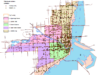
On January 22, after testing Miami’s roads for about a year, Waymo officially launched in Coconut Grove, Coral Gables, West Miami, Brickell, Wynwood, and other select parts of Miami.
By March 5 that coverage area expanded to include Miami Beach, Surfside, Bal Harbour, and the southern portion of Sunny Isles Beach.
As it expands locally, Waymo is seeking to tap into a market with 2.8 million residents and 27 million annual visitors by offering what it describes as a safe driving experience.
“Our goal is to responsibly deploy technology that will make roads safer for everyone. In fact, the data shows that Waymo improves road safety in cities where it operates,” Waymo spokeswoman Julia Ilina told the Spotlight in an email.
According to Waymo, its self-driving vehicles have 10 times fewer serious injury crashes, five times fewer crashes with airbag deployment, and 13 times less crashes with pedestrians than cars driven by humans.
“The Waymo Driver is programmed to respect the rules of the road like stop signs and speed limits; it never drives drunk, drowsy, or distracted,” Ilina said.
But Waymo’s record isn’t perfect.
Some of the more bizarre reports include a Waymo that decided to drive in circles in Los Angeles, a Waymo that whisked its passenger to a parking garage that served robotaxis in San Francisco, and a Waymo that froze beneath a railroad crossing in Austin.

More significantly, multiple Waymo cars shut down in San Francisco during a blackout last December.
And the vehicles have been known to stop operating altogether when harassed by pedestrian protesters, leaving passengers trapped inside, according to a report this month in the New York Times.
Thus far, Waymo vehicles haven’t been targeted by anti-tech humans in Miami-Dade, but that hasn’t stopped self-driving mishaps from occurring.
In early January, a Waymo car undergoing testing shut down on the Venetian Causeway, disrupting traffic, NBC 6 reported.
And on March 2, a few days prior to its expansion to Miami Beach, a Waymo stopped on a MacArthur Causeway on-ramp when forced to go around road construction on Biscayne Boulevard, according to posting on Reddit.
Because an emergency technician affiliated with Waymo refused to get near the vehicle, the car was stuck for 45 minutes, the Reddit poster added.
Adrienne Peters, a South Grove resident for the past 42 years, said she’s seen Waymo cars behaving badly three times.
In one incident, a Waymo car ran a four-way stop sign and nearly hit her. In another a Waymo vehicle nearly hit her dog. And in a third incident this month, a car pulled in front of another vehicle without a turn signal and then just stopped when the light was green.
“With another driver you can at least honk the horn,” Peters said. “With [Waymo] I can’t do anything.”

Ilina, the company spokeswoman, said that Waymo is “constantly learning from situations like these to better improve the rider experience.”
Yet apart from the two causeway incidents there hasn’t been any reports of traffic tie-ups or accidents caused by Waymo in Miami, said Officer Michael Vega, a spokesman for the Miami Police Department, who described the self-driving vehicles as “reliable.”
“They even stop for a police officer on foot directing traffic,” Vega added.
Still, not everyone is on board with the self-driving cars in Coconut Grove, which suddenly seem to be everywhere, all at once, all the time.
“I have some concerns about it,” Coconut Grove Police Commander Freddie Cruz said at a community meeting this month. “I’m all for technology and advancing, but I don’t know if we’re there yet. It’s not perfected.”
Asked whether Waymo had caused any problems or accidents in Coconut Grove, Cruz said no, but then cited the Venetian Causeway incident.
“So, again, it’s not perfected, but I haven’t gotten any complaints,” he said. “We haven’t had any accidents. Nothing in the Coconut Grove area that I know of.”
Although Waymo’s self-driving cars are fully autonomous, the company’s chief safety officer, Mauricio Peña, revealed during a congressional hearing that the vehicles sometimes receive input from human operators, including workers in the Philippines, Futurism reported.
Peña later clarified that human operators don’t “remotely drive the vehicles.” Instead, they provide guidance when a Waymo program asks for it. A spokesperson later told Futurism that those operators include people who live in the U.S.
A “small team” of Waymo employees operates in Miami, Ilina told the Spotlight. The company also partners with Moove to provide fleet management services such as vehicle charging, cleaning, and repair, she added.
So, will Waymo lead to the replacement of human rideshare drivers?
Richard Garcia, an Uber driver for the past two years, said he isn’t worried about Waymo taking away his rideshare gig since Waymo vehicles have trouble adapting to road construction, not to mention other potential mishaps.
“If my car broke down, I would get out of my car and push it to one side so that people can pass. Is AI going to be able to do that? No.”
Before you can get a ride from Waymo at all, you’ll need to download an app. And you might not get accepted right away as Waymo gradually accepts new riders during its ramp up in Miami-Dade. (Even before Waymo launched, the company claimed in a blog post that nearly 10,000 people in Miami-Dade signed up for the service.)
That same app (which I received via a code from Waymo’s spokesperson) directed me to where I’d meet my robotaxi via a Google Map and an arrow, which direction to walk and how far.
Once I got inside, a disembodied female voice told me to put on my seatbelt and to avoid touching the steering wheel and pedals. If there’s an emergency, the voice said, keep your seatbelt fastened and remain in the car “unless there’s an urgent need to exit.”
“We may use interior cameras to check on riders, improve our products, and more,” the voice said. “Our microphones are only on when you’re connected to rider support, so sing your heart out. We can’t hear you.”

The music playing was electronic instrumental music from Ombra Oscura, though, if I wanted to, I could use a touchtone computer screen to select another tune from iHeartRadio, Spotify or YouTube Music. I decided to continue listening to the calming Vangelis-type music as I watched the steering wheel move on its own.
Yet while my Waymo ride home was relaxing, it took an hour for the vehicle to drive me from Coconut Grove to Miami Beach late Saturday afternoon. In contrast, it took Garcia the Uber driver around 30 minutes to take me from South Beach to Cocowalk.
Both rides cost the same (about $40 each trip), but Waymo took longer in part because the vehicle dutifully stopped for every pedestrian, bicycle or car that came near it. And there were plenty of such obstacles since Waymo’s route took it through Coconut Grove, Brickell, Overtown, and downtown Miami again before finally reaching the MacArthur Causeway.
Why did Waymo travel down such congested roads? Because the autonomous vehicles still don’t use major expressways in Miami like I-95. Nor do they travel to Miami International Airport. At least for now.
“We’re already testing on Miami freeways and look forward to making freeway rides available to public riders later this year,” Waymo’s spokeswoman said.
That testing includes Waymo’s white Jaguars being sent to the airport where they sometimes pick up company employees, but not anyone else.
Garcia the Uber driver said one of his recent fares was a hedge fund manager who twice tried to get a Waymo to pick him up at MIA, only to be cancelled.
Desperate, the man flagged Garcia down and pleaded with him to give him a ride. His destination: Naples, more than 100 miles away from MIA and the current borders of Waymo’s Miami service area.
“I said, ‘Sir, get in the car.’” Garcia said he then proceeded to take him all the way to Naples, stopping to recharge his electric vehicle only after he dropped him off.

















You have to be an American Ninja Warrior when crossing Bayshore during morning rush hour.
One morning while midway through the crosswalk at Mary and Bayshore, two cars accelerated to beat us. The only car to stop until we were safely across was a driverless Waymo.
There are folks who realize we are in a significant sea change and others who are hardwired to cling to the past. Self driving cars will become the expected norm and we will all be better for it.