
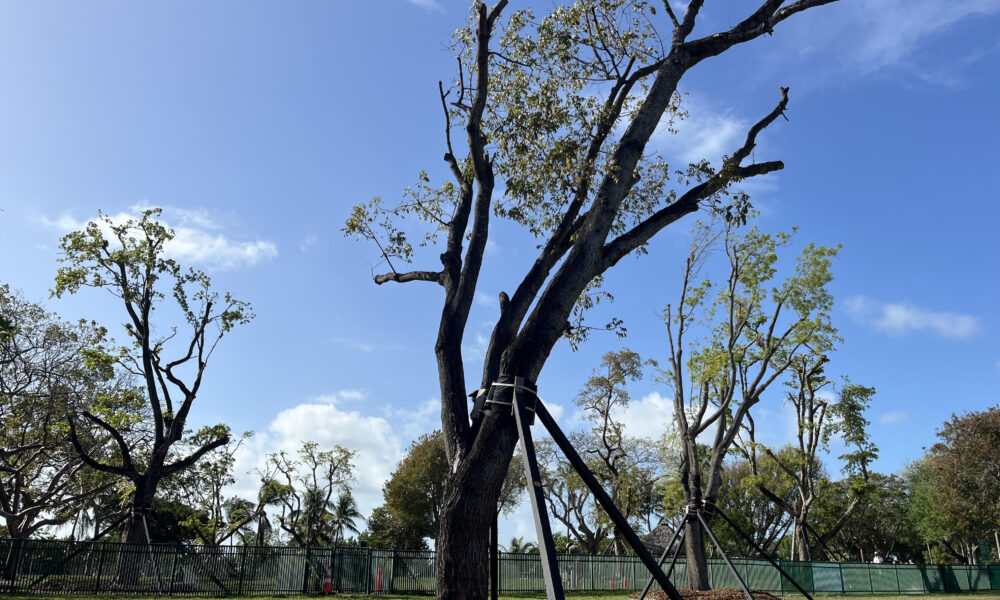

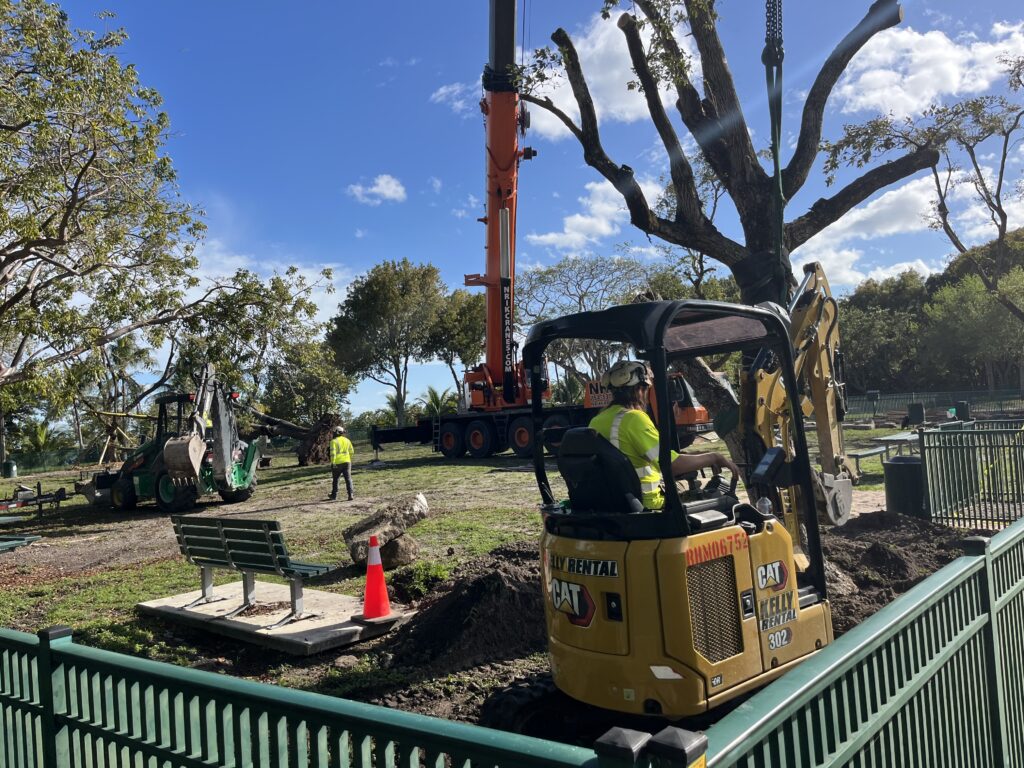
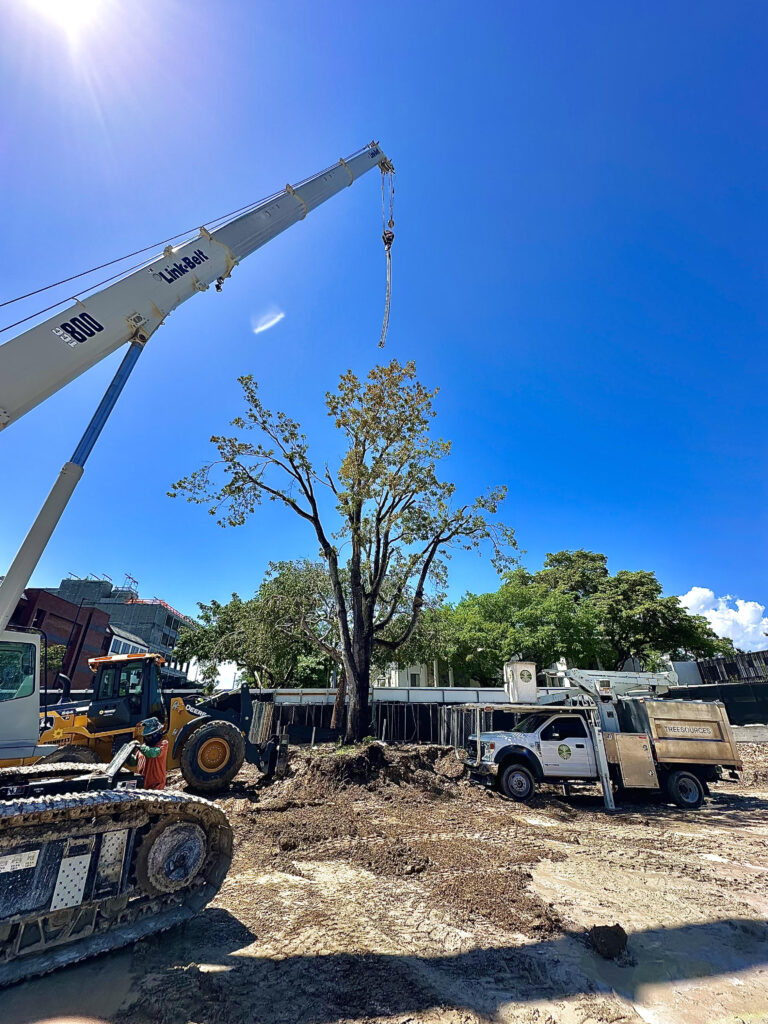
Local arborist Ian Wogan relocated 17 trees last month from a construction site on Tigertail Avenue where The WELL Coconut Grove is slated to rise; eight of those trees found their way to Kennedy Park.
The Spotlight caught up recently with local arborist Ian Wogan to ask him about the new trees that appeared last month in Kennedy Park on South Bayshore Drive. Wogan and his company Treesources coordinated the relocation of eight mature trees from The WELL construction site on Tigertail Avenue to Kennedy Park.
Spotlight: How many trees were removed from The WELL construction site and replanted in Kennedy Park and elsewhere? What types of trees were moved, how large were they, and how old (if you can estimate)?
Wogan: A total of 17 trees were preserved through relocation offsite from The WELL. Eight of these trees, of specimen size, were relocated to Kennedy Park – five black olive, and three mahogany. The remaining trees were smaller pink tabebuia, silver buttonwood and a gumbo limbo.
Spotlight: What’s the success rate for transfers like this; what factors determine whether a tree survives and thrives in a new location; and how long before you can say definitively that the move was successful?
Wogan: The success rate of moving plant material is highly dependent on process and procedure. Treesources has been working with the team from The Well for the past 12 months on properly preparing these trees for relocation offsite. This includes phased canopy and root pruning as well as nutrient root drenches and supplemental irrigation.
When done right, success percentages can be upwards of 90% and post relocation care is a critical component of ongoing tree health and successful establishment.

Spotlight: Why did the trees have to be moved at all, and why was Kennedy Park chosen as a destination?
Wogan: The (construction) site already had a large portion of sub-grade parking, which is being expanded and requires full-site excavation.
The development team at Terra, led by David Martin, really pushed for preservation of trees onsite and within the neighborhood of the project. For this, we explored multiple options throughout Coconut Grove. Alternate locations included the Grove BID, stretches (of the) Commodore Trail, and other parks within the Grove.
Ultimately Kennedy Park was chosen because the area around the dog park was lacking shade, the species from The Well are salt tolerant, and there were park improvements that were already planned – namely resodding within the dog park, which made the timing of landing these large trees appropriate.
Spotlight: How many trees will be replaced on The WELL property? Is there a mitigation plan approved by the City of Miami, and do we know the types and sizes of the trees that will be planted as replacements?
Wogan: I will ask Matt Lewis, the landscape architect to provide additional information on this, as he is responsible for the new planting plan.
(In a short interview, Matthew Lewis of L&ND, a master planning and landscape firm, said 88 existing trees and palms at the construction site will be replaced with 250 to 260 new trees and palms, 80% of which will be native. The Spotlight invited Lewis to provide answers in writing for this Q&A; Lewis did not respond in time for our deadline.)
Spotlight: In terms of the Grove’s tree canopy, is this effort likely to result in a net gain or a net loss of canopy, or will the effect be negligible, in your opinion?
Wogan: Of the trees and palms existing on the original site, those preserved were of the best condition and best species (native, naturalized, shade trees), whereas a large portion of the vegetation removed during demo of previous structures were palms or trees in poor condition.
From what I’ve seen, the planting plan is ambitious. The whole team behind the project has really prioritized the canopy and vegetation onsite and the landscape architect of the project, Matthew Lewis of L&ND Studio selected a predominantly native plant palette that reflects many of the species that would have been found along the historical rock ridge of this site.
Spotlight: Who did you work with at the City of Miami to make sure the transfer went smoothly, and did you encounter any problems in removing, transporting or replanting the trees?
Wogan: From the start of the process, we worked with the former head of Environmental Resources Quatisha Oguntoyinbo-Rashad and her now successor, Shawn Smith, along with District 2 Commissioner Damian Pardo and his team.
As the project progressed, we worked directly with the City of Miami Parks team.
In exploring the many options around Coconut Grove, we worked with Mark Burns from the Grove BID, Mel Meinhardt and Mary Munroe Seabrook of the Commodore Trail along with other community stakeholders.
It’s exciting to see the amount of enthusiasm and willingness to participate in some of the more involved practices of tree preservation.
When moving trees of this size, especially offsite, it can be a great challenge to move them down the road, and often the canopies have to be reduced in order to avoid any damage to the trees. We moved all of the largest of the trees with escorts, mainly at night as to avoid interruption to traffic along the busy corridor. It was challenging to say the least, but we are very happy with the results.
There was one tree that had abandoned utilities running through the root ball, which we didn’t find until digging it out, and it was especially onerous. That’s the nature of the work though – it takes time, patience, teamwork, quite a few tools and a measure of grit to get it done.
Editor’s Note: Local dog owners have complained recently about the deteriorating condition of the dog park inside Kennedy Park. “It used to be a lot greener,” Amber Sreenan, a healthcare worker who visits the park with Petunia, her Shih Tzu, told the Spotlight. “The issue with the park is that it’s a dustbowl.” Sreenan said she contacted city officials at the end of February about replacing the grass. City officials notified her in March that the dog park would be re-sodded.








Wow… a somewhat uplifting story I could read to counteract the suicidal news I confront in the New York Times every morning. I suppose the darker side of this story is the additional height The Well is hoping to be granted or perhaps has already been granted, I don’t know. Regardless, the salvaging of these trees and the coordinated efforts of the city and Ian and The Well are something to feel good about.