
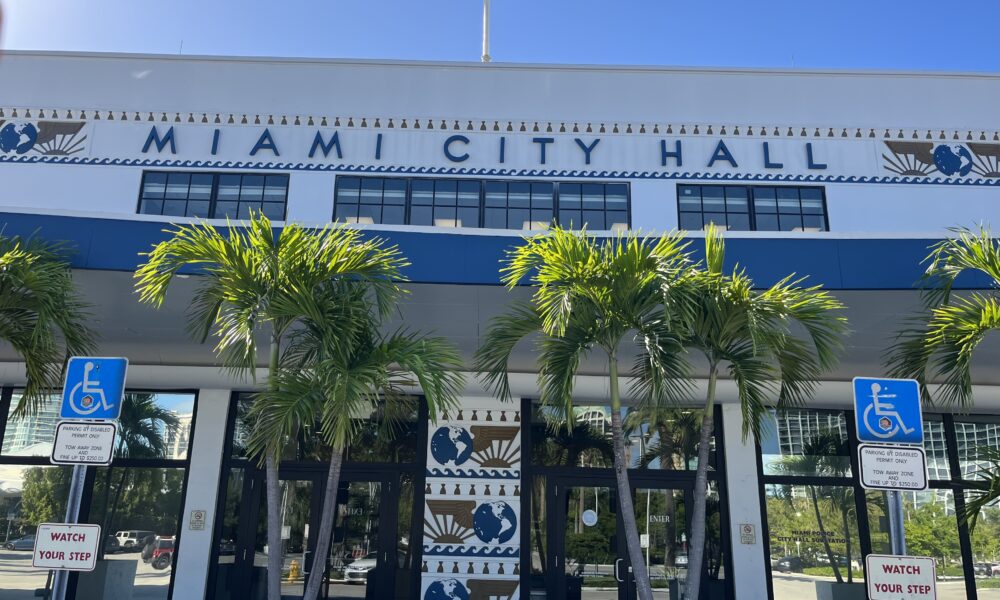



The federal lawsuit challenges a City Hall policy that requires most media inquiries to be routed through the city’s communications office, arguing that it restricts the flow of public information and limits residents’ understanding of how their government operates and how decisions are made.
The Coconut Grove Spotlight, through its nonprofit publisher, Miami News Trust, has filed a federal lawsuit against the City of Miami, alleging that a longstanding city policy restricting communications between city employees and journalists violates the First Amendment rights of both public employees and the press.
The lawsuit, filed Friday in U.S. District Court for the Southern District of Florida, challenges a City of Miami administrative policy that generally prohibits city employees from speaking with reporters unless communications are routed through the city’s Office of Communications and approved by city leadership.
The complaint argues that the policy acts as an unconstitutional “gag order” that interferes with the public’s ability to receive information about the operations of local government.
“To protect freedom of the press and freedom of speech for the City’s employees, Plaintiff challenges the constitutionality of the Gag Order under the First Amendment,” the complaint states.
The lawsuit names the City of Miami and City Manager James Reyes, in his official capacity, as defendants.
The challenged policy dates to 2011 and was most recently revised in 2018. According to the lawsuit, it requires city employees to route media inquiries through the city’s Office of Communications and, in most instances, obtain approval before responding.
The complaint further alleges that city employees may not contact reporters on their own without prior authorization and that the policy effectively requires employees to obtain permission before speaking with the media, even when expressing personal views on matters of public concern.
The lawsuit argues that such restrictions affect more than journalists. When city employees cannot speak freely with reporters, the complaint argues, residents are less able to receive timely information about how local government works, how decisions are made and how public money is spent.
The complaint cites multiple instances in which Spotlight reporters were prevented from obtaining information directly from city employees or were directed to route questions through the city’s communications office. In several cases, the lawsuit alleges, city employees who had previously communicated with the publication stopped doing so after being reminded of the city’s policy.
The suit seeks a court declaration that the policy violates the First Amendment and an injunction prohibiting the city from enforcing it.
According to the complaint, the lawsuit follows nearly two months of unsuccessful efforts to resolve the dispute without litigation.
In April, attorneys with the Florida State University College of Law’s First Amendment Clinic, acting on behalf of Miami News Trust and with the support of several South Florida news organizations, sent a detailed letter to City Manager Reyes outlining their constitutional concerns and requesting a meeting to discuss possible revisions to the policy.
The Miami Herald, WLRN and The Miami Times supported those pre-suit discussions, but they are not parties to the lawsuit.
The complaint alleges that the meeting request did not result in substantive negotiations or changes to the policy. Miami News Trust says it filed suit only after those efforts failed to produce a resolution.
FSU’s First Amendment Clinic, which is representing Miami News Trust in the lawsuit, is a public-interest legal program that supports journalists, news organizations and individuals in matters involving free speech, freedom of the press and public access to government information.
The lawsuit comes amid broader debates at the local, state and federal levels over government transparency, public records access and the ability of journalists to communicate directly with public employees.
For the Spotlight, the case centers on what it describes as a fundamental principle of local journalism: the ability to obtain information directly from people with firsthand knowledge of government operations.
The publication argues that residents benefit when journalists can speak directly with public employees, ask questions in real time and receive responses from subject-matter experts rather than through multiple layers of administrative review.
The complaint also alleges that the policy imposes restrictions on journalists that do not apply to private citizens, citing examples in which members of the public were able to obtain documents and information from city officials that were not provided to Spotlight reporters.
The complaint further alleges that the city’s policy gives officials broad discretion over which employees may speak with reporters and when, creating the risk that information favorable to the city may be released while less favorable information is delayed or withheld.
The city has defended its handling of media access, the complaint notes, arguing in a pre-suit email that its policy complies with U.S. Supreme Court precedent because it governs official city communications, not employees speaking as private citizens.
The complaint disputes that interpretation, arguing that the policy and its enforcement effectively require employees to obtain permission before speaking with reporters under any terms or conditions.
The lawsuit asks the court to declare the policy unconstitutional, bar the city and the city manager from enforcing it, and award nominal damages, costs and attorney’s fees.
The City of Miami had not filed a response to the complaint as of publication.
To read the complaint in its entirety, click here.

















The press is the watchdog of the people.
We all owe the Spotlight an enormous “thank you” – for their tireless work to keep the community informed, and our government accountable. 🙏👍🤲 (Why would our elected officials fight efforts such as the ones described in this article? One would think this is an opportunity for them to embrace accountability and transparency…)
Thank God for the Spotlight. 🙏🏻
I am grateful we have the Spotlight.
My Gratitude to everyone involved in the Reporting and Publishing of the Spotlight.