

With appeals surging and trust in the city’s permitting process fraying, a newly appointed advisory committee will spend the next eight months rethinking Miami’s tree ordinance.
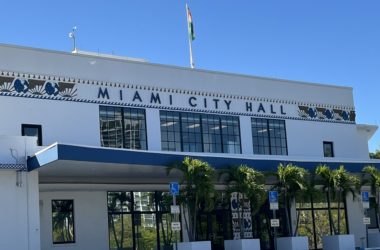
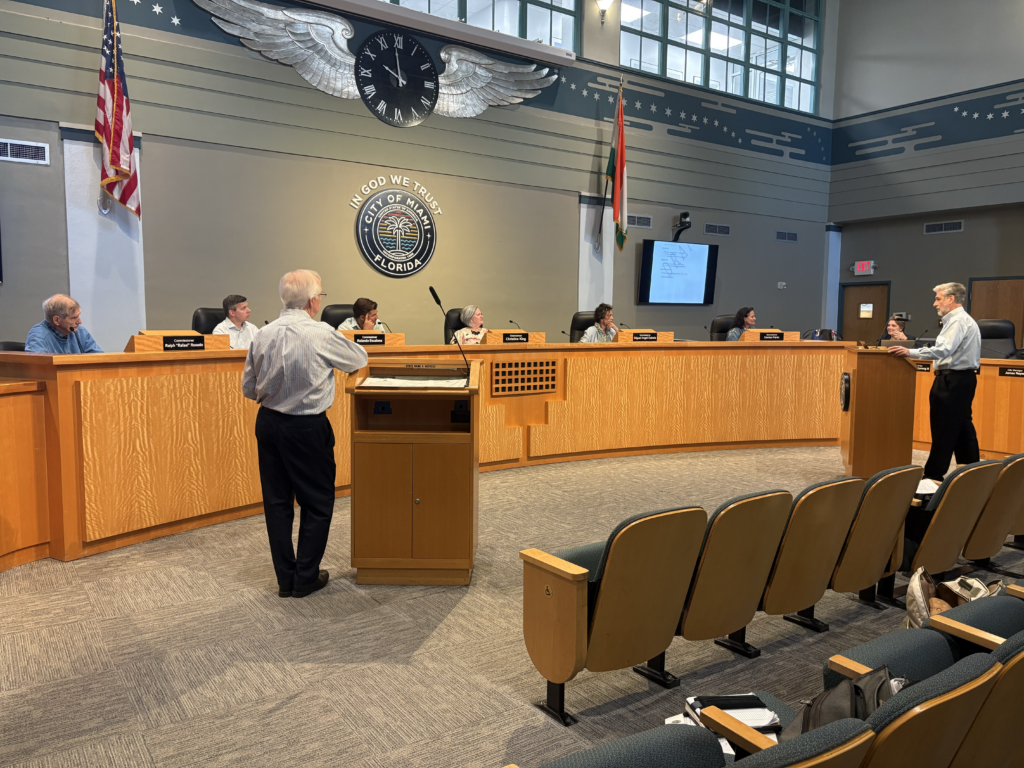
After nearly two years of increasingly bitter battles over tree removals — and the city rules governing them — a newly formed citizens advisory committee convened for the first time Monday to begin reviewing one of Miami’s most contentious environmental regulations.
The city’s Tree Ordinance Advisory Committee — created by the City Commission a year ago in response to mounting public outcry over tree removals and the city’s permitting process — launched on Monday what is expected to be an eight-month review.
The process will include public workshops, online feedback submissions and committee meetings before the panel presents its recommendations to the City Commission by next March.
The committee will consist of 11 members — two appointed from each commission district and one at-large member. Only six, the minimum needed for a quorum, attended Monday’s inaugural meeting at Miami City Hall.
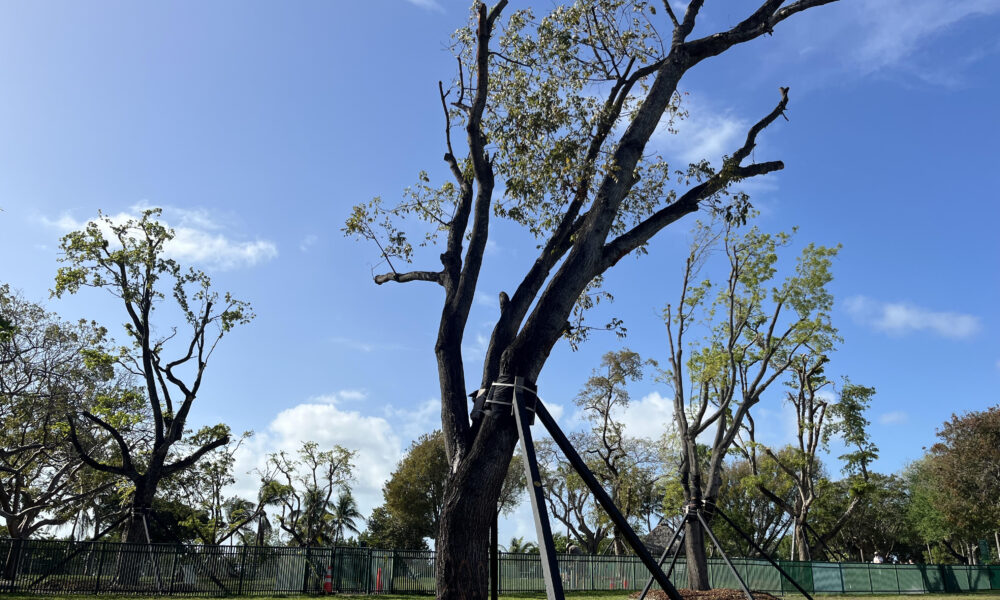
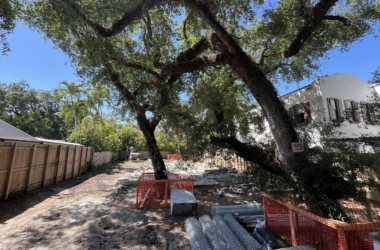
The committee will reconcile two competing goals: easing what many homeowners view as a laborious permitting process for tree pruning and removals, while strengthening protections against abuse by developers. Critics say builders often remove trees without authorization and simply treat the resulting fines as a cost of doing business.
Ian Wogan, a Coconut Grove arborist representing Miami Commission District 2 on the advisory committee, said despite having one of the nation’s most stringent tree ordinances, Miami often falls short when it comes to enforcement.
“We’re still in this crisis mode of large trees being removed and our canopy dwindling,” he said.
Both the City of Miami and Miami-Dade County have set a goal of achieving 30% overall tree canopy by 2030. But current estimates for both place canopy coverage at just 17% to 20%, with little evidence of meaningful gains in recent years.
Other committee members attending Monday’s inaugural meeting were Andy Parrish (District 1); Deena Bell Llewellyn and Thomas Lawrence (both District 4); and Mariela López De Alvear and Avra Jain (both District 5).
Chris Baraloto, District 2’s other appointee and associate director of Florida International University’s International Center for Tropical Botany, was traveling and unable to attend.
At least two seats remain unfilled.
The committee will meet at least six times by February, with a possible seventh meeting scheduled for March. Members will review feedback from two rounds of public input, tentatively scheduled for August and early December. Feedback sessions will be both in-person workshops and online.
The public feedback sessions will be facilitated by Hal Beardall and Rafael Montalvo of Florida State University’s Florida Conflict Resolution Center, who attended Monday’s meeting to present a preliminary summary of interviews with committee members, stakeholders and community members about the city’s tree ordinance.
Read more: City Offloads Public Outreach on Tree Ordinance Rewrite
Some overarching themes identified in their summary are: strained trust between the city government and residents, the need for increased awareness of the importance of the tree canopy, and lack of an overall strategy to preserve the canopy.
“There’s got to be more incentives for people to do the right thing early on, rather than rely on enforcement,” noted committee member Parrish.
Staff from Miami’s Building Department — which oversees tree permitting and enforcement — briefed the committee on the city’s tree removal policies, including the Tree Trust Fund, an account intended to direct mitigation fees and fines toward planting new trees.
During public comment, speakers largely focused on what they described as the accelerating loss of Miami’s urban tree canopy and frustration with the city’s permitting and enforcement practices.
“I’ve lived in Miami for seven years, and [tree removal] has never been as excessive as it is this year,” said Miami resident Lindsay Cain.
Truly Burton, executive vice president of the Builders Association of South Florida, urged committee members to weigh other priorities as well, particularly the need to expand affordable housing, which can sometimes conflict with efforts to preserve existing trees.
“Part of our goal,” Burton said, “is to make sure everyone has a decent place to live.”
Burton also urged residents to file fewer appeals of tree removal permits. While only one such appeal was filed in all of 2025, eight are scheduled to be heard this month alone — an increase that has prompted the city’s Historic and Environmental Preservation Board to double its meeting schedule, with one monthly session now devoted exclusively to tree-removal appeals.
Read more: As Tree Appeals Surge, Critics Question City’s Permit Practices
Parrish, a developer and longtime civic activist, told the Spotlight he remains hopeful the committee can strike a balance between protecting Miami’s tree canopy and accommodating responsible development.
“We all have to work together to make a better Miami,” he said. “But the balance has gotten out of whack.”
Not everyone shares Parrish’s optimism. Some tree-protection advocates remain skeptical, arguing that previous promises by city leaders to strengthen tree protections have resulted in little meaningful change.
Sandy Moise, Conservation Co-Chair for Sierra Club Miami Group and a founding member of the advocacy group Miami’s Trees Matter Most, said she fears the process could be used to weaken, rather than strengthen, the city’s tree ordinance.
Read more: Tree Overhaul Returns as Quiet Changes Take Root
She pointed to repeated comparisons by city officials between Miami’s regulations and Miami-Dade County’s tree code, arguing the county’s ordinance provides fewer protections and should not serve as a model for Miami.
“Comparisons suggesting the city’s ordinance should be weakened to align with the county’s current code are misleading,” she said. “The county’s existing ordinance reflects legal constraints, not its policy objectives.”
Moise said the committee’s credibility will ultimately depend on whether it follows the evidence wherever it leads, rather than using the process to justify changes that may have already been decided.
“Miami’s residents deserve a transparent process grounded in facts, not predetermined outcomes,” she said.
Anita Li is a Spotlight reporter and Report for America corps member covering government accountability in Coconut Grove and Miami City Hall. She joins us through our partnership with Report for America, a national organization that places journalists in local newsrooms across the United States.




Good luck to this group of tree huggers! When you have 5 feet of set back to a property line and a 2 story wall of solid concrete and glass, it’s awfully hard to envision what could reasonably grow in that space. Plastic grass grows really well almost anywhere you put it, apparently. And the comment that we must balance nature with affordable housing is a head scratcher. What affordable housing?
Ian Wogan is correct; Miami has a fairly strong tree ordinance, but falls short on enforcement.
The City permitted cutting down 36 royal palms and four black olive trees at 1401 Brickell, even though the trees were in the public right of way (on public land) and did not interfere with the high rise now being built there. At a minimum the trees should have been relocated.
The City also intended to allow cutting down five very large mahogany trees at 1837 NE 4 Avenue, which were also in the public right of way. Fortunately, the public appealed that Intended Decision, and the trees were saved when the developer, faced with strong opposition, withdrew their request.
At Margaret Pace Park, the City has plans to cut down 95 palms as part of a park redesign, then replace them with 80 new sabal palms which provide little shade. It all sounds like a big waste of money.
Many Miamians have good reason to doubt the City’s sincerity towards tree protection, especially following the transfer of veteran tree inspector Quatisha Oguntoyinbo-Rashad to a position without the authority to enforce the tree ordinance.
Read about it here:
https://coconutgrovespotlight.com/2026/04/02/tree-overhaul-returns-as-quiet-changes-take-root/
I just wish I could post pictures of two beautiful trees, 80 feet tall, that were allowed to be cut down because they were “exotic”. With the ordinance allowing that, they could bulldoze the entirety of Fairchild Tropical Gardens without anyone batting an eye. It is heartbreaking.
And the previous comment about zoning not allowing canopy is spot on.
Move to the Grove for the abundant nature and bohemian vibe. Tear it all down to build a big white box with a few non-native palms and some artificial turf. Inconceivable that people would destroy what they moved here for.