


The measure would require protected pedestrian access at certain construction sites, but a last-minute change to the measure opens a wider path for developers to obtain exemptions.
Three months after Coconut Grove residents raised concerns over prolonged sidewalk closures at several major construction sites, Miami commissioners are poised to take a final vote Thursday on legislation intended to keep pedestrians moving safely through construction zones.
The ordinance, sponsored by Miami District 2 Commissioner Damian Pardo and co-sponsored by commissioners Rolando Escalona and Ralph Rosado, would require right-of-way permits for certain large construction projects — generally those taller than three stories — to include temporary pedestrian protection designed to preserve the public’s uninterrupted use of sidewalks during construction.
Those protections could include sidewalk sheds, overhead coverings, scaffolding or similar temporary structures shielding pedestrians from construction hazards.
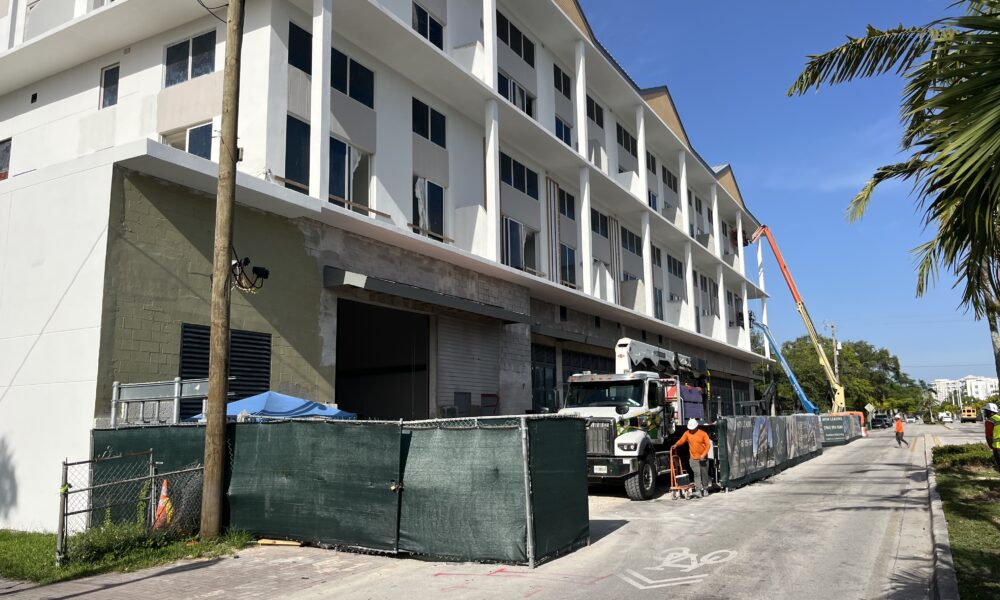
The proposal follows months of complaints by Coconut Grove residents over construction projects that blocked sidewalks, occupied parking lanes and, in some cases, forced pedestrians into busy streets.
Earlier this year, the Spotlight documented questions about whether the City of Miami was consistently enforcing permit conditions and existing regulations governing construction activity within the public right-of-way.
Read more: Residents Question City Oversight of Construction Closures in the Grove
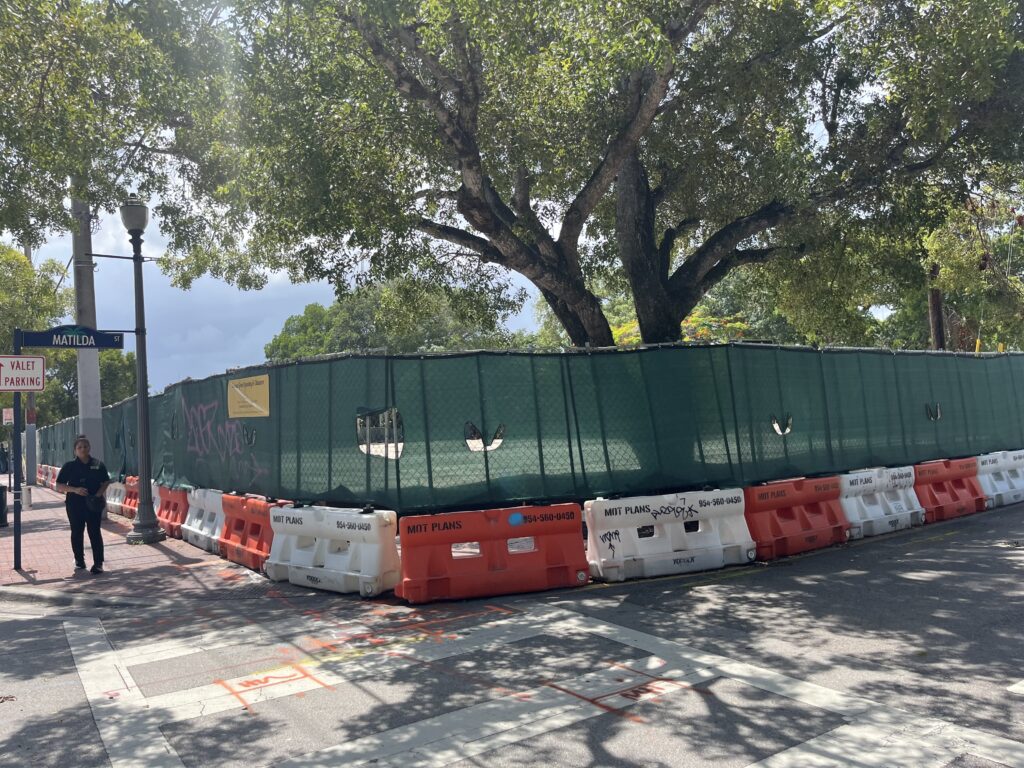
Among the projects drawing neighborhood complaints were The WELL Coconut Grove on Tigertail Avenue, where portions of the sidewalk and parking lane have been closed for months; the Ziggurat development at Grand Avenue and Matilda Street, where residents raised concerns about pedestrian safety near Coconut Grove Elementary School; and the Four Seasons Private Residences project, where sidewalks along South Bayshore Drive remained closed for nearly two years before reopening.
The measure up for a final vote Thursday differs slightly from the version Pardo originally introduced. Under that proposal, exemptions from the sidewalk-protection requirement can be granted — by the Department of Resilience and Public Works —only after a licensed engineer submits a report concluding that such protections are “impractical.”
The amended version potentially opens a wider path to exemptions by allowing the report to be prepared by any Florida-licensed contractor — including one hired by the developer seeking the waiver — as long as it is approved by a licensed Florida engineer or architect.
Spencer Morris, president of the Allen Morris Co., the developer behind the Ziggurat project, said the ordinance could benefit residents while recognizing that construction sites sometimes require temporary use of the public right-of-way.
“When construction is happening on the property line, sometimes it is necessary to have fencing extend beyond the property line and onto the sidewalk,” Morris said. “That’s something that would happen for a few days or a few weeks, and then you would try to pull it back in. It’s a constantly evolving process.”
Morris said the Ziggurat project adjusted barriers along Grand Avenue after neighbors raised safety concerns.
For Center Grove resident Paris Wallace, whose complaints about several Coconut Grove construction sites helped focus attention on the issue, the ordinance is a positive step. But he said its effectiveness will ultimately depend on whether the city enforces it.
“There are rules on the books now that are not being followed,” Wallace said. “If this rule is another rule on the books that is not followed, it’s not going to make a difference.”

The ordinance states that violating the conditions of a right-of-way permit could result in that permit being declared null and void. It does not, however, establish specific standards governing when sidewalk protection may be deemed “impractical,” create new inspection requirements or identify additional enforcement resources, as some residents have requested.
Anita Li is a Spotlight reporter and Report for America corps member covering government accountability in Coconut Grove and Miami City Hall. She joins us through our partnership with Report for America, a national organization that places journalists in local newsrooms across the United States.


















anyone who’s spent more than 5 minutes in new york city will recognize this issue. every construction site in the city builds covered sidewalk access. rarely, if ever, is a sidewalk inaccessible because they are essential for pedestrians. in miami, of course, pedestrians are cannon fodder for vehicles and developers so go figure.
Paris Wallace is correct. This change, although very welcome indeed, will be meaningless unless the City bureaucracy actually enforces the requirement for keeping sidewalks open during construction, using sheds as many, many other cities do. And the last minute addition of an exception where a shed is said to be “impractical” may allow a developer-hired “expert” to opine that a shed would “cost too much” and escape the requirement.
A far better approach would have been to limit exceptions to circumstances where a shed over a sidewalk would create a “dangerous or hazardous condition that endangers life or property”, copying the exception from the City’s noise ordinance. That is a much more objective, fact based standard. But of course when limiting language is added at the last minute, public input becomes impossible. That practice by the City Commission has to stop.
The limited language was not added at the last minute. Rather, it was added as a modification at the July 9, 2026 City Commission meeting and the First Reading passed the City Commission by a unanimous vote on that date. This is unlike the T5 substituted language issue where the language was added within the 10-day advance public notice period required by the Florida Statutes. In this case, there is no violation of the 10-day advance public notice requirement and there will be a 2-week period to for public input. However, the modification makes the provision ineffective, since the general contractor and licensed architect or licensed engineer will be hired and paid for by the developer. It is a pretty toothless Ordinance that no doubt will unanimously pass the City Commission. Don’t expect any sheds to be built on the sidewalks of construction sites in Coconut Grove…that’s not going to happen.