


The city’s new dashboard promises to let residents track if and when City Hall follows through on a commission directive. But a Spotlight review found just two of 13 measures requiring action by the city administration had appeared two weeks later.
The City of Miami has launched a new online dashboard that allows residents to track whether the administration follows through on directives from the City Commission — from the time they are issued until the work is completed.
The Directives to Administration Dashboard, required under legislation sponsored by District 3 Commissioner Rolando Escalona and approved by the City Commission in May, lists the city departments responsible for carrying out each directive, breaks assignments into individual tasks and tracks their progress.
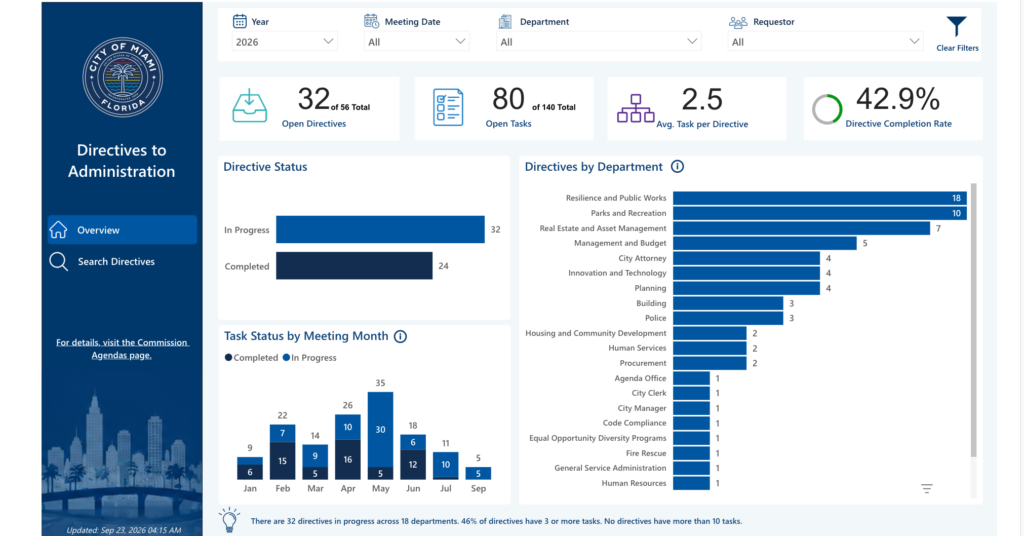
As of Thursday, the dashboard listed 56 directives, with 24 completed and 32 still in progress. The dashboard calculates that as a 42.9% completion rate. It also tracks 140 individual tasks.
The workload is not evenly distributed across City Hall. Resilience and Public Works had the most directives, with 18, followed by Parks and Recreation with 10, and Real Estate and Asset Management with seven.
The dashboard also allows users to see who requested each directive. District 2 Commissioner Damian Pardo accounted for 12 of the 56 directives listed as of Thursday.
The new tool is the latest piece of what Escalona calls his “accountability agenda,” a broader transparency effort he outlined to the Spotlight in June that includes making more information about City Hall readily available to the public.
Read more: Spotlight Exclusive: Escalona Outlines Transparency Agenda for City Hall
At the time, Escalona specifically called for online dashboards that would allow residents to monitor the implementation of ordinances and resolutions approved by the commission. He said putting more information online could also reduce the need for residents and journalists to file public records requests.
“Something that I saw was that sometimes, [city staffers] were not meeting the deadlines, there was no follow-up,” Escalona told the Spotlight. “People want to know what’s going on, so I think making more things public, it just makes sense.”
The dashboard was mandated by a resolution sponsored by Escalona and unanimously approved by the City Commission on May 14. The measure directed the city manager, city clerk and city attorney to create a publicly accessible, searchable portal within 90 days where residents could view “all directives issued by the City Commission” and track their status.
But the new dashboard is not necessarily a real-time accounting of those directives.
At the Sept. 10 commission meeting, the Spotlight identified 13 measures containing directives to city officials. Two weeks later, only two appeared on the public dashboard. A city spokesperson said the remaining directives were “in process” but did not say when they would appear.
Among those not yet listed was a resolution directing the city manager to budget, allocate and appropriate $10.2 million for Fire-Rescue facilities and equipment. Another directed and authorized the manager to establish a special revenue account for the Calle Ocho corridor and allocate $3.5 million annually to it for four years.
According to the spokesperson, the city defines a directive for purposes of the dashboard as a resolution, ordinance or verbal direction containing the word “directing.” Right-of-way deeds are excluded.
The May resolution establishing the dashboard requires the public to be able to view “all directives issued by the City Commission.” It also requires City Manager James Reyes to ensure the status of each directive is updated “on a regular and ongoing basis,” but does not establish a deadline for adding newly approved directives or specify how frequently their status must be updated.
The public dashboard draws its information from an internal tracking system already used by city staff and checks that system daily for updates. Escalona said updates to the internal system must be approved by department directors before appearing publicly.
Once posted, each directive can be broken into individual tasks, with the dashboard identifying who requested it, the departments responsible and whether the work has been completed. The system can also flag overdue assignments when a deadline has been established.
Among Pardo’s directives are co-designating a stretch of Franklin Street as “Rev. Theodore and Thelma Gibson Way” and directing the city to produce a report on short-term rentals. Two of his 12 directives were listed as completed.
The short-term rental directive provides an example of how the system works.
At the Sept. 10 meeting, commissioners unanimously directed the city manager to prepare a comprehensive report on short-term rentals operating in violation of the city’s zoning code. A week later, the directive appeared on the dashboard, divided into three tasks: preparing the comprehensive report, providing quarterly reports on apartment buildings with multiple violations, and providing commissioners with an update.
A city presentation obtained by the Spotlight says that when progress is entered into the city’s internal tracking software, it is reflected on the public dashboard.
Escalona said the idea grew in part out of frustration with the difficulty of determining whether directives from commissioners were actually being carried out.
He pointed to broken streetlights in his district, which includes parts of Little Havana, Shenandoah, Silver Bluff and The Roads. Escalona said it took weeks for the city to work with Florida Power & Light to get them repaired.
The dashboard was built using the city’s existing internal system and is operated by the Department of Innovation and Technology and, according to Escalona, requires no additional cost of personnel.
The new dashboard follows another Escalona-backed transparency initiative launched earlier this year: a searchable database of city employee salaries.
The salary portal made basic compensation information considerably easier for the public to obtain, but a Spotlight review found that it did not provide a breakdown of overtime, bonuses and other supplemental compensation.
Read more: City Launches Salary Portal, But Key Pay Data Remains Hidden
The salary portal was among a broader set of transparency measures Escalona outlined to the Spotlight in June, including greater access to recordings of city board and committee meetings, changes to the city’s handling of public records requests and restrictions on last-minute changes to legislation.
Escalona said more projects are planned as part of his accountability agenda. He hopes the new dashboard will not only make City Hall more transparent but also speed up its work.
“Everything takes a very long time,” Escalona said. “And to me, that has been very frustrating.”
Anita Li is a Spotlight reporter and Report for America corps member covering government accountability in Coconut Grove and Miami City Hall. She joins us through our partnership with Report for America, a national organization that places journalists in local newsrooms across the United States.












This is a great initiative. It would be nice if they added the Tree Fund allocation to this — ensuring trees promised or to be relocated are actually done as well as the fund being used!