
Twice a year, teams fan out across Miami-Dade after dark to estimate how many people are living on the streets. The Spotlight rode along as one team searched Coconut Grove.
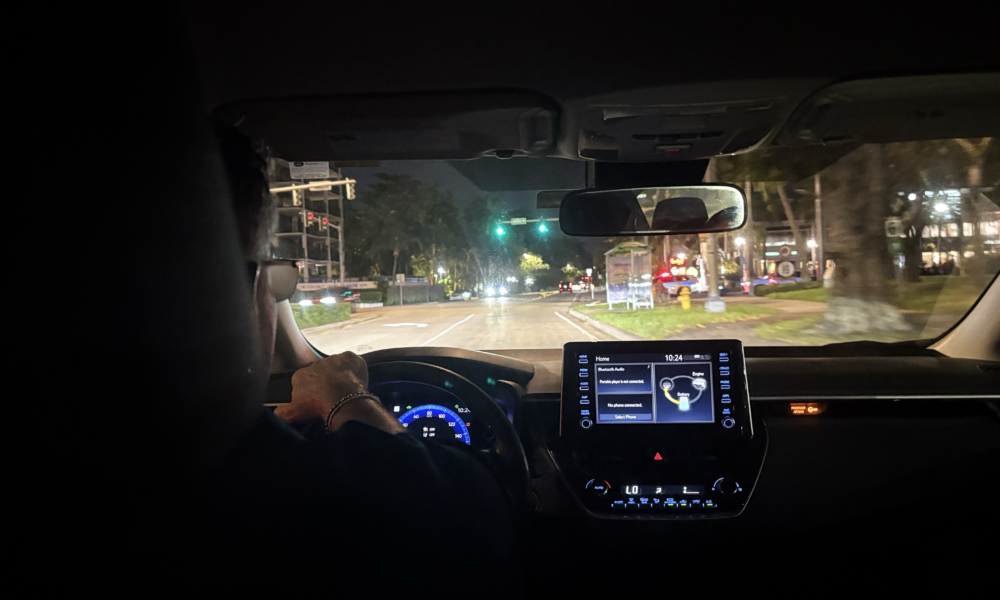
A white sedan turned onto McFarlane Road just after 10 p.m. on a Thursday in late August, slowing to a stop outside the Coconut Grove Library.
Felix Mohip, a staff member with the City of Miami’s Homeless Assistance Program, pointed through the window toward a nook beneath the library’s entrance ramp.
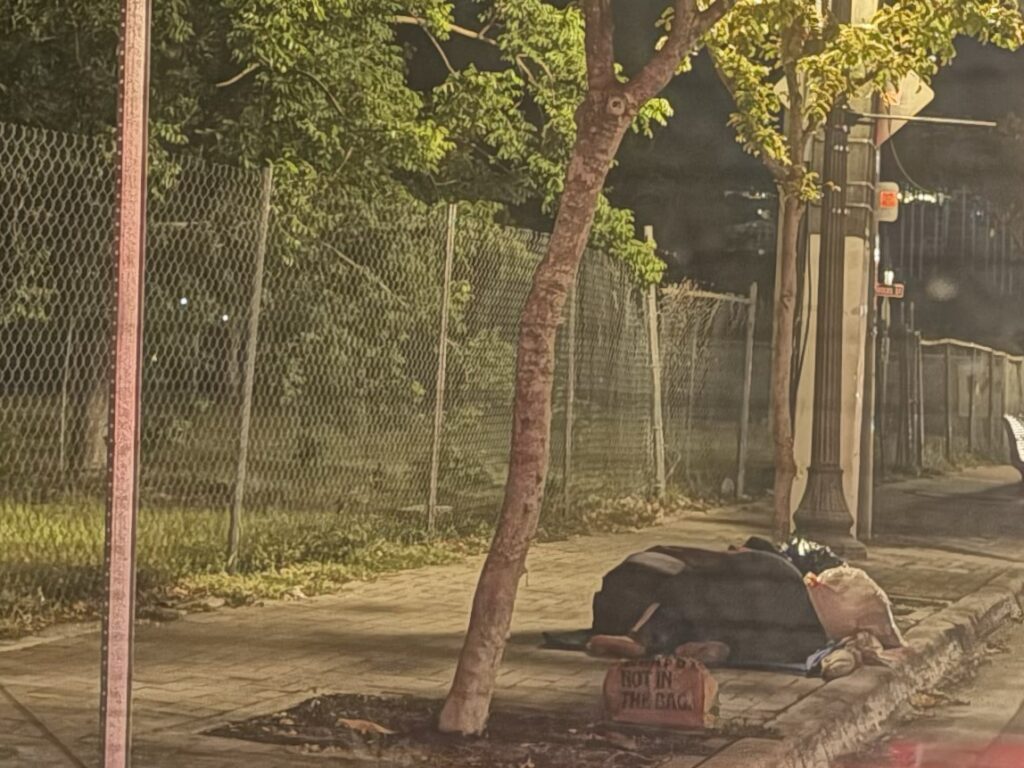
In the shadows was the silhouette of a person lying down.
His co-worker, Carlos Ramos, pulled out his phone, entered some information into an app, and Mohip drove on.
It was one small entry in a much larger undertaking.
Mohip and Ramos were one of 26 teams spread across the county for the Miami-Dade Homeless Trust’s twice-yearly Point-in-Time count, an effort to estimate how many people are living unsheltered and where they are spending the night.
The teams drive predetermined routes, looking in parks, along sidewalks, beneath overpasses and in other places where people without permanent housing are known to sleep.
When workers identify someone they believe is homeless, they enter the information into an app that records the location.
The count is conducted each August and January to account for seasonal changes in the homeless population. The information is reported to the U.S. Department of Housing and Urban Development, which helps fund local homelessness programs.
For about 90 minutes that night, the Spotlight rode along with Mohip and Ramos as they slowly worked their way through Coconut Grove.
They began near the Pollo Tropical on Southwest 27th Avenue, checked parks in the North Grove and circled CocoWalk.
On Main Highway, Ramos spotted a man sitting on a quilt on the sidewalk. The two briefly discussed whether he was homeless before deciding he was not.
Then they headed down Grand Avenue, scanning both sides of the street.
There, they spotted a woman sleeping beneath blankets. Mohip recognized her as Sheila Dixon, a West Grove native who has spent much of the past two decades living on the streets of Coconut Grove.
Read more: For Sheila Dixon, the Streets of West Grove Are Home
From there, Mohip and Ramos checked near Macedonia Missionary Baptist Church and headed north on Douglas Road. They drove through parking lots, including one near the Home Depot at Bird Avenue and McDonald Street, before ending near the Shell station on Southwest 27th Avenue.
Most places they checked were empty.
The official Point-in-Time count ultimately identified eight unsheltered people in Coconut Grove, down from nine in August 2025.
Homeless Trust Chairman Ron Book said the agency compares August counts with the previous August, rather than with its January count, because homelessness fluctuates seasonally.
Across the City of Miami, teams counted 530 unsheltered people, down slightly from 537 a year earlier. Countywide, the unsheltered count rose from 1,068 to 1,089.
Those numbers are combined with a separate count of people staying in shelters, hotels and transitional housing to estimate Miami-Dade’s overall homeless population.
That total rose from 3,570 last year to 3,748 this year, an increase of about 5%.
But counting people living on the streets is an imperfect exercise.
Teams must cover the county in a single night to reduce the possibility of counting the same people more than once. And the results depend in part on what workers see — and whether they determine that someone they encounter is homeless.
Experience plays a large role.
Mohip and Ramos followed a route provided by the Homeless Trust, but their years working with people experiencing homelessness also helped guide where they looked.
“We’ve been doing this for 30-plus years,” Book told the Spotlight. “We know who’s homeless and we know who’s not. We know if someone is sleeping on the street.”
Book said the workers sent into the field typically have extensive experience identifying and working with people who are homeless.
“All of the people that generally go out as teams have been doing it for a very long time,” he said. “And so, they know how to identify folks.”
After finishing their sweep of Coconut Grove, Mohip and Ramos drove on to nearby neighborhoods to continue counting.
For the Homeless Trust, the numbers provide a snapshot — not a perfect census — of how many people are living without shelter and where they can be found.
For one night, that meant slowly driving the Grove’s streets, peering into darkened parks, parking lots and sidewalks, and looking for people who might otherwise go unseen.
“The job’s not done until the last person’s off the street,” Book said.
Anita Li is a Spotlight reporter and Report for America corps member covering government accountability in Coconut Grove and Miami City Hall. She joins us through our partnership with Report for America, a national organization that places journalists in local newsrooms across the United States.