Paralyzed at 21, Harry Horgan turned heartbreak into hope—founding Shake-A-Leg Miami and changing thousands of lives in the process. Thirty-five years later, his mission still sails on.
Andrew Altvater, confined to a wheelchair since 2016, greeted a visitor recently, politely declining to discuss the details of the car crash that has led to his reality.
But Altvater, 28, made sure to talk about Shake-A-Leg Miami, the non-profit organization dedicated to empowering individuals with disabilities through adaptive water sports such as sailing and kayaking.
“Shake-A-Leg taught me how to sail,” Altvater said. “It taught me how to work … It taught me how to feel human again.”

Shake-A-Leg Miami – the brainchild of Harry Horgan – is in its 35th year, all of them here in Coconut Grove.
The organization has grown over the decades, partnering with the Overtown Youth Center; the United States Department of Veterans Affairs; and Miami Dade County Public Schools, among many others.
When it first started more than three decades ago, Shake-A-Leg would host about 25 children for its summer camp. Now, that number can top 200 kids per day – many, if not most, from underserved communities.
And in more recent years Shake-A-Leg has extended its programming to veterans groups.
One of those veterans is Donald Moore, a former private in the U.S. Army who said he “guarded Persian missiles” for three years in Germany.
As a civilian, Moore lost his right leg, above the knee, due to a motorcycle wreck. “I was depressed after my accident,” said Moore, who has been in a wheelchair for 14 years. “I stayed in bed for months. I still take medication for depression and anxiety.”
About 10 years ago Moore learned about Shake-A-Leg, and it changed his life. “They take us out fishing. You can’t be sad when you are fishing.”
Horgan, 67, can certainly relate. He was just 21 when he broke his back in a car crash in his native Rhode Island. Just a couple months prior, Horgan had graduated from Providence College, majoring in Business. Suddenly, he faced a future as a paraplegic, unable to use his legs.

“Life changed in a moment,” Horgan said. “I was like, ‘Holy shit. What am I going to do now?’”
Shortly after his accident – suffering psychologically as much as physically — Horgan
left Rhode Island for a hospital in Englewood, Colorado, with two goals in mind: “I wanted to come home walking with leg braces instead of a wheelchair, and I wanted to ski.”
While neither proved feasible, he did manage, with the help of some friends, to strap himself into a sled for what he described as a “magical” ride down the slopes at a nearby ski resort.
“I forgot I was disabled,” Horgan said. “I felt confident. I felt transformed.” That one ride sparked a vision — a program that would give disabled people the chance to experience the kinds of thrills and adventures that most never dare to dream.
Back home, in Newport, Rhode Island, Horgan floated the idea of summer program serving people with physical disabilities. He found no shortage of support and encouragement, as well as an obvious focus: Given Newport’s standing as one of the world’s sailing capitals, nearly everyone in the program wanted to sail.
“We were borrowing boats,” Horgan said, “and we were taking people out on the water.”
Soon after that, Horgan teamed up with Everett Pearson – a renowned pioneer in the fiberglass boatbuilding industry – to help develop a sailing vessel specifically designed for sailors with disabilities. The first boat was launched in 1986.
“This equalized sailing for people with disabilities,” Horgan said. “We didn’t just launch a boat. We launched a movement.”
Three years later that movement caught the attention, some 1,500 miles away, of Dr. Barth Green, a specialist in spinal-cord surgery and co-founder of the Miami Project to Cure Paralysis — one of the world’s leading research centers on paralysis and spinal cord injuries.
Horgan recounts Green’s mea culpa, shared during their first conversation: “I’m embarrassed,” Green reportedly said. “I have patients from Miami traveling to you in Rhode Island so that they can sail. We’d love to replicate what you’ve done. Can you bring it down here?”
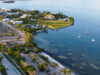
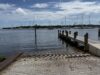
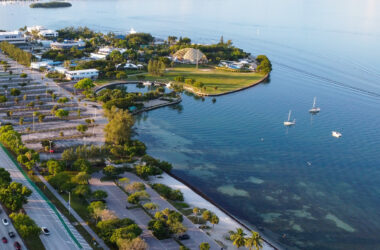
In 1990 Horgan moved south, starting the nonprofit Shake-A-Leg Miami. After bouncing around various locations, the operation found an instant supporter in then-Miami Mayor Xavier Suarez, and the operation settled into its present waterfront location in a historic, former Coast Guard base at the northern end of Dinner Key.
“This spot was under-utilized and kind of falling apart,” Horgan said. “But it had water access.”
Horgan soon made friends with Shake-A-Leg’s neighbors, such as Monty’s Raw Bar owner Manny Medina. “He embraced us,” Horgan said of the politically connected Medina. “And with his stamp of approval, others embraced us, too.”
Along the way, Horgan has built other alliances within the community, including with entrepreneur Cristian Bedoya, a 57-year-old native of Spain who discovered Shake-A-Leg 12 years ago and now serves as chairman of its board.
The organization’s mission — helping people with disabilities — has long been close to Bedoya’s heart. As a 15-year-old, he was a passenger in a car crash that left his best friend paralyzed.
Bedoya spent much of the next three or four months in the hospital, helping to care for his friend. “I had a bed next to him,” Bedoya said. “That became personal to me.”
As board chair at Shake-A-Leg, which serves many underserved communities, Bedoya brings that same personal touch, often putting life jackets on people who can’t do it on their own or assisting a child in a wheelchair.
“We serve people who don’t have anything, and we give hope to people who had lost hope,” Bedoya said. “Families spend most of their money to help their disabled children because it’s expensive being disabled.”
Most of Shake-A-Leg’s programming is free, offering opportunities for disabled children and adults not available anywhere else. Adds Horgan: “For any family that has a disabled child, we want you to know that we have been created specifically for you. We’re a place where you can use the healing powers of the water to pursue your dreams.”
Asked about the apprehension some children feel about getting on the water, Horgan laughed. “At first, some kids are scared to get in a boat—they think a shark might jump in. But then they realize it’s safe. They learn they can actually drive the boat. Their confidence soars, and they start having fun.”
After 35 years running the organization, Horgan said he sees the finish line – for him, at least — in sight. “I’m getting old. In five years, I’m hoping to turn the wheel over to someone else.”
And after that? “I want one of those Viking burials where they put me in a boat and set fire to it,” Horgan said with a laugh.
In the meantime, both Horgan and Bedoya said their focus will remain on the never-ending challenge of raising money to keep the operation afloat. Roughly 80 percent of their $2 million annual budget comes from private donations – a source of revenue that fluctuates with the overall economy.
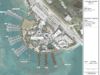
Apart from money, Horgan’s other source of low-level anxiety is Shake-A-Leg’s lease with the City of Miami, calling it “very scary” when he hears the periodic rumors of developers who want to give him the boot so that they can put a high-rise condo on that prized piece of real estate.
But Shake-A-Leg’s general counsel, Scott Silver, is confident that won’t happen.
“They can’t just make this into a waterfront restaurant,” Silver said. “This has to be a general-access public space. That is a condition of the original deed from the U.S. Government to the City of Miami that it be used for water sports and not for commercial purposes.”
Besides, Bedoya said, Shake-A-Leg provides a tremendous amount of value to Miami.
“I’ve never seen a person stand in front of the ocean and say, ‘This is horrible,’” Bedoya said. “I think the water empowers you. The water brings peace. With the water, everything is possible.”
For more information on Shake-A-Leg Miami’s programs, mission, and ways to support it, visit their website here.