


One hundred years ago this month, the Grove’s brief run at self-rule came to a sudden end after just six years, leaving residents once again under the thumb of a much larger City of Miami.
Editor’s Note: For a companion story that recaps Coconut Grove’s attempts to break free from the City of Miami, follow this link.
On a spring morning in 1918, a seaplane lifting off from the new U.S. Naval Air Station at Dinner Key collided with a small, red sailboat in Biscayne Bay. The young pilot survived, but the crash killed 78-year-old John W. Frow, an early Coconut Grove settler, heading out for a day of fishing.
The accident rattled Frow’s neighbors and underscored growing concerns about the presence of the noisy air station amid South Florida’s rapid growth. Within a year, determined to set its own rules and decide its own fate, Coconut Grove incorporated as a town. But after barely six years, its dreams were dashed.
A century later, residents continue to grapple with the aftermath of those events.
Long before the roar of seaplanes and Miami’s encroaching sprawl, Coconut Grove forged a distinctive identity.
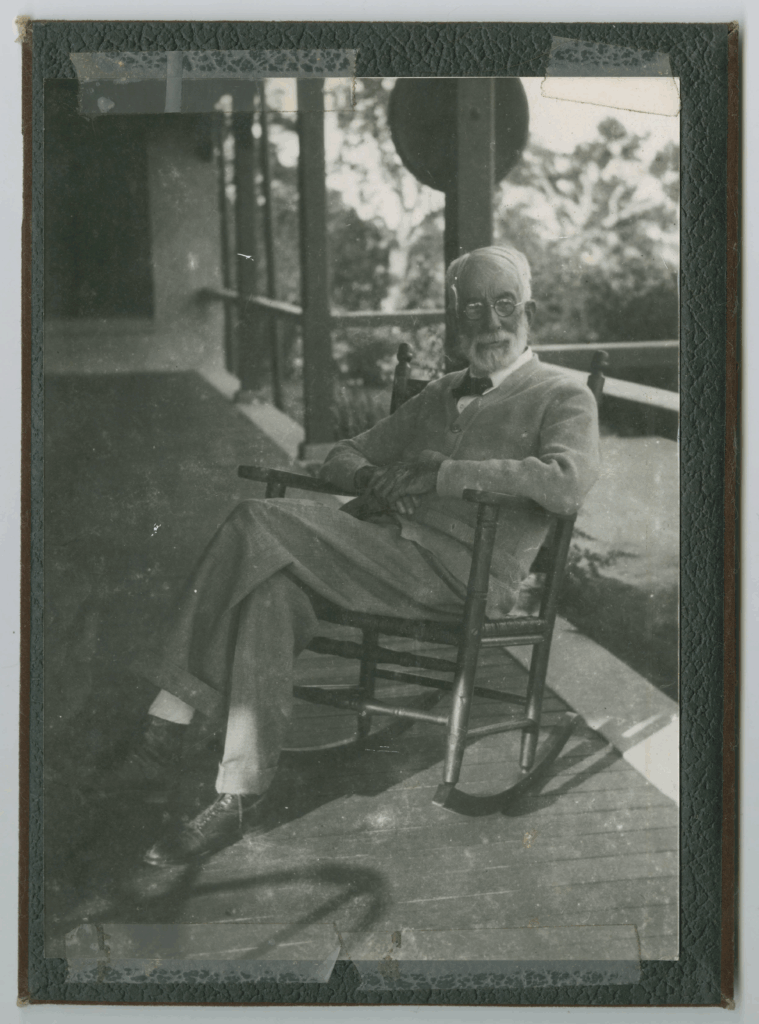
Beginning in the 1880s, the Grove drew an eclectic mix of pioneers — Bahamian immigrants, New England transplants, and others — who prized its natural beauty. While Miami to the north hurtled toward metropolis status, the Grove grew gently, with pioneers like Commodore Ralph M. Munroe fiercely guarding its quieter way of life.
With the end of World War I, seven months after the Frow accident, Grove residents began lobbying Washington to close the air station. While they had supported it during the war out of patriotic duty, they now wanted the men in uniform to vacate Dinner Key.
City of Miami boosters, however, wanted the air station to stay. Although Coconut Grove prevailed, a deeper worry gnawed: the relentless expansion of the budding Magic City.
In March 1919, community leaders in the Grove took matters into their own hands. Residents gathered at the local schoolhouse, and, in a near-unanimous vote, 43 men agreed to incorporate the Town of Coconut Grove. The move gave the Grove a mayor and town council, and, at least in theory, a voice in its own future.
The first mayor, Irving J. Thomas, observed: “Yes, Miami is a city and well known throughout the length and breadth of land,” he told the Miami Metropolis, “but Coconut Grove is much older and is known to some people who never heard of Miami, and we will be better known one of these days.”
One of the new town’s first acts was to drop the “Cocoanut” spelling in favor of “Coconut Grove,” at the urging of botanist David Fairchild.
A series of ordinances soon followed: a 20-mph speed limit within the town, a ban on any drivers under age 14, the designation of Coconut Grove as a bird sanctuary, and set boundaries for the new town: from Dinner Key south to roughly Battersea Road, and from the bay west to the Coconut Grove railway station (present day site of the Metrorail).
The town council also persuaded the county school board to add a high school wing to the Coconut Grove grammar school.
In a strikingly progressive step, the town’s charter granted women voting rights (nearly a year before the 19th Amendment), and winter residents who stayed for three months in a two-year period could also vote despite not being Florida residents.
However, poll taxes remained, disenfranchising many Black residents whose labor and culture were essential to the Grove’s identity.
The new town council, which earned a salary of $1 per year, hired Philadelphia architect John Bright to draw up an extensive urban plan. Bright’s plan envisioned a Mediterranean-style civic center, anchored by a grand city hall and library on the site of today’s CocoWalk, and the forced relocation of Black residents across U.S. 1.
Grove residents ultimately rejected the controversial plan, choosing to preserve their existing, organic layout.
While the new town was getting its footing, Miami’s population continued to soar during the early 1920s land boom. Miami leaders openly discussed the idea of annexing neighboring communities, including Coconut Grove. By then, the Grove had grown large enough to qualify as a city under Florida law.
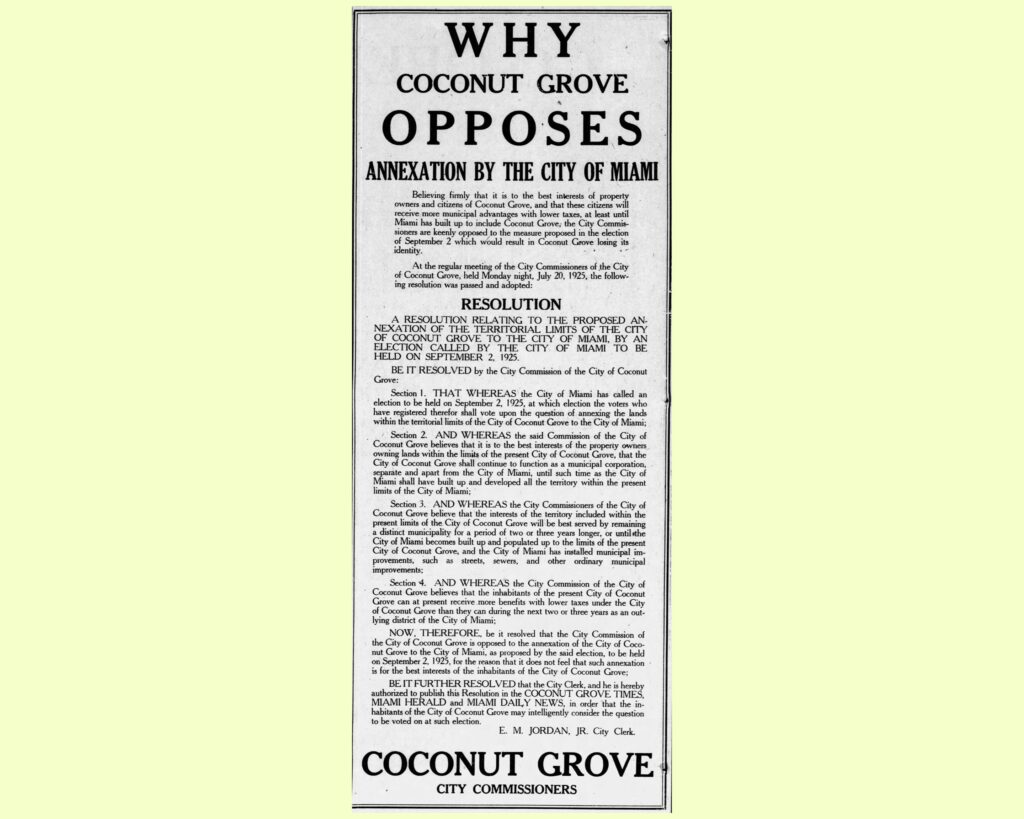
In July 1925, with many of Coconut Grove’s wealthier winter residents away, Miami called a special election. The city drew on a 1905 Florida law that tilted the odds in favor of annexation. Instead of each community voting separately on its own fate, the law stipulated that both the annexing city and all of the proposed new territories would vote together in a single referendum, with a two-thirds majority needed for approval.
Several communities were on the September ballot: Coconut Grove, Silver Bluff, Allapattah, Little River, Buena Vista, and certain unincorporated areas adjacent to the City of Miami.
On September 2, 1925, voters in Allapattah, Little River, and Buena Vista and the unincorporated areas approved annexation. The vote in Silver Bluff was split, while some 87 percent of Grove voters rejected the move. The Grove’s fierce opposition was drowned out in the overall tally.
Grove leaders threatened a Supreme Court challenge, furious at what they called an unjust law. Within weeks of the vote, however, reassurances from Miami’s mayor that the Grove’s interests would be protected quieted the revolt. Reality set in, the Town of Coconut Grove was gone, less than six years after its birth.
Miami promised much in return for annexation. The Grove was to receive an assistant city manager and a municipal judge dedicated to its needs, as well as improved streets, sewer lines, sanitation, and enhanced police and fire protection.
Miami agreed to preserve the Grove’s street names rather than impose the city’s numbered grid. On paper, it looked like a fair trade: local autonomy surrendered in exchange for additional services. The reality was not as promising.
Within a year, Miami’s overheated real estate bubble burst, plunging the city into financial turmoil. For the Grove, annexation had not only meant the loss of independence, but also a bargain struck at the worst possible moment.
Commodore Munroe captured the dismal mood when he said the Grove had been “swallowed, willy-nilly, like a trout by a bass.”
A century later, Coconut Grove remains within Miami’s city limits, but apart in spirit, still resisting the bass that swallowed it whole.
Iris Guzman Kolaya is a local historian based in Miami.





Look at the success, prosperity and improved quality of life achieved by the cities of Key Biscayne, Coral Gables, South Miami, Pinecrest, Palmetto Bay and Cutler Bay. Then consider how much more successful, prosperous and enjoyable life would be in Coconut Grove, if we had not been annexed by Miami in 1925.
We would have had even more respect for our tree hammock, protected our neighborhoods with better zoning, made sure building height did not exceed the tallest trees, and not have to deal with the pettiness, corruption and tantrums of non-residents. In other words, we could be free from the clutches of Miami.
Coconut Grove was and continues to be a unique and special place, even though Miami continues to push us towards emulating Brickell.
If we had to be annexed, couldn’t it be to Key Biscayne, Coral Gables or even South Miami!
Previous efforts were made to secede from Miami. Unfortunately they failed. I wonder if another strategy would make for a stronger legal case.
What if we hired a law firm that specializes in Native American rights? Our case could be that Miami acquired us against our will, that we demand our independence and restitution for all the taxes they absconded with. That we will consider negotiating for a lower amount, if they pack up and leave our historic Pan Am Terminal by next year. And good riddance!
It’s certainly a dream that may never be realized, but Coconut Grove has always had an abundance of dreamers.
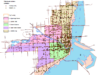
While the grove may no longer be its own city it COULD have its own Commissioner. The Stronger Miami petition seeks to have smaller commission districts and I support it. Currently the Grove district includes Brickell, Downtown, Edgewater, and Morningside. Check out Strongermiami.org