


Four decades after Yiannis Antoniadis was shot dead in his Coconut Grove penthouse, the clues remain — but the killer has never been found.
Prominent architect Yiannis Antoniadis was sitting on the floor of his penthouse Mary Street apartment in Coconut Grove that Monday evening in 1986, his back against the couch, enjoying a glass of white wine that was propped between his feet.
He was dressed in jeans, a casual shirt and barefoot, and, at the age of 49, with his practice thriving and his acclaim on the rise, may well have been gazing out his living room windows on a world that seemed his for the taking.
And that’s when the killer struck, pumping three bullets from a Colt .357 into a man who apparently never saw it coming. The assassin fled, and the wine did not spill.
Forty years later, the slaying of Antoniadis – a man known for his visionary designs, his frequent disputes with clients and his eclectic taste in women – remains as one of the most baffling murder cases in South Florida history.
“It’s a shame we couldn’t solve it,” says David Rivero, who was a young Miami Police Department homicide detective assigned to investigate the April 8, 1986, assassination. “It’s one of those cases that haunts me.”
The killing shook Coconut Grove, a community still reeling from the sensational homicide just 32 days earlier of wealthy developer Stanley Cohen, found shot to death in the bedroom of his South Bayshore Drive home atop Silver Bluff. His wife Joyce Cohen was later convicted of murder and remains in prison, serving life.
Read more: The Grove’s “Murder House” Marks a Gruesome Anniversary
“Two affluent folks killed — there was a lot of heat on the chief of police and us detectives to solve this case,” Rivero recalled. “Unfortunately, that did not happen.”
The Grove of the late 1980s was a community in transition, shedding its tie-dyed identity as a laid-back counterculture haven and morphing into a faster-paced bayside city center, home to leafy residential neighborhoods, touristy commerce and flashy cocaine traffickers, all at the same time.
Read more: Recalling Grove’s ‘Glory Days,’ One Post at a Time
As an architect, Antoniadis was one of the people steering the transition. Born in Greece, he was a teenager when he arrived in the U.S. with his parents and three younger siblings.
The family first settled in Chicago, and then moved to New Jersey. For years they were snowbirds, spending time in both Wildwood, N.J., and Coconut Grove, Vas Andy, Antoniadis’ niece, told the Spotlight.
Always a maverick, Antoniadis in the late 1970s lived in an 800-square-foot plywood house of his own design, suspended between four telephone poles sunk into the ground in the shade of a ficus tree on Oak Avenue. He called it his tree house.
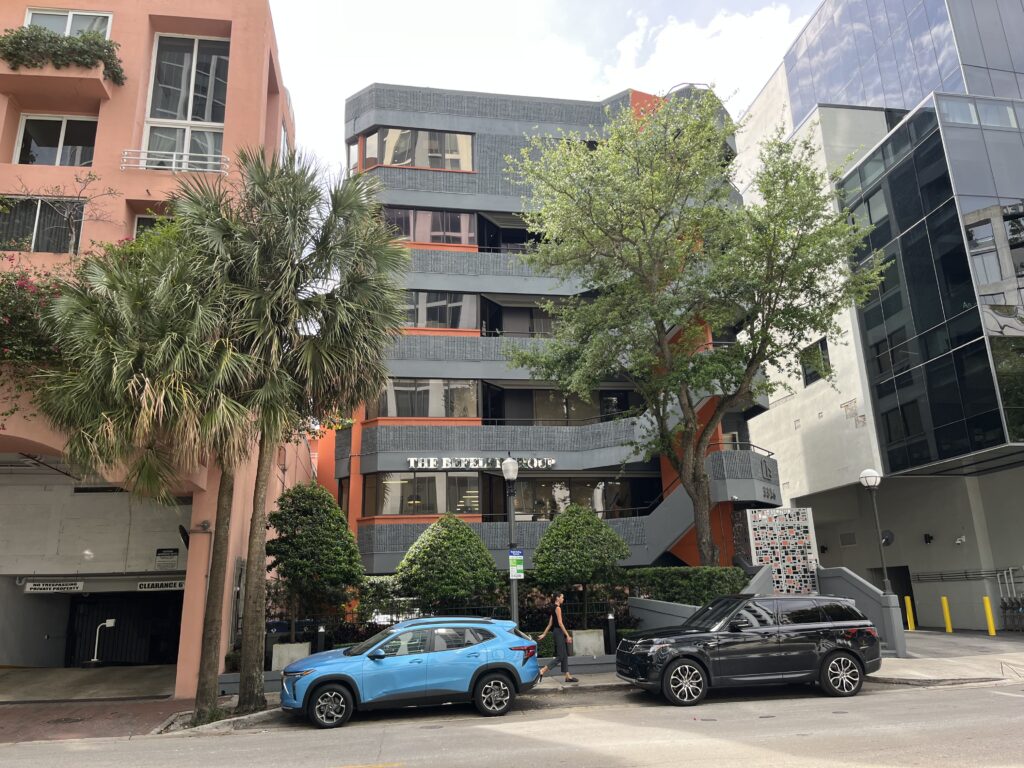
As an architect he designed the Pier House in Key West, redesigned Dinner Key Auditorium and built the distinctive six-story building at 3326 Mary St. where he lived and died.
Antoniadis was also a societal Cassandra, sounding warnings that Miami officials were unprepared for a future in which a population boom would trigger unprecedented demands for water, housing and human services.
He dared to think about shaping the Florida of the next century, imagining cities, including Miami, that would allow more people to live on the waterfront. He dreamed of building communities in Biscayne Bay.
“He was adventurous, willing to take risks, and we needed people like that,” said Dennis Jenkins, a designer and one of a group of artists, architects and other creatives who hung out at the Taurus, the popular Main Highway watering hole.
Added Grove architect Robin Parker: “He had a great personality. Well-known, very friendly, always happy. I just can’t imagine why anybody’d want to kill him.”
Rivero, now 68 and retired, can think of several possible reasons.
Antoniadis was litigious; he was involved in several lawsuits involving clients and the City of Miami. He had an active social life. “He had a lot of girlfriends,” said Rivero, including opera singers, lawyers, high society elites, even other men’s wives. Said Rivero: “There were so many people who didn’t like him.”
Antoniadis’ housekeeper discovered his body when she showed up for work at his apartment about 8 a.m. on a Tuesday morning. In a panic, she hurried down two flights of stairs and summoned Stephen J. Parr, a dentist who rented office space on the fourth floor.
“The maid came in running, saying ‘Come quick, Yiannis has been shot,’” Parr, now retired, told the Spotlight. When he entered the apartment and saw his landlord, “he was already purple. Rigor mortis had set in,” said Parr. “There was nothing to do but call the police.”
Parr recalled seeing three wounds – one in the belly, one in the chest and another through a hand. He also noted the glass of wine between Antoniadis’ feet. “It looked like he was entertaining,” Parr said.

Police scoured the apartment for clues. They dusted a second wine glass for finger prints.
They quickly determined that the architect’s wallet, a three-carat diamond ring and his Mercedes 500 SL were missing. From a girlfriend, detectives learned that Antoniadis was expecting someone to come over at 8 p.m. the night before to discuss a 1984 Audi he had listed for sale in the Auto Trader. Police did not know if that prospective buyer had ever shown up.
Checking Antoniadis’ answering machine, police heard a message from a woman who said she found a plastic baggie containing the architect’s wallet and credit cards while rummaging through a dumpster near Biscayne Boulevard and NE 125th Street, Rivero said. Detectives rushed out to meet her.
Along with the credit cards, the baggie also contained three shell casings from a Colt .357 — the murder weapon, said Rivero.
Later that day, police recovered Antoniadis’ Mercedes, left in the parking lot of what was then a Holiday Inn by the Rickenbacker Causeway.
The only witness to the murder – besides the killer – was a macaw who belonged to the victim’s girlfriend. As police began collecting evidence at the crime scene, Rivero pulled out a pen and notebook, approached the squawking parrot, and said, “Okay, you saw it all — tell me who did this.”
Rivero says his jokey avian interview was an attempt to break the tension at the scene and, if reported in the news media, to draw attention to the case. He says he was criticized for it. “Why do something funny? Because it attracts viewers, clicks. It’s a way of attracting interest in a case,” he says now.
The parrot was not helpful. The investigation stalled.
Rivero remains convinced that Antoniadis was the victim of a professional hit.
“We know it was a hit,” he says. “A hired assassin. It looks like the killer met whoever hired them in that shopping center (near where the baggie was found), showed the credit cards and shell casings as proof that he had been killed, that the job was done, and said, ‘Pay me my money.’”
And how did the killer get into Antoniadis’ secure apartment?
Antoniadis may have let him in, because he knew him, or, suggests Rivero, “he knew the person he was drinking with, and he may have let the killer in. Are they one and the same? We don’t know.”
Many of the forensic tools police now use routinely were not available in 1986.
“Unfortunately, back then we didn’t have cameras, cell phone data — so much we could have used today,” said Rivero. “Even DNA was just starting to be used. So, we didn’t collect (DNA samples). We might have found out who killed him.”
Days after the slaying, Antoniadis’ brother Gus Andy and sister Katherine Ragsdale held a press conference in Miami to plead for tips from the public. They offered a $25,000 reward for information leading to an arrest. But they both died – she in 2005, he in 2023 — without ever learning who killed their brother.
Vas Andy was 15 when her uncle was killed. “He was a fun, generous man,” said Andy, a real estate broker in New Jersey. “He was known as a playboy. He had many girlfriends. He liked to party on the rooftop of his building.
“I remember that he traveled to other countries and he always brought back mementos for us,” Andy said. “I have nothing but fond memories of him. Always jovial, so happy, a hard worker who loved community. He wanted to make a difference.”
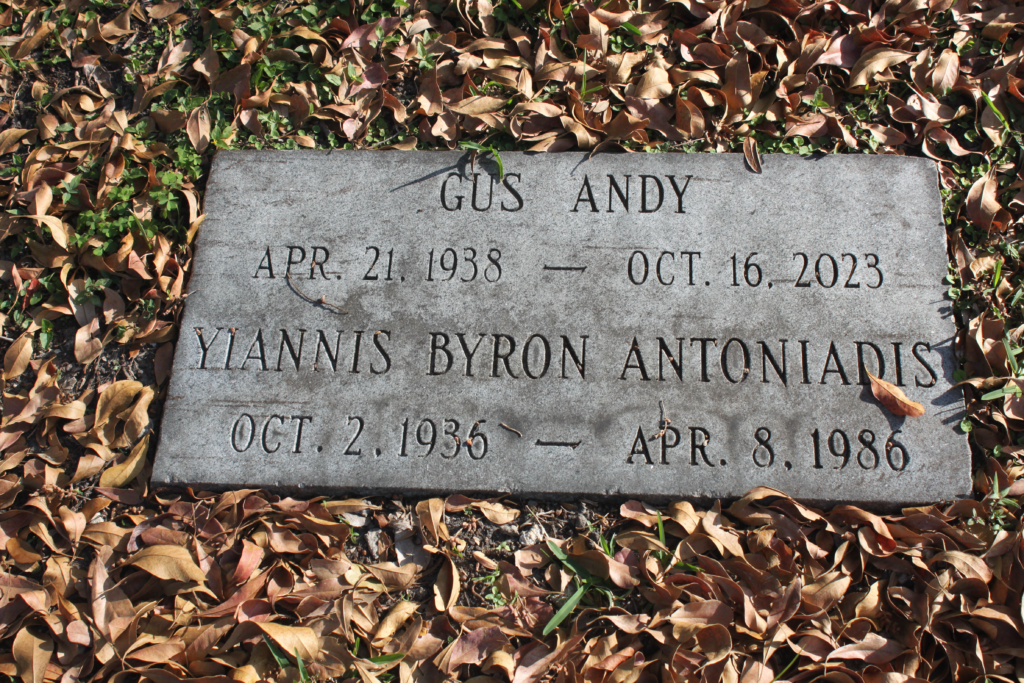
Yiannis Byron Antoniadis is buried, along with his parents and his brother Gus Andy, at the Caballero Rivero Woodlawn Park North Cemetery in Miami.
Officially, his murder remains “an open cold case with no further development,” said Miami police spokesman Michael Vega.
“The primary challenges in solving cold cases often involve missing or deteriorated evidence. Investigators also face difficulties locating witnesses, and in many instances, key witnesses may have passed away. Additionally, DNA evidence does not always produce a usable profile that can be matched to a suspect…”
The chances of solving the case?
“Slim to none,” said Vega. “Unless a good lead comes in.”
Rivero, who retired last year from the University of Miami after 19 years as police chief, says that even after four decades, it is possible the case could be solved.
“It would be a miracle, but maybe there’s a murderer who’s dying in jail, it’s gnawing at their brain. Or someone who wants to get this off their chest, cleanse his soul,” he said. “If we get a call…”
Rivero suggested that new techniques for detecting DNA might also be used on the bullet casings. And, he added, investigators continue to withhold one bit of evidence collected at the crime scene – having to do with the sequence of the shots into Antoniadis and whether he was shot while facing his killer – that could be used to verify any confession.
Andy says her father, Gus Andy, believed, as Rivero does, that Antoniadis was the victim of a professional hit. Her hopes of ever knowing for sure what happened to her uncle are faint.
“What do you do at this point?” Andy said. “You do want to see justice, but we have long made peace with it. You hope that God sorts it out.
“It’s a Greek thing that we say: May his memory be eternal.”














Yiannis was an unusually intelligent man with exellent manners, generous to his friends, civilized behavior and, like all men, he liked beautiful women.
He held the most generous, intellectual, and entertaining parties for his friends consisting of intellectual discussions on various topics and by listening to Greek music.
What a shame to lose such a man while there are millions who offer nothing to society but burden.
We will never forget Yiannis.