

Miami-Dade County officials say they are willing to talk to concerned residents ahead of a critical City Commission vote on the playhouse next month, but the outcome of those talks is far from certain.
Heading into a summer showdown at City Hall over the fate of the Coconut Grove Playhouse, Miami-Dade County officials are signaling their willingness to compromise on key elements of their playhouse plan to address neighborhood concerns.
The county lost a critical vote last month before the city’s Planning, Zoning and Appeals Board (PZAB), and is now appealing that decision to the Miami City Commission. The commission is expected to hear the county’s appeal on July 9.
Ashlee Thomas, the interim director of the county’s Department of Cultural Affairs, said many of the concerns raised by playhouse neighbors are “quite reasonable” and she said she intends to engage the community this month to address them.
Playhouse neighbors want the county to commit to a five-point plan to prevent traffic and commercial activity from overwhelming their neighborhood; to provide jobs, business opportunities, and programming for residents; and to highlight the history of the Charles Avenue corridor and historically Black community in the West Grove.
“We are working on those five points,” Thomas told the Spotlight last week. “I don’t know if there will be different ones, or more, later on, but we are working with our county attorney… to understand the county’s legal and financial capacity to accommodate the requests.”
Thomas said she intends to meet with Preserve the West Grove – a group representing residents who live within 500 feet of the playhouse – and other West Grove community groups to discuss the county’s plan ahead of any vote by the City Commission. Four community organizations are backing the five-point plan.
That meeting, which could happen this Friday, is likely to be facilitated by Miami City Commissioner Damian Pardo, who told residents last week he will seek to broker a compromise. “Our role, in our office, is to bring everybody in alignment,” Pardo said.
The county’s willingness to compromise remains to be seen, however.
During an interview at County Hall, Thomas defended the county’s $59-million playhouse plan – critics call it a “mini-mall” – and said the project already addresses some of the neighbors’ major concerns.
The county is seeking to reopen the playhouse, at least partially, for its 100-year anniversary in 2027. The playhouse closed abruptly amid a financial freefall in 2006.
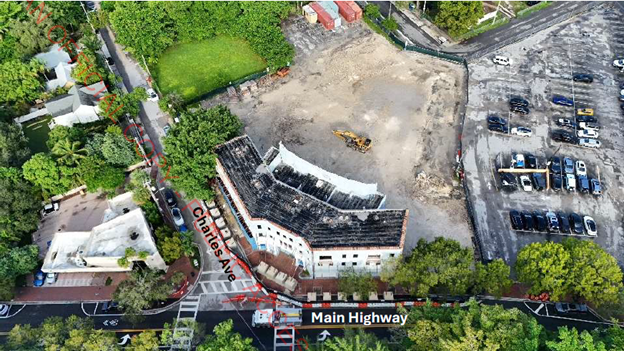
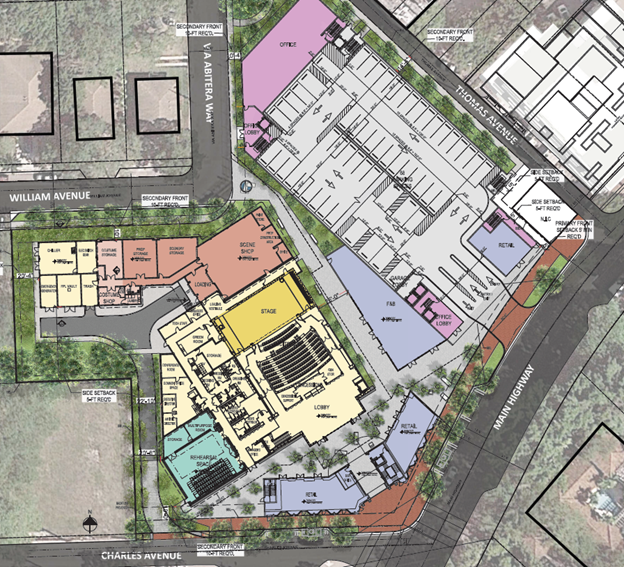
The county’s revival plan calls for a new 310-seat theater, a 287-space parking garage, retail shops, a restaurant, and office space, with plazas, pedestrian paseos and a new mini-park that would open onto the quiet residential streets behind the playhouse.
Residents fear the project will push traffic and commercial activity into their historic neighborhood and they have been asking the county to respond to their concerns, without success, since a key church meeting last September.
That dynamic changed on May 6, when a minority of the city’s planning board members blocked approval of the project, based in part on neighborhood concerns. That gave residents additional time and leverage, pending a vote by the City Commission.
Read more: Miami Planning Board Rejects the County’s Playhouse Plan
“We hope the city will hold the county to the same level of accountability as they would with any other developer,” said Anthony Vinciguerra of Preserve the West Grove.
“When developers are working on a project, developers are held to a standard of community engagement. Could we have something like that for Village West (West Grove) and the playhouse?” Vinciguerra asked in an interview.
Thomas says the county has been listening all along.
“What we’ve done in the past is, we’ve had community meetings, we’ve gone back and informed ourselves, we’ve made adjustments within the parameters that we have, and so the plan continues to work like that,” she said.
She cited one example: The county eliminated two stories of office space on the back of the parking garage that would have faced William and Thomas Avenues, reducing the space to one story, to be used for theater education programming.
“This same group, when we (met) at the church, specifically talked about office space facing their community. So, we heard that and adjusted that,” Thomas said.
One of the neighbors who organized that church meeting last year is not convinced.
“They treat us as Public Enemy No. 1,” said Courtney Berrien, also of Preserve the West Grove. “It’s being conflated into ‘everybody is trying to stop the playhouse.’”
But, she added, “We have always been very clear that we are asking for dialogue.”
To be fair, Berrien and Vinciguerra were named plaintiffs in a lawsuit that sought to do just that – stop the playhouse – but they say that chapter is now over. “That other stuff ended, as far as Courtney and I are concerned,” Vinciguerra said.
Read more: County Prevails in Playhouse Lawsuit
Thomas said the litigation made it difficult for county officials to sit down with neighbors (“When you are in any active litigation,” she said, “you just want to be prudent and protect yourself”). But, she added, the county didn’t ignore neighborhood concerns.
“Much of the plan contemplates many of the requests that are there,” she said. “Traffic, we have mitigated that. We have looked at those things. We will go over that in the meeting again, to show where there’s no commercial intrusion. All those sorts of questions. Is this a mall? No, it is not.”
If county officials and Preserve the West Grove do sit down this week, two major sticking points are likely to be the neighbors’ request for a “clear traffic mitigation plan” and a wall of some sort to prevent commercial activity from spilling into the West Grove.
Thomas said the county is updating its previous traffic study, but neighbors insist that all construction and loading zone traffic should access the playhouse property via Main Highway, not Charles, Thomas or William Avenues. The current plan routes that traffic onto Charles Avenue. It’s not clear whether the county could – or would – change that.
As for the wall, Thomas says the county is open to suggestions but will insist that the new playhouse be open and accessible to the historically Black neighborhoods behind it, to redress the past sin of segregation when Black residents were barred from attending playhouse performances.
County Commissioner Raquel Regalado, a champion of the county’s plan, has been adamant. No wall, she says. But Thomas said there may be a way to thread that needle – to limit access but not seal the neighborhood off from the new playhouse.
“It’s about no commercial intrusion, so making sure that people can’t go in and out of the community, maybe at certain times of the day, maybe that kind of intervention could allow for that. Maybe someone else would still call that a wall, but it’s different, a little different, because there’s access,” Thomas said.
Thomas called that a compromise. “It meets very closely to what the community, or that particular group of community members, are looking for, it meets and accommodates that, while also ensuring that we don’t repeat the history of creating a wall that segregates that community.”
When it comes to the commercial components of the new playhouse – the 2,600 square feet of retail space, the 3,800 square feet of restaurant space, and the 30,600 square feet of office space – the county has less flexibility, Thomas suggested.
Under the county’s plan, each of those components, plus the parking garage, will generate revenue to support theater operations, retire the construction debt, and pay for ongoing maintenance and future capital improvements.
“We are required by the state to make sure the project can sustain itself,” Thomas said. (The playhouse property is owned by the State of Florida and leased to Miami-Dade County.)
“I’m going to say, it is very difficult to do this plan without the revenue which we have contemplated. Almost impossible, if not impossible,” Thomas added.
Despite those hurdles, and before sitting down, all three parties – Thomas for the county, Vinciguerra for Preserve the West Grove, and Pardo for the city – say they are optimistic about finding a way forward for a project beset by controversy, and delay.
“I just think we all have to come to the table and iron it out. I think we will,” Pardo said.
“Our hope, as we have outlined multiple times, is that the city will support us in establishing a legally binding community benefits agreement (CBA) with the county that would make concrete the county’s commitment to addressing our concerns,” Vinciguerra said.
“We think Commissioner Pardo could be a huge winner in this process,” he added. “I think this could be a real win for the county, too.”