

As routine rainstorms increasingly flood streets far from the coastline, Grove residents say clogged drains, rapid development and a lack of city response have made flooding part of everyday life.
Philip Schuss will never forget Thanksgiving 2025.
He and his wife planned to tour his parents through his new home on Day Avenue, but the skies opened up midafternoon, sparking chaos.
“My mother called and said there was no way they could get to the front door. Our street was totally flooded. Water had formed a moat that surrounded two sides of our house.”
Schuss moved his car from the garage, his parents pulled in, and he parked his vehicle across the street. Getting back, he crossed through water that “came up to my knees,” he said, and was flowing fast enough to sweep one of his Birkenstock sandals downstream, “to where, I’ll never know.”
Later, Schuss got to the root of the problem. “I walked around the four corners of our intersection, and there were no storm drains to be seen.” Drains he discovered further away, he said, were blocked by layers of decaying leaves and other waste.
He reported the problems using 311, which serves as Miami’s Report Flooding hotline, but never received a reply.
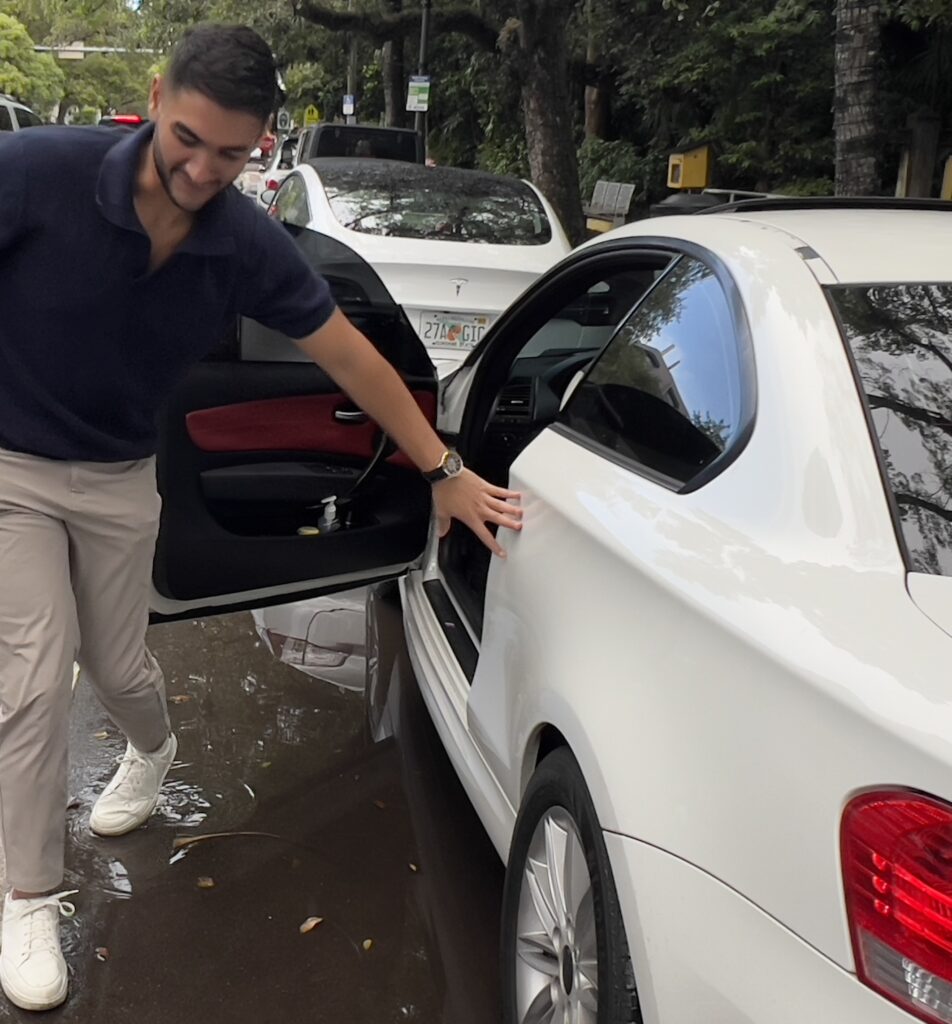
Meanwhile, on Thanksgiving, Schuss’s neighbor, Leah Tibbals, watched helplessly as water gushed into her garage and blanketed her yard with debris. She was aggravated, but not surprised, as she’s seen the same event play out repeatedly, despite the fact that Day Avenue is located well outside a floodplain.
“All it takes is a short, hard rain — nothing near the level of a tropical storm, and I’m trapped inside. There are no deliveries. I can’t even take the dog out,” she said. Tibbals, too, has tried 311, but has never received a response.
Further down the street, Mary Rankin was relieved that her garage, which has flooded before, was spared on Thanksgiving, thanks to her building’s defense strategy. The protocol, triggered by the alarm of moisture sensors in the garage, sounds about as fun as cleaning toilets, but it works.
First, building residents use rakes and garbage cans to clear debris from nearby street drains. It’s a job that belongs to the city. But, as Rankin explained, “They don’t keep up with the constant debris. A single plastic shopping bag plus all of the fallen leaves are enough to clog a drain.”
Next, cars must be moved from the garage to paid parking lots out of harm’s way. And finally, condo residents heave layers of sandbags that are stored nearby across areas vulnerable to flooding.
Months ago, Rankin wrote to Miami District 2 City Commissioner Damian Pardo and contacted the city’s Department of Resilience and Public Works. She also submitted reports through ISeeChange, a platform used by Miami and other communities to track flooding. None produced a response beyond automated emails, she said.
She has also tried Miami’s 311 system, which recently generated a text message stating: “Something’s wrong with our services. Please check back later.” She and other residents say that type of response from city agencies compounds their frustration.
It hasn’t always been like this. Rankin moved to the neighborhood in 2009. Back then, neighbors assured her that the only incidents of flooding had been from major hurricanes, such as Katrina and Wilma in 2005. But by the mid-2000s redevelopment marched through the neighborhood, paving over vacant lots and tree-shrouded bungalows with larger buildings and brick patios.

This was years before both the city and the county passed an ordinance that required the use of porous asphalt, pervious concrete, and other permeable materials for driveways, patios, and other hard surfaces surrounding a building. Rankin believes the loss of permeable land, plus a weak drainage system, are to blame for the flooding problems.
In fact, scientific research has long shown that a loss of permeable land increases flooding, and local experts say that Miami is a case in point.
“The landscape has transformed,” said Esber Andiroglu, a professor of architecture and civil engineering at the University of Miami. “There is a disconnect with zoning ordinances and flooding issues. We are very pro-development in general.”
A quarter mile north of Day Avenue, West Trade Avenue is another narrow street where large buildings are replacing small homes, a trend starkly visible in before-and-after photos of the landscape.
The result is frequent flooding, and the problem is compounded, residents say, by sloppy construction crews. Tom Roelandse, who has lived on the street for more than 20 years, wrote in an email to the Spotlight that he has repeatedly seen work crews ignore laws that require construction waste to be hauled off-site for disposal.
“You could see a lot of concrete runoff, and coral rocks, and other debris being deposited in the drain,” Roelandse said. “Now that construction is finished it is evident that the drain is partially blocked as water pools there very quickly now.”
Flooding has become a nuisance on Main Highway, too, in the aftermath of last summer’s repaving project near the village center.
Pat Mackin, who lives in the Abitare development just south of The Barnacle Historic State Park, said the roadwork raised the midline of the street, creating a steeper pitch that directs rainwater quickly toward the curbs. Several drains that line the curbs are now clogged, Mackin noted, so water has nowhere to go.
“What would happen in the case of a tropical storm or hurricane? There are twenty-one townhouses downhill from here. I don’t want to even think about how we could be impacted,” she said.

As Mackin described the problem during an afternoon visit last fall, it began to rain and wide pools of water formed quickly along Main Highway. Cars slowed to a crawl and pedestrians became stranded on either side of the street. Eventually, water crept its way onto sidewalks, and to Mackin’s relief, stopped just short of her driveway.
The development’s manager, Cristina Castillo, said that last September she reported the problem to Pardo, who responded that Main Highway is “maintained by Miami-Dade County, so the city has limited jurisdiction over the matter.” He added that “The county has already initiated a drainage project that is currently in the planning stages.” Castillo said that despite her request, no information has been provided.
Chronic flooding on streets such as Day Avenue, located far from FEMA-designated floodplains, might sound surprising, as these areas are traditionally considered low risk.
But this “low risk” designation means they are less studied by scientists, and that creates a problem, as “data can be scarce and unreliable,” said Katherine Mach, a professor and department chair at University of Miami’s Rosenstiel School of Marine, Atmospheric and Earth Science.
“The most accurate information we have on whether a home might flood is whether it has flooded before,” she explained. Mach, whose research focuses on predicting flooding risk, said that along with a loss of permeable land and insufficient drainage, there are a myriad of factors that can set the stage for flooding. Other experts agree.
Michael Sukop, professor of hydrogeology at FIU’s Institute of Environment, said that groundwater levels, impacted by both rainfall and Miami’s infamous king tides, also play a role. On Thanksgiving, he said, there were no king tides threatening the Grove. But considering other data, he said it is possible that heavy rain triggered a “smallish jump in the water table” near Day Avenue. “Rainfall amounts can vary a lot from place to place, and the groundwater level can change accordingly.” In any case, a higher water table increases the chance of flooding.
Another factor is the Grove’s geological composition. Andiroglu, of the University of Miami, noted that unlike the absorbent limestone rock so common in South Florida, “The substrate also includes a lot of hard rock… that impedes its permeability.
“Saturation can happen quickly,” he explained. Once the ground is saturated, water collects on the surface and flows according to gravity.
And, exactly where gravity takes the water depends on topography, which in turn can pose another threat. Sukop, a leading expert in groundwater management, said that certain areas of Day Avenue are on relatively low ground, similar to a basin. During heavy rain, he explained, “the homes at the bottom could be particularly vulnerable.”
Finally, the age of the building can impact the risk of flooding. Many permit requirements did not exist prior to 1992, when Hurricane Andrew triggered an overhaul in building codes.
“General standards were low and corruption was high in the 1980s,” Sam Van Leer, founder of the nonprofit, Urban Paradise Guild, described in an email. “Bigger projects tend to have more professional engineering, including drainage.”
Residents impacted by chronic flooding call the city complacent, and worse. And some experts agree. A simple fix for clogged storm drains, they say, is more street sweeping and routine cleaning of stormwater catch basins and coastal outfall grates.
Dave Doebler, co-chair of the Biscayne Bay Marine Health Coalition, calls it, “basic maintenance,” that the City of Miami has long underfunded and deferred.
Stormwater management standards recommend that drainage systems be inspected and cleaned at least once a year or more, depending on the level of rainfall and street debris. But in Miami, Doebler said, the target cleaning cycle is once every two years, at most.
“Without proper maintenance our stormwater drainage system cannot function as designed,” said Doebler. “And yes, it will back up into the streets.”
A City of Miami spokesperson declined to comment on the maintenance of stormwater drainage in the Grove.
Another issue is communication. The city encourages residents to report flooding via the websites Miami 311, Flood Tracker, and ISeeChange, but each has its limitations.
For example, the main purpose of ISeeChange is to collect data, and FloodTracker is simply a tool within 311 for reporting a flood with videos and photos in real time. And even if stormwater is seeping into your car, there is no guarantee of intervention.
As far as Miami 311, the city posts conflicting information. On the one hand, it describes the hub as “the primary way to receive requests for clogged storm drains, street flooding, and issues with catch basins, ensuring crews are dispatched.” But there are numerous disclaimers on the Miami 311 website regarding if and when any service might be provided.
So, if it’s intervention that’s being sought, direct calls to the Miami Public Works Department yield better results, some residents say.
That’s what Ana Wenger did a few years ago when, after a large spec house went up on her block, her yard was continually flooded by normal rainfall.
Wegner made numerous calls to the city, but was not promised anything. So she was surprised when, weeks later, a crew from the city’s Department of Resilience and Public Works began digging up her street.
“They installed several large drains,” she recalled. “That took care of the problem.”
In November, a city spokesperson declined to confirm if similar projects are planned for Day, West Trade Avenues or elsewhere in the Grove, but forwarded an email status report of its Stormwater Master Plan: “In 2024 we completed five local drainage projects in Coconut Grove and are on track to complete another five projects in 2025.”
Some of those 2025 projects are still ongoing, and include a new pump station off Bayshore Drive and West Fairview Street; tidal valves to control both stormwater and king tides; drainage improvements on Poinciana Avenue near Kent Road; and improved infrastructure on East Glencoe Street.

Funding for flood-mitigation projects comes from the city’s $400 million Miami Forever Bond program. In addition, a stormwater utility fee, paid by all city property owners, is earmarked for the operation, maintenance and expansion of the stormwater drainage system, according to local ordinances. Fees are based on an estimate of the runoff created by a property’s impervious areas.
Federal rules mandate that municipalities provide residents the infrastructure, operation and maintenance necessary for flood protection. Critics say it is failing to deliver on that duty.
Anthony Alfieri, Director of the University of Miami’s Center for Ethics and Public Service, believes “short of private litigation the best path forward for affected homeowners is to band together and meet directly with their district commissioner to hammer out a street-level, remedial plan to solve the problem.”
That may be easier said than done, given a problem that is multifactorial, understudied, and complicated by overlapping jurisdictions and administrative processes. Yet, others agree.
The idea that “the city should come and build drainage in my street, and all my problems are gonna go away,” is short sighted, said the University of Miami’s Andiroglu.
Mach also supports a multidisciplinary approach. “Thinking about where water is coming from across the whole system is absolutely crucial to know if any given local stormwater management plan has a hope of succeeding,” she said.
In the meantime, patience may be exhausted, as officials with the Department of Resilience and Public Works ended their email regarding current stormwater projects with a sobering message:
“Unfortunately, interim flooding (less than 24 hours) should be expected in low-lying areas during heavy rain events and/or seasonal high tides.”














As a Grove homeowner who has experienced flooding, I value this article’s depth and range of research. Ms. Mann consults an array of experts who highlight many contributing causes. Her article also underlines how far behind the planning curve the City of Miami has fallen–plus its negligence in enforcing existing codes and its inability to respond to reports.
Extreme rain events will only become more and more common here in South Florida, yet every new home in Center Grove is built to within a few feet of the lot line. There appears to be no plan for the increased water runoff. As a community and as a city, we can and must do better.
Thank you, Spotlight, for this reporting!
Very well written and researched article. You should join the South Bayshore Drive Condominium Alliance (SBDCA.) Our Association currently doesn’t have anyone representing us on the SBDCA. You would be a valuable asset. The SBDCA focuses in part part on negligence in code enforcement, which was the focus of your article.