
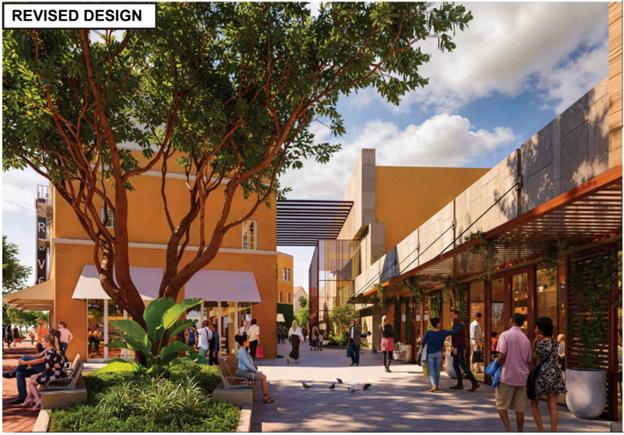

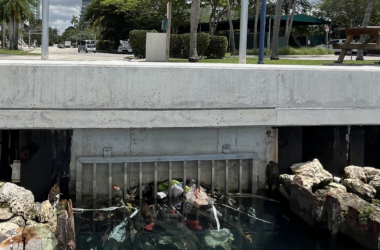

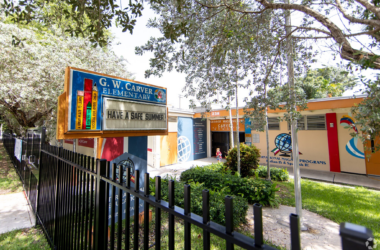
Critics of the proposed development plan for the Coconut Grove Playhouse got another chance this week to voice their concerns, ahead of a pivotal vote next month by the Miami City Commission.
Are we done fighting over the Coconut Grove Playhouse?
Apparently not.
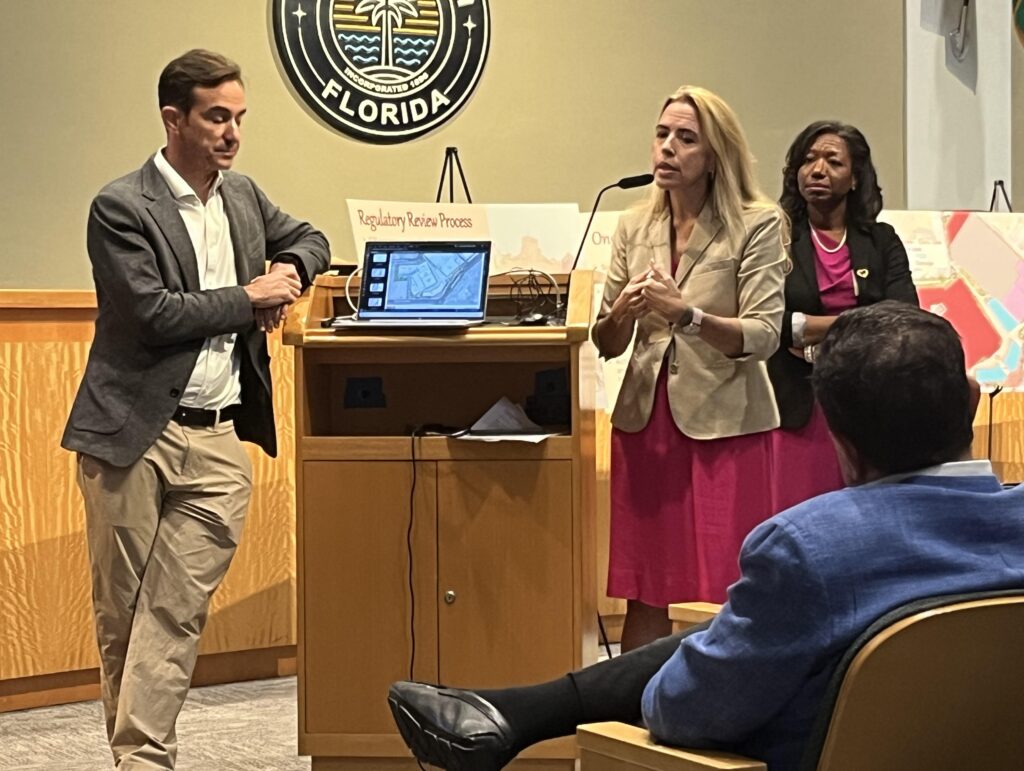
Miami District 2 Commissioner Damian Pardo invited critics of the playhouse redevelopment plan to meet this week with Miami-Dade County officials in hopes of brokering a compromise so the project can move forward.
The critics came and listened but were largely unmoved by the county’s attempts to address neighborhood concerns about the project, which still needs to win the approval of the Miami City Commission.
“You are putting band-aids on a bad project,” Gloriana Calhoun told Miami Dade County Commissioner Raquel Regalado and Ashlee Thomas, interim director of the county’s Department of Cultural Affairs.
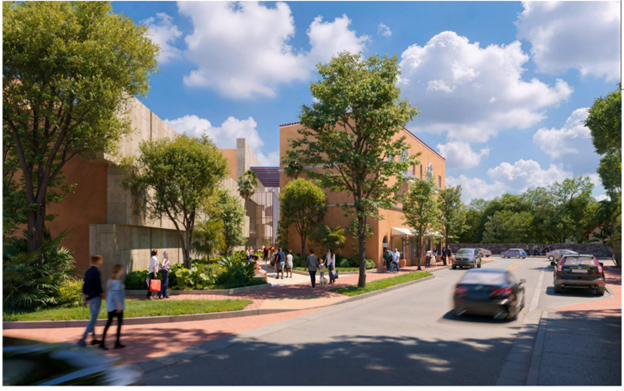
The Monday night meeting served as a prelude of sorts for the main event to come on July 9 when the county will ask Pardo and his fellow commissioners to bless its plan to revive the playhouse as a smaller, 300-seat theater with shops, offices and parking.
Those plans are opposed by preservationists who fear the playhouse will lose its spot on the National Register of Historic Places, and by West Grove residents who fear the project will push unwanted traffic and commercial activity into their neighborhood.
Read more: Playhouse Neighbors Reject the County’s Plan for Inclusion
The city’s Planning, Zoning and Appeals Board (PZAB) rejected the county’s plan last month because of those neighborhood concerns.
The county is now asking the City Commission to override that decision and approve the zoning changes the project needs to begin construction.
“We are here to be responsive,” Regalado said at one point during the meeting.
On Monday night, Regalado and Thomas offered to:
- Install a gate at the end of the pedestrian walk designed to connect the theater to the West Grove. The gate could be closed permanently, or on performance dates, to protect the neighborhood from any spillover effect, Thomas said.
- Erect a barrier around the pocket park that the county wants to build behind the planned parking garage, so the park could be closed at night.
- Complete a new traffic study for the project (which Thomas said is not likely to be completed until after the July 9 commission meeting).
- Showcase the history of Charles Avenue and the West Grove, a historically Black neighborhood, perhaps by opening a visitor center or by offering neighborhood tours. The county also pledged to return the historic Charles Avenue marker that once stood in front of the playhouse (the marker is currently in storage).
- Help neighborhood residents access job opportunities at the new complex.
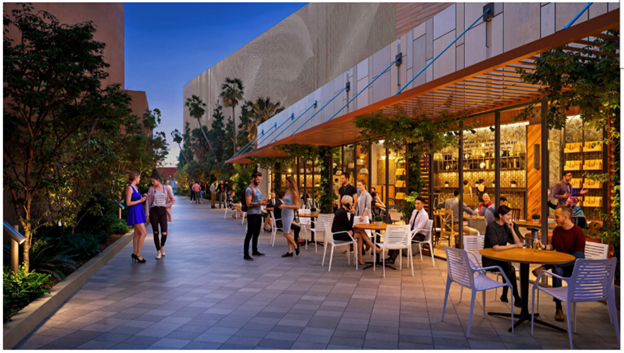
The county did not back off its plan to build the project with a significant commercial component, however, including 28,000 square feet of office space, 2,600 square feet of retail space, and 3,800 square feet for food and beverage service.
See more: View the County’s Playhouse Presentation Here
The county insists those commercial spaces are needed to subsidize the cultural components of the project and avoid the need for taxpayer subsidies, but they represent a significant sticking point for neighbors, who fear commercial intrusion.
Long-time critics of the project predicted the county’s proffered concessions might be enough to win commission approval. Even so, that victory might be short-lived if opponents go back to court to block the project.
Grove resident Andy Parrish, a former member of PZAB, urged Regalado and the county to take the project back to the city’s Historic and Environmental Preservation Board for additional review, suggesting that added step could head off future litigation.
Regalado dismissed the suggestion, even though the project was tied up for years by past litigation. The county says it has all the approvals it needs to move forward, save the zoning exemptions and waivers it is asking the commission to approve on July 9.
Read more: Another Bite at the Playhouse Apple
“We are literally at the finish line on this thing,” Regalado said.
But the county also wants to reopen the theater, or at least a portion of the project, in time for the playhouse’s 100th anniversary in 2027 – a timeline that could be derailed by additional litigation. The playhouse opened in January 1927 as a silent movie house and closed abruptly 79 years later, in 2006, because of financial problems.
The county formally committed to the playhouse project in 2013 when it signed a long-term lease with the state of Florida, which owns the property.
Four years later, the county presented its plan to the city’s historic preservation board, which led to litigation, then a return visit to the board in 2019, and then more litigation.
The county now estimates the project will cost $59 million to complete, a figure that does not include the construction cost of the parking garage.
Since hiring John Bell Construction for preliminary site work, including the demolition of the playhouse’s auditorium and stabilization of its distinctive façade, the county has added $2.8 million to the original contract. That contract now totals $6.8 million.
In addition, the county now expects to pay architectural firm Arquitectonica $6.6 million for its design work, an increase of $4.2 million from the original contract amount.
That $4.2 million includes an additional $2.1 million to complete the original scope of work and $2.1 million more for services related to the proposed parking garage.
Both new contract amounts were approved this month by the County Commission.


















I was at the meeting, and during public comment I said:
I’m glad you’re preserving the Kiehnel and Eliott designed original, historic façade portion of the playhouse, but the rest of the project is ultra-modern boxitecture which is incongruent and architecturally conflicts with the historic portion. That’s very disappointing. If it could be redesigned for better architectural compatibility, that would be great.
YOU KNOW it’s truly a failed project by the number of times the Miami-Dade County Department of Cultural Affairs uses our own money to litigate against us, the very taxpayers who voted to preserve our entire century-old theatre that WAS on the National Register for Historic Places, before Raquel Regalado illegally demolished it. Mark your calendars for the next election 🗳️. We’ll still be here, keeping the spirit of Coconut Grove alive.
https://youtu.be/4jlbXb30DBY?is=GvJ7E8vdhiM7444D
I blame this entire fiasco on two events:
1) They City allowed The Miami Parking Authority to sell off Coconut Grove’s public parking garage at Mary & Oak Ave to Terra group for their private offices. The garage was easily accessible off of 27th Avenue. It had 402 spaces. They sold it for $16 million. They are now spending $12 million of those proceeds, plus $2.3 million of the BID’s money and financing $20 million with municipal bonds to build a new garage deep in the heart of West Grove which will force people to drive down Commodore Plaza or Main Highway every single day whether there is a show or not. Most likely, people will drive down Douglas Road and cut through Charles Ave. I can almost guarantee it. That will be the new route to the Grove and the County knows it.
2) Architectonica built a Borg-cube of a building with parking variances knowing full well that they planned to stick the garage at the Playhouse site. And the county is paying THEM $2.1 million to design it, on top of the $6.6 million for the office-park of a design for the Playhouse, which fits nicely with the Borg cube, but has zero vernacular of a cultural asset on the Historic Register. That building just sold for a record-breaking $61 million, by the way, after a few crazy financial exchanges.
Here’s the AI breakdown of the entire Playhouse maneuver:
1. The Big Winners
* Arquitectonica: They walked away with $6.6 million in taxpayer-funded design fees. Their contract was quietly bumped up by $4.2 million due to “delays.” At the exact same time they were designing this public garage, they were the private, zoning-defying lobbyists for the luxury office building at 3480 Main Highway down the street, securing massive variances so that building didn’t have to waste space constructing its own parking.
* Miami Parking Authority (MPA): They claim they take “$0 in management fees,” but they won big. They sold the old Oak Avenue garage to luxury developers for $16M, used $12.1M of that cash to fund this new project, and now get a brand-new, modern asset wrapped in 37,000 square feet of Class A office and retail space. They also get to absorb their own corporate overhead under “operating expenses” and keep 100% of all parking ticket and citation revenue on the newly congested block.
2. The Taxpayer Receipt: $59 Million (And Counting)
The public is being bled from every available funding angle to get this built:
* $20 Million from the 2004 Miami-Dade Building Better Communities Bond (Money we voted on decades ago specifically to restore the theater, not to downsize it).
* $10 Million from the City’s 2017 “Miami Forever” Bond (A general cultural fund allocation that city politicians have used as a bargaining chip for years).
* $20.4 Million in MPA Revenue Bonds (Which you will pay back out-of-pocket via high hourly parking rates and inflated retail prices at the site).
* $12.1 Million in liquidated public land equity from the 2016 Oak Avenue garage sale.
* $2.3 Million from the Coconut Grove BID (A tax levied on local commercial properties).
* $7 Million+ in recent county cost overruns to patch the gridlock.
They stripped public parking in 2016, waived parking requirements for billionaire developers building luxury offices on Main Highway, and are now spending nearly $60 million of public moneyto build a garage on a historic cultural site to fix the parking crisis they manufactured. The public absorbs the infrastructure burden, while private real estate flips down the street for $61 million.
So Gloriana is exactly right. It’s is and always has been a bad project shoved down Coconut Grove’s throat and forcing us to live with the congestion AND finance it. They really do think we’re stupid. The only stupid thing here is this whole scheme.
And in the meantime, the proscenium arch, the seats, the history was dumped out on the parking lot and hauled away.
When I chaired the Historic and Environmental Preservation Board two decades ago, I learned one way to tell when someone is really worried about something is when they say “We’re not going to talk about that.” That’s what happened Monday when I asked Commissioner Regalado to consider going back before HEPB, as that Board has asked the County to do.
Why should she be so worried? That Board is comprised mostly of experienced, professional architects familiar with “Adaptive Reuse” as a way to keep outdated Historic structures useful without losing their Historic designations. Wouldn’t those professionals do their best to advise the County how to do both? After all, about 80% of the Playhouse has been demolished, so working with the County Plan instead of starting over would be what the Board would try to do, wouldn’t they?
After HEPB has reviewed this final version of the County Plan and given a Certificate of Approval (COA) conditioned upon some reasonable modifications, the litigation would finally cease. Everyone is sick of the stalemate, including any judge who this might come before after the HEPB has spoken.
Here’s a suggestion for the Miami Commission: Defer the County’s appeal until the County has returned to HEPB. After that, even if the County refuses to follow HEPB’s recommendations, the County can still come back to Commission to try to bludgeon their way through, as they are trying to do now.
A horrible, expensive resolution. There’s a gulity list of those who have profited from this long, drawn out saga, and Coco Grove residents are the victims. I’ve seen warehouses that are more attractive. A sad conclusion/travesty.
Thanks for the noble efforts of those many concerned citizens that dedicated countless hours battling this betrayal. Regrettably historic registration, lobbying by Miami’s beloved and missed historian Arva Moore Parks and the desire of the majority of Grovites, was just not enough to overcome the greed, arrogance and poor leadership that permeates our community.
The county is lying to the public. The claim that they held the June 22 meeting to listen to the public is an insult. Those who spoke against their plan were interrupted and cut off and had the microphone taken away. When did they get the “approval” of the city historic preservation board? Answer: THEY DIDN’T. When did they get the State required review done (statute 267 review)? Answer: THEY didn’t. The statute clearly says the review is to be done before the demolition not after, and whatever “review” they’re fantasizing about occurred after the demolition which means it wasn’t done. I sat there at the June 22 meeting with my hand raised and they refused to let me speak. Yet, they let several other people speak multiple times. There is no basis or grounds for the county appeal of the city zoning board decision other than they don’t like the decision and they should be allowed to undermine the authority of the Zoning Board because they are above the law. And the Spotlight and the Herald should stop dismissively referring to the critics of the county plan as “preservationists” unless they’re willing to refer to the county as lawbreaking, lying demolitionists. The critics are CITIZENS/taxpayers who voted to use our $20 million to restore a theater, not build what is predominantly a retail/office/dining center. Don’t write them off as a fringe group of troublemaking preservationists. We are citizens standing up for the laws the county is violating.
Ask the county the date they received approval of the City Historic Preservation Board. They LOST the ruling of that board! Ask when they had the 267 review done? It wasn’t done! The statute says it must be done before the demolition. I was not called upon to ask my questions because they know I know things the average citizen doesn’t know. I have the documents to prove they are lying. After being not allowed to ask questions during the public comments of the meeting I was told I could approach Regalado and company after the meeting was over. So I did and all three officials (Regalado, Thomas and Winnick) refused to answer any questions about the alleged 267 review, about the economic damage their commercialization plans will do to the already struggling nearby restaurants and shops, about the feasibility studies top theaters experts which the county PAID for which recommended a larger theater due to the fact that a 300 seat theater is economically unsustainable. And they plan on supporting a theater with the proceeds of retail which has no guarantee of succeeding especially when their own feasibility study says it is unsustainable?