
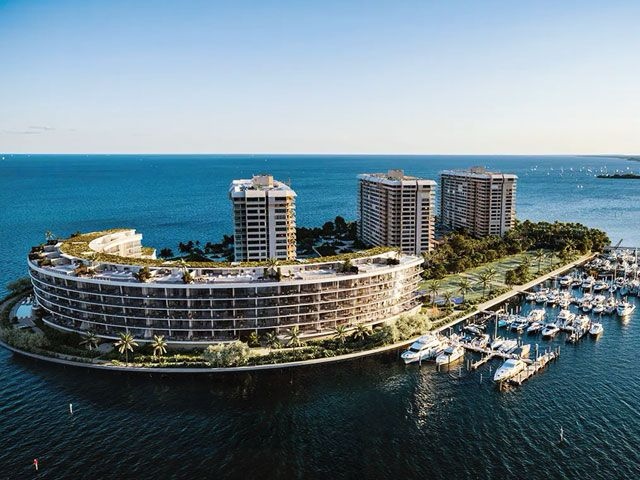



New residents are moving into the seven-story Vita at Grove Isle luxury condominium in North Grove, but longtime residents are still pursuing a lawsuit that claims city officials erred in approving its construction.
For years, Elizabeth Tamayo watched a seven-story luxury condominium rise outside her eighth-floor Grove Isle apartment, gradually replacing her sweeping view of Biscayne Bay with glass and concrete.
Now the construction is largely over.
Residents are beginning to move into Vita at Grove Isle, the horseshoe-shaped luxury condominium that has joined three original towers within the gated, 20-acre North Grove island that is reachable by bridge.
The waterfront project is led by CMC Group, the Miami development company founded by Ugo Colombo that has built a range of high-end condominium towers across Miami-Dade County. Vita includes 65 waterfront residences, with units currently listed for sale from about $5.8 million to more than $21 million.
“Every time I see the [new] building, I miss the beautiful sea I would see before,” Tamayo said.
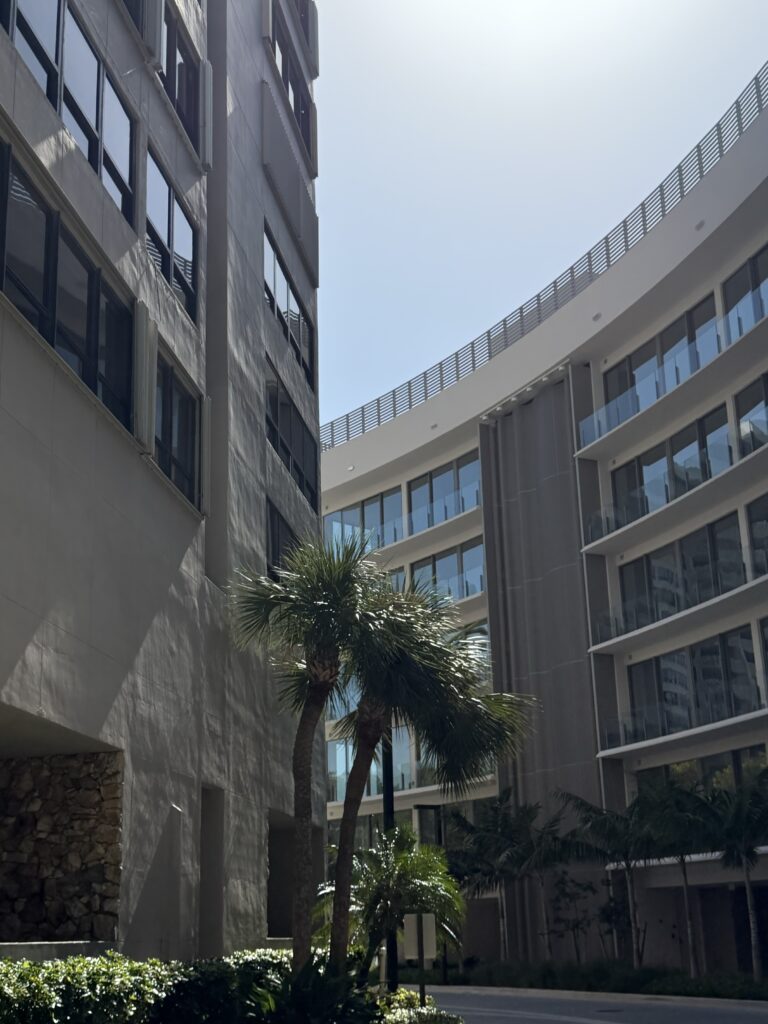
But while Vita is becoming home to its new residents, the legal fight over whether the City of Miami should ever have allowed it to be built is far from over.
More than a year and a half after a group of Grove Isle residents and neighborhood organizations sued the city challenging permits and approvals for the project, the case remains pending in Miami-Dade Circuit Court. A hearing on the city’s latest motion to dismiss is scheduled for Oct. 15, and a trial that had been scheduled for December 2025 has been pushed to January 2027.
At the center of the dispute is a complicated but potentially consequential land-use question: Did the land beneath Vita need to be formally subdivided, or “platted,” before Miami could issue permits allowing the condominium to be built?
Read More: Paradise Lost: Grove Isle Development Sparks Endless Outrage
In an amended complaint filed in April, the plaintiffs argue the city violated its own code by issuing permits without first requiring a plat. They point to Section 55-10, which prohibits building and other permits on land for which a required plat has not been recorded in county records, or on a lot of record that has been divided into separate parcels.
The lawsuit asks the court to void permits and approvals that the plaintiffs contend were unlawfully granted.
“If they get away with this here, you’re going to see all these condos taking any land they have extra, selling it to third parties and letting them build these weird structures without getting platting,” said David Winker, an attorney representing the plaintiffs.
The plaintiffs include Protect Grove Isle, the Tigertail Association, Kenneth Eblen and the Coconut Grove Civic Association.
The city disagrees, arguing in a court filing that the issues have already been resolved through previous court decisions and agreements involving the Grove Isle Condominium Association.
City attorneys also argue that the plaintiffs have failed to establish standing and that the court lacks jurisdiction over some of the zoning and permitting decisions being challenged.
Winker says the earlier cases and agreements did not resolve the specific platting question at the heart of the current lawsuit.
“We disagree vehemently with that proposition,” he said. “They cannot point you to where there’s a judgment or an order that says platting is not necessary.”
Winker told the Spotlight that the long delay in resolving the lawsuit is not unusual. Land-use litigation can take years, he said, and the completion of Vita does not change the underlying legal questions.
The dispute is the latest chapter in a legal and political battle over development on Grove Isle that has stretched for more than a decade.
In 2013, an investment group led by developer Eduardo Avila purchased Grove Isle’s former hotel and club businesses for $24 million, later selling the property to CMC Group. Plans to redevelop the site with new residences drew opposition from residents of the island’s three existing condominium towers.
At one point, the city itself raised concerns about the platting issue.
In January 2019, the City Attorney’s Office concluded that “the division of land between the club parcel and condominium parcel was unrecognized and does not meet an exception to platting” under city code. The city subsequently imposed a brief island-wide permitting freeze.
But city memorandums reviewed by the Spotlight show the city reversed course weeks later, after an attorney for the Grove Isle Condominium Association threatened a potential claim exceeding $500 million over the permitting restrictions. Citing the potential damages, the City Attorney’s Office retracted its recommendation and allowed permit applications to resume.
A year later, the Grove Isle Condominium Association reached a settlement with the development group, allowing the project to move forward. Under the agreement, the developer agreed to cover a portion of infrastructure costs on the island, while Grove Isle residents would no longer be required to pay mandatory membership dues for new club facilities.
Some residents continue to view that agreement as a betrayal.
“It’s interesting that an association would wish to partner with a developer instead of defending us,” Tamayo said.
For residents such as Tamayo, whose Tower Three condominium is among those most directly affected by the new building, the consequences of Vita’s completion are already visible.
She bought her Grove Isle apartment in 2007, drawn in large part by its expansive views of Biscayne Bay.
Watching new residents move into the building she spent years opposing has not ended her hope that the courts will eventually provide an answer.
“I don’t give up, because I know that at the end there will come someone that wants to resolve the damage that this has created,” she said. “That’s why I’m still living here.”
Anita Li is a Spotlight reporter and Report for America corps member covering government accountability in Coconut Grove and Miami City Hall. She joins us through our partnership with Report for America, a national organization that places journalists in local newsrooms across the United States.


















Another sad example of how the City of Miami favors enabling developer profits over protecting residential quality of life.