
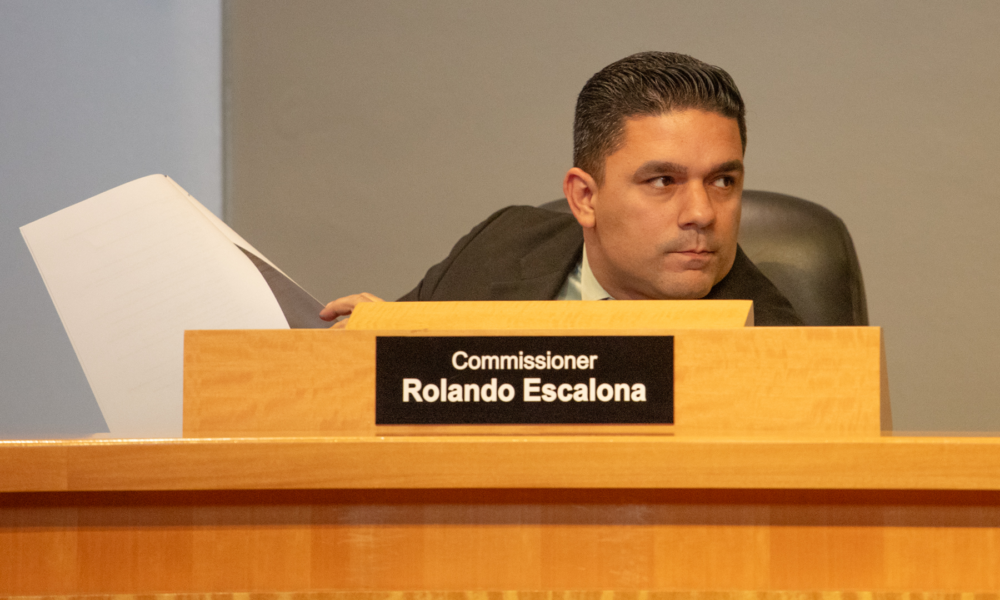


Calling City Hall’s culture “damaged,” Miami District 3 Commissioner Rolando Escalona tells the Spotlight he wants to curb undisclosed legislative changes, overhaul public-records practices, and use technology to give residents unprecedented access to government information.
Legislation aimed at preventing last-minute changes to city ordinances and zoning proposals without public notice is among a series of transparency initiatives Miami City Commissioner Rolando Escalona says he is pursuing as part of a broader effort to rebuild public trust in City Hall.
In an exclusive interview with Coconut Grove Spotlight, Escalona outlined a wide-ranging agenda that would leverage technology — including artificial intelligence tools — to make government information more accessible, expand public access to city records and meetings, and reform the city’s handling of public-records requests.
On Thursday, commissioners will vote on the latest of his proposals, a publicly accessible online archive of all city board and committee meetings.
Another Escalona initiative — approved by the City Commission in February and launched last month — allows residents to review city employee salaries through a publicly accessible online database.
Escalona described the proposals as long overdue in a city where residents have grown accustomed to limited access to information about government operations and decision-making.
“When you talk about the City of Miami, there are a lot of questions,” Escalona said. “A lot of residents don’t trust the city because of many things that happened in the past.”
Escalona is a first-term commissioner who took office in December, replacing the term-limited Joe Carollo, whose lengthy tenure in city government included a string of political controversies, lawsuits and allegations of misconduct.
Among Escalona’s proposals still under development is legislation that would limit the use of so-called substitution memos — documents that can substantially revise ordinances and resolutions after they have already been publicly advertised and scheduled for a vote.
As the Spotlight has reported, the practice, though largely out of public view, can allow substantive changes to be introduced only days or hours before commission votes, limiting the public’s ability to understand and respond to the revisions.
Read more: City Measures Often Approved with Undisclosed Changes
“Changing a word could mean a lot of things,” Escalona said. “You need time to digest what they’re changing.”
Indeed, such was the case in 2023 when the impact of a revised zoning ordinance increased dramatically after city officials changed just a few words moments before a final vote.
Read more: The WELL: How 5 Became 8
And in April, a substitution memo — never publicly disclosed before the commission vote — doubled the amount of housing density that can be transferred from affordable housing developments to market-rate projects elsewhere in Miami, vastly expanding the reach of the new law.
While Escalona did not share details of his proposal to rein in the use of substitution memos, he said significant revisions to any legislation should, as a practice, be deferred to a future commission meeting, giving residents, commissioners and other stakeholders additional time to review the changes.
“If [commissioners or city staff] want to make a change, be fair, go to the next meeting,” he said.
In the meantime, Escalona is touting his proposal — scheduled for a commission vote on June 11 — that would require the city to create a searchable online archive of city board and committee meetings
While the City Commission and some major boards already make recordings available online, many advisory boards and city entities do not. Escalona said residents should be able to easily review the discussions and decisions that shape city policy.
“I think everything should be public,” he said.
If technologically feasible, Escalona told the Spotlight, he would like the archives to be searchable, allowing users to locate discussions on specific topics without having to watch hours of meeting footage.
Escalona also outlined a series of additional transparency measures he would like the city to pursue.
Among them are online dashboards that would allow residents to track bond-funded projects and monitor the implementation status of ordinances and resolutions approved by the commission. Although some of that information is already available online, the city’s existing portals can be cumbersome to navigate and offer only a fragmented view of government activity.
As an added bonus, Escalona said, making such information publicly available online would not only increase transparency but also reduce the need for formal records requests filed under the state’s government transparency laws.
“Instead of making you file a public-records request, make it available on a website for people to go and check the information they need,” he said.
And in cases where public-records requests are necessary, Escalona said he is considering new legislation to revamp city policies and procedures to ensure requests are handled promptly and efficiently.
“There is no reason why you do a public-records request and it takes a month,” Escalona said. “That’s insane.”
Escalona, whose district encompasses parts of Little Havana, East Shenandoah, West Brickell, Silver Bluff, and The Roads, said his accountability and transparency agenda stems from a broader concern that City Hall has developed a culture many residents view as inaccessible, slow-moving and resistant to public scrutiny.
“Residents are very tired of all the shenanigans” that seems to define the “culture” of Miami, Escalona said.
Changing that culture with meaningful reform, he acknowledged, will take time, even with a new mayor and city manager who have pledged to lead the effort.
The city’s new salary portal offers one example of those challenges. While the database allows residents to review employee salaries online, it falls short of offering the full cost of staff employment, omitting overtime, bonuses, special pay, benefits, pension contributions and other forms of remuneration that can significantly increase taxpayer expense.
Read more: City Launches Salary Portal, But Key Pay Data Remains Hidden
Informed of the limitation, Escalona said he would propose expanding the portal to include additional compensation data, giving residents a more complete picture of how public dollars are spent as rising salaries and benefits threaten, in his view, to eventually “bankrupt” the city.
“I think the culture has been so damaged for so long,” he said.
Still, Escalona said he remains optimistic that greater transparency, easier access to information and stronger public accountability can help restore confidence in city government.
“I genuinely would love to change the image that people have of the City of Miami,” he said.

















These are common sense, long overdue proposals.
Ideally, all the City of Miami board meetings would be posted to YouTube, which is easily searchable and user friendly, and it’s free.
Thank you, Commissioner Escalona, for this initiative.
I hope Comm. Escalona has a long career in politics. In the last year, I’ve become a frequent speaker at commission meetings. It’s sad to see the level of frustration other speakers share in, what appears to be, a whole lot of shenanigans that benefit one class of citizens; developers! Thank you, Team Escalona.