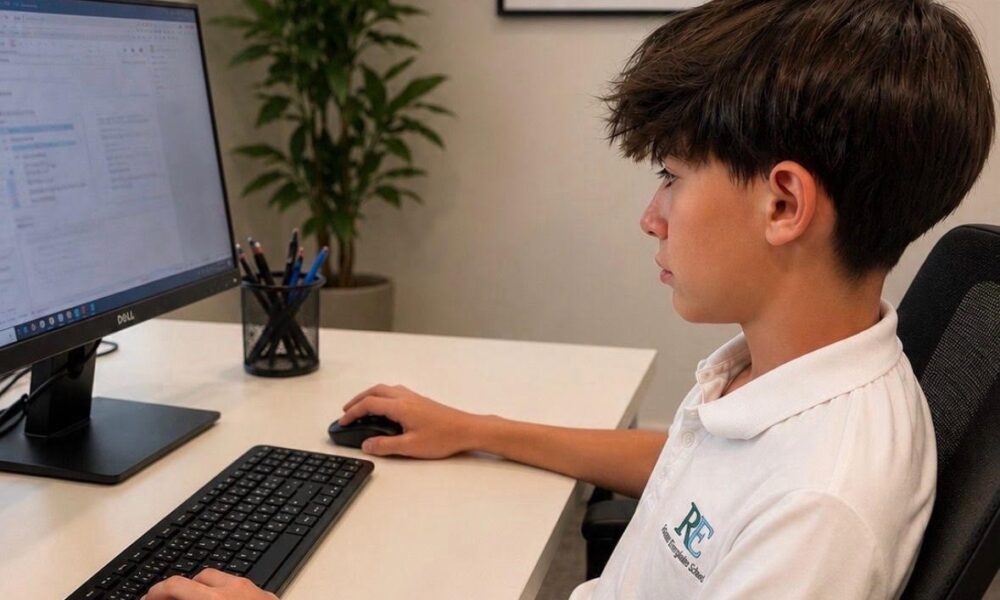

“If you can memorize lyrics to a song, you can memorize digits of pi. Just try,” says the winner of this year’s Pi Day contest at Ransom Everglades Middle School.
A hush fell over the room as the sixth grader took center stage, hundreds of digits of pi balanced entirely in his memory.
You could hear a pin drop as he stepped to the microphone in the school gymnasium at Ransom Everglades on a Friday afternoon. One wrong number would end his run instantly.
Under the pressure of shaking legs, staring classmates, and a racing mind, 12-year-old Daniel Cavalcanti de Alberquerque Rocha began reciting pi, the infinite sequence of numbers that represents the ratio of a circle’s circumference to its diameter.
Daniel focused his mind and the numbers locked into place:
3.1415926535897932384626433…
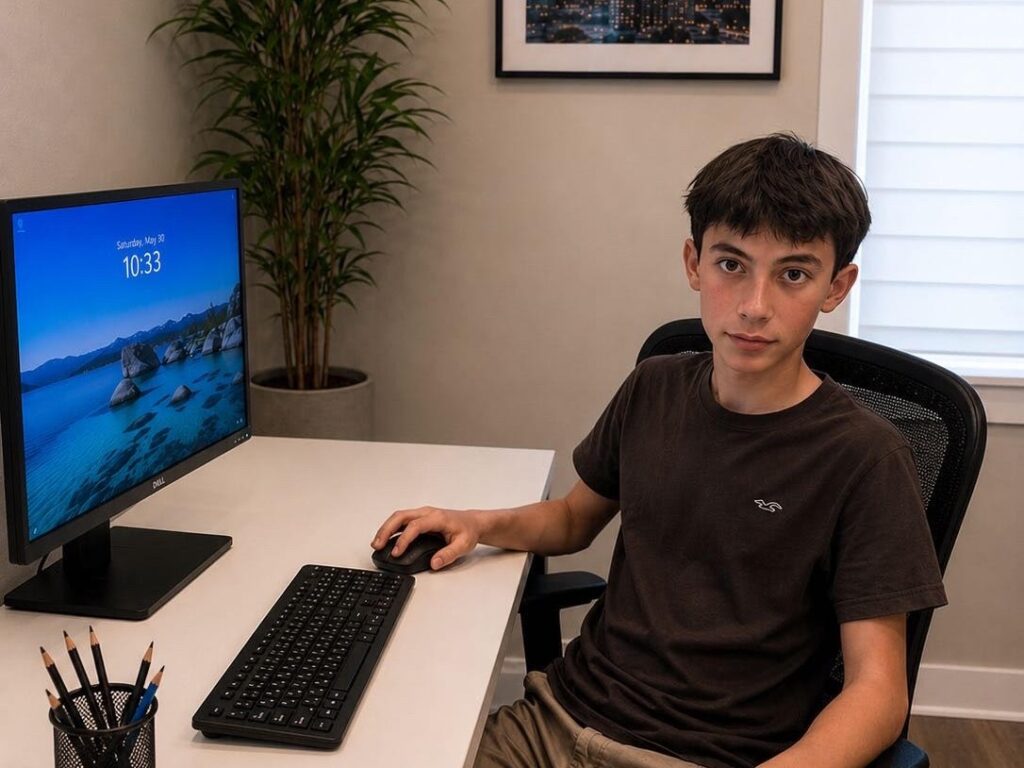
Three hundred and ninety-nine digits later, Daniel stood alone, the winner of the middle school’s Pi Day competition this past spring, and the owner of a new school record.
For many students, the middle school’s annual Pi contest is a quick lunchtime event. But for serious-minded competitors like Daniel, it becomes a test of focus, composure, and endurance.
“I was just telling myself, at all costs, don’t mess up,” he recalled in an interview.
To win this year’s contest – one of the most high-pressure academic competitions on campus – Daniel relied on music, and repetition.
His journey into the world of pi did not start in a classroom. It started at home two years ago, when he watched his older sister prepare for a Pi competition at the elementary school they both attended.
“I had never heard of it before,” he recalled. “So, I just decided to try.”
Using a YouTube channel called ASAP Science, which turns digits of pi into songs, Daniel began memorizing. He repeated the track over and over until the numbers stuck.
What began as a simple experiment quickly became something remarkable: in just three days, he memorized over 300 digits and won his elementary school competition.
By the time he arrived at Ransom Everglades as a sixth-grade student this past school year, Daniel was not starting from scratch, but the challenge was bigger.
The opportunity almost passed him by. While checking his email one night, just minutes before the sign-up deadline, he stumbled across the registration form for the Pi contest.
“I had like 10 minutes to sign up, but I did it,” he said.
From there, the competition narrowed quickly. After an initial qualifying round where students had to type 150 digits of pi with perfect accuracy, only a few students advanced. By the final round, only four contestants remained.
The format then changed, adding another layer of pressure.
The four contestants took turns, each saying one digit at a time, until only two competitors were left. Then came the final test – reciting as many digits as possible, alone, in front of the room. Daniel went second.
“When I walked in, my legs were actually shaking,” he recalled.
To stay calm, he relied on small, almost invisible habits. He tapped his foot, fidgeted with an object in his hands, and focused his gaze somewhere in the middle of the room.
But even with preparation, the pressure was real.
“There was a time where I got lost and didn’t know where we were,” he said. “I just stood there for like one or two minutes, completely nervous.”
Instead of giving up, he took a deep breath, reset, and kept going.
His strategy set him apart. While his opponent rushed through the digits, racing to finish reciting, Daniel slowed down, stayed grounded, and focused.
“I was trying to slow myself down,” he said. “If I messed up, I felt like everyone would remember it.”
Ironically, that pressure may have worked in his favor.
“I think I’m the type of person who does better under pressure,” he says.
His preparation process was simple but consistent. Repetition through music. Whether in the car or during moments of procrastination, he replayed the pi song repeatedly, stopping at random points to test himself.
“It’s more about memory than math. Pi is just a random number, it doesn’t repeat.”
Still, the process seemed to do the trick and helped him with skills to be used in his future. “It helped me remember things better,” he said. “Like what’s important for a quiz.”
Competition also played a role in pushing him further. Hearing how many digits others had memorized motivated him to keep improving.
“Hearing other people’s numbers made me want to memorize more.”
In the end, he successfully recited nearly all the digits he had prepared, finishing at 399. The final digit he missed? “Eight,” he said, without hesitation.
Despite the near-perfect performance, he’s already thinking ahead.
“Next year, I want to try for 500,” he said. “Maybe even 520.”
And for students who doubt their abilities in math or memorization, his advice is simple.
“If you can memorize lyrics to a song, you can memorize digits of pi,” he says. “Just try. It’s not like failing a test. It’s just a number.”
Lila Yale is a rising junior at Ransom Everglades School in Coconut Grove. Lila is one of two high school students who will be on assignment this summer for the Coconut Grove Spotlight. If you have story suggestions for either student, please send them to [email protected].