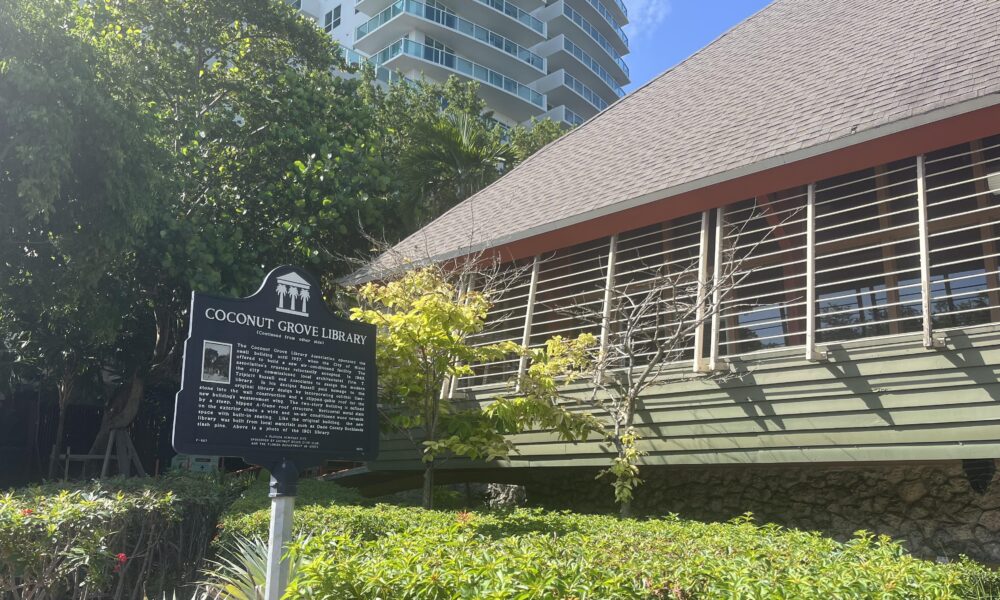



An advocate for the Miami-Dade County public library system, which include the Coconut Grove and Virrick Park branch libraries, says the proposed tax measure represents an “existential threat” to local libraries and the services they provide.
Editor’s Note: This story was first published on June 26 by WLRN Public Media. The Spotlight is re-publishing the story under a partnership agreement with WLRN.
This summer, the Florida Legislature quickly passed a major overhaul of the state’s property tax system.
The Save Our Homes from Excessive Property Taxes Act would raise the current $50,000 exemption for homesteaded properties statewide to $150,000 in 2027, and to $250,000 in 2028.
Because the shift requires an amendment to the state’s constitution, 60% of voters will have to approve the change in November for the measure to take effect.
Though the move is meant to lower the cost of living for Floridia homeowners, local governments are sounding the alarm about how this will affect the services they provide.
In a memo sent June 1, Miami-Dade County Mayor Daniella Levine Cava said the county expects a revenue shortfall of $386 million if the ballot measure passes. That number is expected to nearly double in 2028, amounting to a $696 million revenue loss.
City of Miami officials estimate the measure could cost the city $54 million in lost tax revenue a year, when fully implemented.
Because property taxes are an integral part of municipal revenue, local leaders are expecting cuts to services like libraries, transportation and public medical care.
“I’m terrified. At a library level, this threat is absolutely existential. In the first year, we’re expecting a $20 million cut just to the library system’s budget,” said Marylynne Schwartz, president of the nonprofit Friends of the Miami-Dade Public Library.
The majority of public library budgets are funded by a millage on ad valorem taxes. In Miami-Dade, this millage pays for services like free tutoring for children, internet and printing services for those without computers at home, and the existence of a free and air-conditioned space for members of the public.
READ MORE: Fact-checking claims that Florida’s property tax amendment will ‘defund’ essential public services
Schwartz tells WLRN her organization expects much of this to be on the cutting room floor if property taxes are eliminated.
“ It will absolutely result in branch closures, fewer hours, employee layoffs, programmatic cuts,” she said. “I mean, everything that the library has worked so hard to build is at jeopardy because of this referendum.”
Gov. Ron DeSantis, who pushed the bill through the Legislature, claims its goal is to reduce the cost of living in an increasingly unaffordable Florida.
“Property tax revenue collected by local governments has nearly doubled in the past seven years and is expected to reach an astounding $83 billion by 2032. Florida homeowners need relief. Now is the time to stand up for taxpayers, enact a historic reform, and save the home of every Floridian,” DeSantis said in a statement.
Maria Llorens, policy and research director for the Miami Workers Center, a tenant advocacy group, says the bill is likely to make things more unaffordable, not less, for families and individuals who rent their homes.
Local governments are likely to increase tax rates on non-homesteaded properties, and that increased tax burden will trickle down to renters.
For those looking to become homeowners in the future and benefit from the tax break, Llorens contends that the finish line will only get further away.
“Especially in urban areas like Miami, we’ve had this influx of wealthy people that has really raised property values while wages don’t really keep up and we’re not seeing the kinds of jobs that would allow people to become homeowners here,” Llorens said. “So, I think that’s a risky proposition to assume that this is just gonna get better all on its own.”
Along with increasing the state’s homestead tax exemption, the proposed constitutional amendment would also significantly limit how local governments can spend property tax revenue, restricting those tax dollars to specific categories.