


Organizers say they do not have enough time to collect the signatures needed to place the proposed City of Miami charter reforms before voters this fall.
A proposed referendum on Miami city charter reforms, including the creation of more city commission districts, does not have enough petition signatures to be placed on the November ballot this year, an organizer told the Coconut Grove Spotlight.
Marlene Erven, a director of One Grove Alliance and a petition volunteer, said there is not enough time to gather the estimated 26,000 needed signatures by July 30.
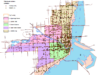
The Stronger Miami referendum, if approved by voters, would increase the number of commission districts from five to nine, ban political gerrymandering, and require regular city elections to be held on even-numbered years instead of odd ones.
So far, Stronger Miami — a coalition that includes One Grove Alliance, the ACLU of Florida, and other voting rights groups — has collected about 3,000 verified signatures from Miami voters, Erven said.
The petition drive fell short of its goal because it “got off to a late start,” she added.
“We were relying on major events to get… signatures, but now it’s summer. There are not so many people here,” explained Erven, president of the Coconut Grove Park Homeowners Association. “If we started in January, we would have made it.”
Miami voters will have a chance this November to vote on two other proposed reforms, both of which were placed on the ballot by the Miami City Commission.
One of the ballot questions, proposed by Miami District 2 Commissioner Damian Pardo, will ask voters to approve retroactive lifetime term limits for Miami elected officials.
If approved, the stricter limits would cap a politician’s maximum lifetime in office to two four-year terms as mayor and two four-year terms as commissioner.
The other question, which was part of the city’s legal settlement with the ACLU over a contested redistricting, will ask voters to prevent future gerrymandering in part by creating a citizens committee to draw the city’s district voting map.
Despite the missed deadline, Erven insisted that Stronger Miami’s proposed reforms will only be delayed, not derailed. Petition collectors are not giving up, she said.
“Whenever we reach that magic number, we’ll [get] a special election,” she said, later adding: “We will reach our goal.”
Mel Meinhardt, founder of One Grove Alliance and lead organizer of Stronger Miami, was out of town and not available for comment.
Andy Parrish, chairman of the Stronger Miami political committee, said adding more districts to Miami will make commissioners more beholden to the people they represent and more focused on actual neighborhoods.
The proposed reform, if approved, could lead to Coconut Grove having its own district. At present, Coconut Grove is within District 2, which also includes Brickell, downtown Miami, and the city’s upper eastside.
The Stronger Miami referendum would also require city elections to be held on even-numbered years, along with national and state elections, when voter turnout is higher – a move the City Commission endorsed last month when it voted to postpone the 2025 election for city mayor and two commission seats to 2026.
Parrish worries that Stronger Miami’s effort to reform city government is being overshadowed by that decision, which opponents call a “power grab” because it allows Mayor Francis Suarez and all five commissioners to remain in office for another year, without voter approval.
Another source of concern among commission critics: The term limits backed by Pardo do not count terms of less than four years, meaning Commissioner Joe Carollo, termed out from running for re-election under the city’s present charter, could still run for mayor.
“The worst government is, the more apathetic [voters] become,” Parrish said. “They have just given up. They don’t think the system can be changed. That is my take on it anyway.”
Ken Russell, a former District 2 commissioner and current mayoral candidate, said the commission’s decision to delay the 2025 election and hold future mayoral and commission contests on even years certainly “muddied the waters” for Stronger Miami.
“People think they don’t need to sign a petition that includes moving elections to even years now that the commission moved it to 2026,” Russell said.
But if commissioners can vote to shift elections to even years — even though the city charter now states that elections are held on odd-numbered years — there is nothing to stop commissioners from switching back to odd years in the future, Russell said.
“This sets a precedent where any commission can do that,” he said.
The commission’s decision to move the election is being challenged in court, however, and may not stand. A hearing in the case was held on Wednesday. Circuit Judge Valerie Manno Schurr is expected to rule shortly.
In addition, Governor Ron DeSantis and Attorney General James Uthmeier have threatened to take legal action against Miami officials who supported the move.
Pardo and fellow Commissioners Christine King and Ralph Rosado voted to postpone the 2025 election by a year, and the mayor signed the measure into law. Commissioners Miguel Angel Gabela and Carollo voted against.