

Rising costs and slower traffic have put the squeeze on local dining spots. Restaurant owners are responding with different strategies to survive leaner times.
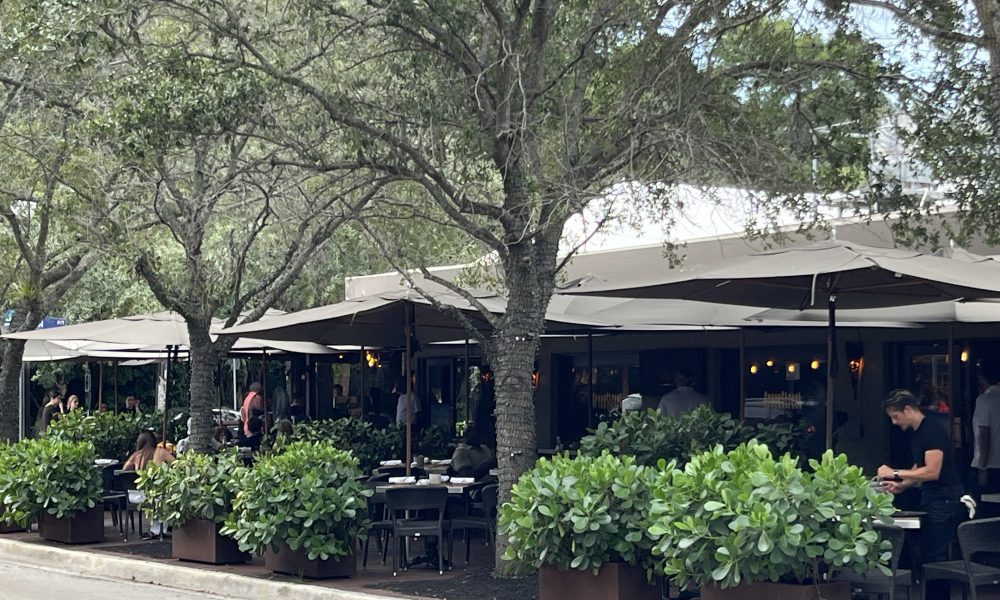
Grab your phone and search the Resy or OpenTable apps for prime dinner reservations on Saturday night in Coconut Grove and you’ll find seats at any of your favorite restaurants.
This may look like great news for diners. But it’s a clear sign that Miami restaurants are in serious trouble.
Restaurants across South Florida are closing in droves, including the Michelin starred Itamae Ao—whose chef, Nando Chang, was just named best in the South by the James Beard Foundation—which follows the earlier closure of Maty’s, his sister Val’s Beard Award–winning restaurant.
In Coconut Grove alone, the list of closures includes everything from well-funded, out-of-town restaurants like New York’s Red Farm, Portugal’s Sereia, and Toronto’s Planta Queen, to local spots like Harry’s Pizzeria, Key Club, Like Mike, El Taquito, Minty Z and Eva and its Oyster Bar in CocoWalk.

Re-development is forcing Sapore di Mare, a fixture on Grand Avenue for 11 years, to move. And the same development means The Last Carrot — open for 50 years — will have to relocate or close.
Restaurant experts predict there will be many more closures before tourists return in the fall — if they do at all.
“It’s a reckoning,” said Ben Wolkov, a local since 1997 and managing partner at Caldera Law, which represents restaurants like Sunny’s Steakhouse in Little River. “The restaurants that do well are supported by the local ecosystem.”
The challenges facing restaurants in Coconut Grove are a reflection of a wider economic reality.
The United States stands to lose $12.5 billion as international tourists stay away, according to a May 2025 economic impact report from the World Travel & Tourism Council, a global organization representing the travel and tourism industry.
Visitors from Spain, Germany, Colombia, Ecuador, and the Dominican Republic — big contributors to the South Florida economy — dropped by double figures, between 24 to 33 percent, in March 2025, year over year, according to the report.
This is especially being felt in a tourism-dependent city like Miami.
“International visitors to Miami are generally not visiting or spending as much as they did a year ago,” the Greater Miami Convention and Visitor’s Bureau concluded in a June 2025 report. Airlines have cut their summer routes from Canada and South America as demand drops, the GMCVB’s report stated.
All of this is playing out in dining rooms across Coconut Grove: fewer tourists, fewer dollars spent on local businesses, fewer locals with money to dine out at restaurants.
And fewer people in dining rooms.
“I don’t know any of my peers who are making money,” said Lokal restaurant owner Matt Kuscher, who opened his restaurant on Commodore Plaza in 2011.
Meanwhile, overhead for restaurants — rent, insurance, food and labor costs — have all gone up. The cost of some of the most common restaurant foods are up over last year: eggs 39 percent, beef 14 percent, according to the U.S. Bureau of Labor Statistics.
Kuscher estimates his insurance costs at his four restaurants (two of which are closed for renovations) top $100,000 a year, more than four times what they were before South Florida received a wave of new residents after the pandemic.
That has led to re-development around the Grove, displacing some restaurants and raising rents for others.
“I don’t believe in the Grove long term, unless you can own the property,” Kuscher said. “I’m only focusing on restaurants where I own the property. And I don’t own the property in the Grove…. I hope I’m wrong, but I’m not betting on it.”
Miguel Massens worked as head chef for Sereia, a Michelin-star Portuguese restaurant that opened an outpost on Main Highway in Coconut Grove — and closed in June after just 14 months despite overwhelming critical praise.
“Even if we would have gotten a Michelin star, I don’t think it would have given us the boost we needed,” Massens said.
Massens, who had been looking for a location to open his own restaurant, found himself in competition with out-of-town investors, who spent millions of dollars to build huge, new restaurants from scratch or took over locations whose rents had doubled.
Now we’re starting to see “a correction,” he said.
“The out-of-towners, they’re playing with fire,” Massens said.
Just months after opening in 2024, the 125-seat Sereia turned to Miami Spice, a seasonal dining deal of fixed-price lunch and dinner menus, to help fill seats.
The GMCVB program, which begins this weekend and runs through the end of September, was created in 2001 to entice local diners to return to restaurants when the economy slumped after the September 11th attacks.
Restaurants pay $1,500 to join the tourism board and be listed among Miami Spice participating restaurants. The limited menus — starting at $35 a person for lunch, $49 and $60 for dinner — help a restaurant fix their costs and cook with minimal staff.
Massens said he ran Sereia with just one other chef for three weeks last summer because of the fixed expenses of Spice.
“Spice can keep you alive,” Massens said.
But fewer restaurants in the Grove are participating. Fifteen were listed on the Spice website on Wednesday afternoon this week, including a handful of longtime independent restaurants like Michelin-starred Ariete, Bombay Darbar, and Jaguar.
Some local restaurants are trying to survive the summer their own way, without paying for the promotion.
Los Felix and Krüs Kitchen, co-owned by Josh Hackler, share a space. They have been honored by the Michelin Guide, but Hackler said they are relying on their regulars more than their reputation. They stay in touch with repeat customers through email blasts, where they offer exclusive deals to locals first.
They have planned a collaboration dinner with Nashville’s Bad Idea restaurant, offered to Chase Sapphire credit card users, joined a summer dining series through OpenTable, and are hosting bartenders for cocktail collaborations all summer long.
The result: Their profits are higher this summer than last, when they offered Miami Spice, according to Hackler. And their revenue this year is up overall.
“We’re just trying to stay relevant and atop people’s minds,” Hackler said.
While some restaurants cut expenses by laying off staff over the summer, Hackler said his restaurants kept their team intact.
Instead, they have used that time to train staff and let chef/partner Sebastian Vargas try out new dishes for the fall. The slower dining rooms allow the longtime staff to get to know regular customers better, recognize them by name and create connections.
“The idea of cutting fat in the summer and having to re-train creates a whole problem,” Hackler said. “We did what we had to do to maintain the team and weather through it.”
Two newer restaurants have taken a radical approach: offering a single menu item.
Cotoletta, which opened on Grand Avenue in October of 2024, serves only one entrée, veal parmigiana with a side of pasta.
And at their newest restaurant, 3190 on Commodore Plaza, the Si Papa lasagna is the only thing on the menu, one with meat, one vegetarian.
“We’ve carved a niche out. It’s old-fashioned specialization. We do one thing and we do it the best we can,” said co-owner Andrea Fraquelli.
Cotoletta takes only call-in reservations. Si Papa 3190, only walk-ins. And both whisk repeat diners to the front of the line for reservations.
“We call it a ‘meritocracy of repeat visits’,” he said.
People drive across the county, seeking them out, Fraquelli said. They leave the house with one dish on their minds and that’s exactly what they get.
“We serve you the food you’ve already decided you want,” he said. “We get thanked all the time for giving them no choice.”
Owning restaurants at opposite ends of the price spectrum is keeping Alvaro Perez Miranda’s restaurants in business, including the hidden Midorie in the Grove, tucked inside a courtyard off Main Highway.
At his high-end omakase counter, Ogawa in Little River, he needs to fill only 24 seats a night, at $350 a person. (“When you go buy a Rolls Royce or a Bentley, they don’t offer you a discount,” he said.) That lets him offer more accessible sushi at Midorie, where he has figured he needs to sell 70 meals a day. There, he runs specials for locals.
“I try to stay connected to my neighbors,” he said. “Your regulars are your life.”
Despite the Grove’s newer residents, the neighborhood retains a local vibe. And that’s why Raheem Sealey chose the Grove as the permanent location for his barbecue pop-up Drinking Pig, opening this fall in the same courtyard off Main Highway as Midorie.
Sealey, the original head chef at Kyu and current executive chef at Wynwood’s Shiso Asian Smokehouse, started barbecuing in front of his friend’s house in North Miami during the pandemic.
All of their business, from orders to promotion, was on Instagram. And those followers remain loyal. He recently held a Drinking Pig pop up at Shiso and sold 320 orders in less than four hours.
“The community we built on Instagram was all real. I think that’s why when we do a popup, we get such a good turnout,” Sealey said. “They’re the ones supporting us.”
Marc Chasin offered his lease spaces in the Grove to Drinking Pig and a new concept, Chuggie’s, a pared down version of Chug’s, with burgers and ice cream. He’s now a partner in both.
“There’s a little bit of fine dining fatigue,” Chasin said.
The restaurants doing well all have important things in common: smaller dining rooms, simple menus with predictable food costs, and familiar food — often at more affordable prices.
They may be the only ones left standing.















I sympathize with the struggles of the restaurants here in the grove, . My friends and I love to walk in for dinner and some wine, but when deciding where to go, we find ourselves eliminating many possibilities. Here in the Grove the restaurants blur the line between a restaurant and a nightclub. Eating out with friends is an opportunity for conversation and most restaurants have such loud music it makes conversation impossible. There are very few places that provide a nice meal along with an opportunity to talk. I know I would be eating out a lot more often if this were not the case.
I wholeheartedly agree! The whole point of going out is to have a nice conversation with a nice meal, and it is very hard to do in many of the restaurants not only in the Grove but everywhere around Miami. Prices don’t help either, everything has gone up, not to mention that a lot of restaurants “suggest” a 25% or 30% tip. If prices went up, the waiters automatically are getting more tips.
Eating out has become so expensive in Miami I really think long and hard now before going anywhere. Case in point: Mandolin. My last two visits left me dizzy with sticker shock. This a place we’ve been going to for many years but, honestly, $30 for four meatballs is something I have a hard time justifying anymore. It’s sad. I’m not sure what the solution is, but I imagine prices are not going to come down anytime soon, if ever.
Wholeheartedly agree about fine dining fatigue. I’ll definitely try Si Papa!
Also, I’m in house sitting in Italy right now and I can tell you that no one wants to travel to the US. They have lots of other options. Tradition, quality and local vibes, rather than gimmicks and glitz, are mainstays that attract people year after year. When you chase fads, you’re almost guaranteeing you’ll become irrelevant in the near future.
Interesting article on the seasonal challenge faced by Grove restaurants. I think you missed a critical component for local patrons…. parking!
My wife and I live in south Grove. When we think about going out for lunch or dinner, the sky high dining prices always give us pause but the headache of parking is usually the killer. If we go, it’s by rideshare. Until the parking situation is addressed, the locals will be a fading fantasy for regular business.
Most of the restaurants ignore the atmosphere. Dining out is about the experience as much as the food. A good experience requires a noise level that encourages conversation, and relaxing lighting. Too many restaurants have all hard surfaces resulting in a noisy reverberating clamor. Brands need to differentiate themselves, not emulate every other street café on the strip. If you do fine dining, make it memorable. If you do street café, keep it affordable. Don’t mix it together.
What the Grove neighborhood needs is more affordable, value-oriented, casual dining and a diverse selection of authentic ethnic menus (not more Cubanized cuisine). The Grove’s fine dining market is oversaturated and the food is all the same bland, tasteless fare.
The four V’s – vibe, value, variety, and valet (free) are the ingredients for success with local patrons. Owning the building makes it much easier.
I have one or two places I like. Bartaco, for one, is great. However, dining (or just eating out) in the Grove is unbearable. The noise level and atrocious music in restaurants means you can’t go out with another couple, because you can’t hear anyone on the other side of the table. Parking is so-so, I park in the large parking and walk. But, sitting on a sidewalk with pedestrians walking, cars going by, noisy and hot… then paying $100/person for that? There are 52,000 better choices in Coral Gables. Then you have what is usually mediocre to aggressive service and the now-customary 25% tip for that service. I’m sure that there are super-expensive, exclusive places where this does not happen, but for “regular joes” like me… solid pass.