

A $2 million shoreline project aims to protect Coconut Grove’s iconic bayfront from rising seas—but with no construction funds, a $465,000 design tab, and plans to remove mature palms, critics are asking: Is it worth it?
Peacock Park is set for a climate resilience makeover — but not without controversy.
The $2 million shoreline stabilization project, championed by the City of Miami’s Office of Capital Improvements (OCI), comes with a $465,000 design and permitting price tag, no confirmed construction funding, and the planned removal of a row of mature palm trees from Coconut Grove’s iconic waterfront park.
After more than two years of planning, city officials are finalizing plans for a 450-foot-long, 12-foot-wide landscaped berm to act as a natural seawall. The berm, expected to reach at least six feet in height, is pitched as a hybrid vegetated berm system—a combination of clean fill, FRP sheet piles, riprap, and native vegetation.

The system is designed to stabilize the shoreline, absorb wave energy, and support intertidal habitat, while still maintaining public access to the water, city officials say. Construction is tentatively scheduled to start in July 2026 — pending permitting and secured funding.
But to date, only Phase I of the project — design and permitting – has been fully funded, thanks to a $156,600 grant from the Florida Inland Navigation District (FIND) and $307,980 from the City of Miami.
The unfunded construction phase, Phase II of the project, is estimated at around $1.6 million. City officials say they plan to apply for additional FIND grants and seek support from the National Fish & Wildlife Foundation.
But funding uncertainty aside, not everyone is thrilled by the city’s plans, or its use of taxpayer funds. “It’s a project that doesn’t compute,” says Bill Finan, a nearby resident active in the civic group Center Grove Neighbors.
Finan questions how a $1.6 million construction project should require design and permitting fees of roughly 30 percent of that amount, or about $465,000.
Florida-based consultants Metric Engineering and Cummins Cederberg are overseeing the design.
Finan also questions the value of a six-foot berm in an area already prone to flooding and which he argues will do little to stem a storm surge during a hurricane.
“Can you tell me how that structure will withstand that kind of pressure?” Finan asks. “So what it means is that you build the thing for a million bucks, but then you’ve got to repair it x number of times in 10 years or more.”
Finan said city officials, including Miami District 2 Commissioner Damian Pardo, have largely ignored his repeated requests for details about the project, including a cost analysis.
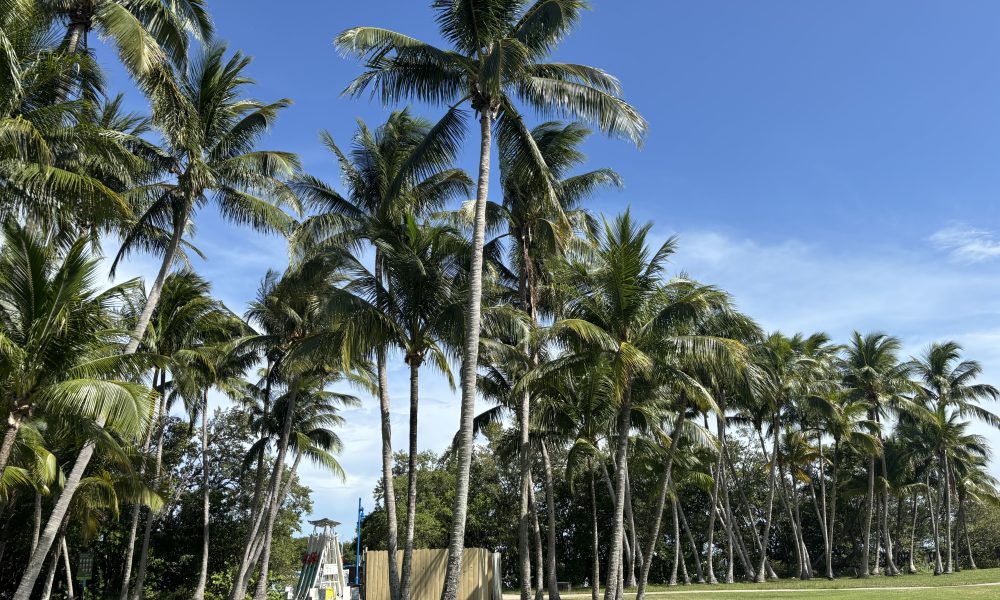
The project, Finan and others note, also comes at a cost to the park’s tree canopy. A large row of palm trees by the shoreline will be removed, and the Amy Billig Meditation Garden will be pushed back to accommodate the berm’s construction. Officials say the exact number of trees to be removed has not been determined.
“Of course we want to fight climate change,” said Kyle Lochridge, a Grove resident who opposes the tree removal and has campaigned for stronger canopy protections citywide. “But we know that trees play a huge role in flood control and cooling. Yet we keep hacking them down.”
The mangrove trees, which line the water’s edge, will remain untouched, as will an elevated boardwalk that extends into the shallow bay waters.
Peacock Park is considered especially vulnerable to sea-level rise and storm surge—with up to 15 feet of flooding possible in a major storm, according to county data. The area was identified as a critical site by the city.
In an email to the Spotlight, Patricia Pocasangre, the city’s Office of Capital Improvements outreach coordinator, defended the project, citing nearby infrastructure including schools, a fire station, a library and evacuation routes.
The Miami District 2 commission office has announced plans for a public meeting to address waterfront-related issues, including this project, in September.
More information about the City of Miami’s Peacock Park climate resilience project — including a link for public feedback — is available here.












What about this Current Study?:
Lt. Gen. Scott A. Spellmon, U.S. Army Corps of Engineers Commanding General and 55th U.S. Army Chief of Engineers, signed the Chief’s Report for the Miami-Dade Back Bay Coastal Storm Risk Management Feasibility Study Aug. 26, 2024, at USACE Headquarters in Washington, D.C.
The formal signing of the report elevates the study to the next phase of consideration for Congressional authorization and funding. The study is an $11.2 million, fully federally funded study led by USACE in partnership with the non-federal sponsor, Miami-Dade County, and in collaboration with key stakeholders and municipalities. The purpose of the study is to identify, evaluate and recommend a set of solutions for managing coastal storm surge risks to infrastructure, public health and safety.
The Chief’s Report recommends a nature-based solutions (NBS) pilot program and programmatic nonstructural studies for Congressional authorization. Cumulatively, the array of efforts will help the county advance a multiple lines of defense approach to reducing damage from future storms.
“The recommendations in this report are the culmination of years of co-design with our community resulting in an initial suite of projects our whole community can support,” said Miami-Dade Co. Mayor Daniella Levine Cava. “We look forward to continued collaboration with USACE for a broader evaluation of potential projects to reduce the risk of storm surge in our community, protect human life and safety, and prepare our residents and visitors to live more effectively with water.”
READ MORE HERE
https://www.nao.usace.army.mil/Media/News-Stories/Article/3884730/miami-dade-county-moves-closer-toward-coastal-resiliency-with-key-project-endor/
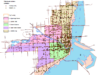
There are two studies, one that culminated in a chief’s report awaiting appropriation by Congress and one underway. Neither identify coconut grove as part of their study areas.
Given that this is not a continuous berm that ties to higher ground, the only thing that it will do is maybe reduce some wave energy during extreme storm conditions. However, if the structure is landward of the existing mangroves, the mangroves do most of that wave energy dissipation already. The fact that the length of the berm is only at peacock park is the limiting factor. Unless the sail club is planning to do something similar as part of their fortification improvements, water from storm surge, tides, and future sea level rise will just wrap around the berm turning it into an island. I’m not against a resilience project at peacock park, it just needs to be more thought out. It’s needs more coordination with adjacent properties and public input needs to be taken into consideration.
I dont trust the City to spend this money appropriately, especially now that governor’s office has ordered an audit of Miami. Lets not add to the infamous high level of Miami mismanagement, corruption and kickbacks with this project, an answer looking for a problem that does not exist. That park has been underwater during major hurricanes and is still there after the tidal surge subsides. Are we to simply continue a pattern a spending just because the money is ‘there’? This is why our nation is in deep trouble.
The city commissioner is just can’t seem to find enough projects to spend taxpayer money on you. Almost wonder if they’re getting a piece of the action from the contractors I remember hurricane Andrew and I don’t care what they build there. It’s not gonna hold up to the hurricane so it’s just a big waste of money. There’s a lot of other more important things that that money could go to rather than filling some commissioners pocket with a referral fee. !
I took the time to go to a meeting about this project. The stated intent was to create a berm that would protect peacock park from hurricane surge. A few other people in the room pointed out that it would just force the water to go around Peacock Park and into the Sailing Club and the Cloisters. My comment was that this is an important playing field for the children in Coconut Grove, and I think the money should be spent to raise the field and install proper turf. This would protect Peacock Park from storm surge, not block the view, and not impact the palm trees or the mangroves. This would finally give us a real playing field with good turf not a mud pit with weeds as we have now.