

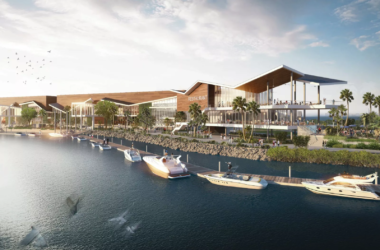
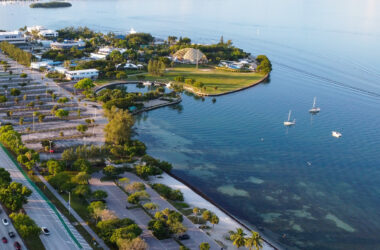
The City of Miami missed a chance last week to move forward with a plan to restore the iconic stadium on Virginia Key. It’s unclear where the plan goes from here.
Editor’s Note: This story was originally published by WLRN Public Media on Friday September 5. The Spotlight is re-publishing this story under a partnership agreement with WLRN.
Two City of Miami ballot amendments will not appear on November ballots, a major setback for plans to move forward with voting reforms and efforts to restore Miami Marine Stadium, which has been abandoned by the city for 33 years.
A special city meeting to put the items on November ballots was cancelled on Friday because not enough city commissioners showed up to City Hall. Only Commissioners Ralph Rosado and Damian Pardo were in attendance.
The main reason for the setback was a major indictment that the city had no idea existed.
The CEO of Oak View Group, the parent company of Global Spectrum LP — the company that won the bid to manage Miami Marine Stadium that voters would have been asked to approve — was indicted two months ago in an alleged bid rigging scheme in Texas.
The Department of Justice alleged that CEO Tim Leiweke rigged a bid to manage events at the Moody Center, an arena located on the campus of the University of Texas at Austin. Prosecutors alleged that he convinced another bidder to back down in return for granting the company subcontracts at the venue.
City manager Art Noriega said he was unaware of the indictment until a Miami Herald reporter emailed the city asking about it on Thursday evening.
“I didn’t know about the indictment,” said Noriega in an interview. “I wasn’t comfortable and I don’t think the electeds were comfortable moving forward right now.”
The cancellation of the meeting also impacts another ballot item that commissioners hoped to send to voters in November: a contentious plan to move city elections to even number years starting in 2032 (read more here).
‘Not comfortable with the vendor’
The Leiweke indictment was sealed and the charges were dismissed after the company paid $15 million in penalties, reported Variety.
Leiweke denied wrongdoing and was reportedly offered a non-prosecution agreement. He stepped down as CEO and transitioned into the role of vice chairman of the company. The indictment is no longer available for review on federal courts databases.
Noriega said the city is not necessarily “done” with considering Global Spectrum LP as an operator, but added that he is “not comfortable with the set of circumstances with the vendor and the continued role of the former CEO.”
“We’re just going to put it on hold for now while we continue to do some work. The hope is maybe we come up with a strategy to address some of those issues, and we come back to the commission at some point,” said Noriega.
WLRN has reached out to Oak View for comment.
The deadline for placing a ballot item on the November ballot was Friday. Noriega said realistically the two ballot items will not be considered until next year.
When Noriega announced the cancellation of the meeting, groans emanated from the small crowd gathered at City Hall. Residents have dealt with setback after setback over the course of several decades on plans to renovate Marine Stadium.
But this time was supposed to be different.
Longtime advocate Don Worth told WLRN prior to the special meeting that “this is the best news that we’ve had in the 18 years I’ve been working on this.”
Pardo pleaded with residents harboring doubts that this time things would actually get done: “I think you have to believe.”
The setback is also a major disappointment for Mayor Francis Suarez, who has spoken about moving forward with the renovation plans as an important part of the legacy he wanted to put in place before leaving office later this year. That will not be possible now.
Under the terms of the potential 40-year contract that did not go forward at the cancelled meeting, the City of Miami would receive 93% of gross sales at Marine Stadium, after deducting a $33,333 monthly management fee to the company.
The city would have also kept 85% of sponsorship revenues. The company would have been required to provide $10 million in renovation towards the restoration of Miami Marine Stadium.
Pardo previously told WLRN that details on how to finance the rest of the restoration still had to be figured out by the city, even if the contract was approved by voters.
He estimated up to $65 million might have to be borrowed by the city to pay for the renovation.
Noriega said that while the contract is pending further investigation, the city is resolved to move forward with the overarching plan and will move forward with the financial part of the equation.
“We’re going to work on that in the interim,” said Noriega.
Commissioner Joe Carollo told WLRN he could not make the meeting because it was originally scheduled for Thursday, but was changed to Friday.
“I made plans to go yesterday and changed my whole schedule, but could not do that for today,” said Carollo.
Besides that, Carollo said the numbers presented to him on Thursday about the fiscal plan for Miami Marine Stadium made him question that deal in the first place. He said the process was pushed forward too quickly, even before the news of the indictment came out.
“How in the world is the city going to vote for something without any analysis whatsoever,” he said. “What they presented to me was just numbers that they threw down with no backup.”
Commissioner Miguel Angel Gabela was on a pre-planned trip outside Miami.
The office of Commissioner Christine King said the reason she was not at the meeting is that she was feeling “under the weather.”










The Miami Marine Stadium was a treasure prior to Hurricane Andrew. Apparently the administration at that time thought they could save a few bucks by being self-insured. They never figured that a hurricane could do so much damage. Eventually FEMA came to the rescue with funds to lend a hand with repairs. It was my understanding that The City Miami decided to divert those fund elsewhere. It’s taken years of effort, aggravation, time and money for The Friends of The Miami Marine Stadium to come this far in restoring our treasure. How is it possible that The City of Miami didn’t find out about the indictment history until it was revealed by The Miami Herald? Is there anything else that The Miami Herald may help them with?