



Nearly six years after his brother’s death in a hazing tragedy at Cornell University, a high school senior at Coconut Grove’s Ransom Everglades School is turning grief into leadership — helping students learn how to step in, speak up, and save lives.
Christopher Tsialas was a few months into middle school when his older brother, Antonio Tsialas, was found dead at the bottom of a gorge in Ithaca, N.Y.
Antonio had left home just a couple months earlier, excited to begin studying at Cornell University after a rigorous athletic and academic high school career at Coconut Grove’s Ransom Everglades School.
College life seemed to treat Antonio well. That’s what his mother, Flavia Tomasello, thought after an early dinner with her son on October 24, 2019 while she visited the prestigious Ivy League campus during the annual “family weekend.”
That was the last time Flavia saw her son alive.

After dinner that evening Antonio attended a “dirty rush” – an initiation ritual for freshman students vying for coveted invitations to “pledge” at residential fraternity houses. Such events, under campus rules, are prohibited, given their reputation for excessive alcohol consumption and, at times, physical abuse.
The event Antonio attended, at the fraternity Phi Kappa Psi, was branded “Christmas in October.” Throughout the night, older students shuffled Antonio and other prospective pledges – who were prohibited from using their phones — through several holiday-themed rooms where they were encouraged to drink large amounts of alcohol.
Some students vomited, others blacked-out. What happened to Antonio is not entirely clear, but this much is known: later that evening he fell approximately 100 feet into a steep gorge about a ten-minute walk from the party, dying of blunt force trauma. His autopsy revealed he had acute alcohol intoxication at the time of the fall.
In the six years since Antonio’s death few details have emerged. Criminal charges have never been pressed. But his family has continued on.
Now a senior in high school, Christopher is helping to prevent the senseless loss of someone else’s sibling, child or classmate.
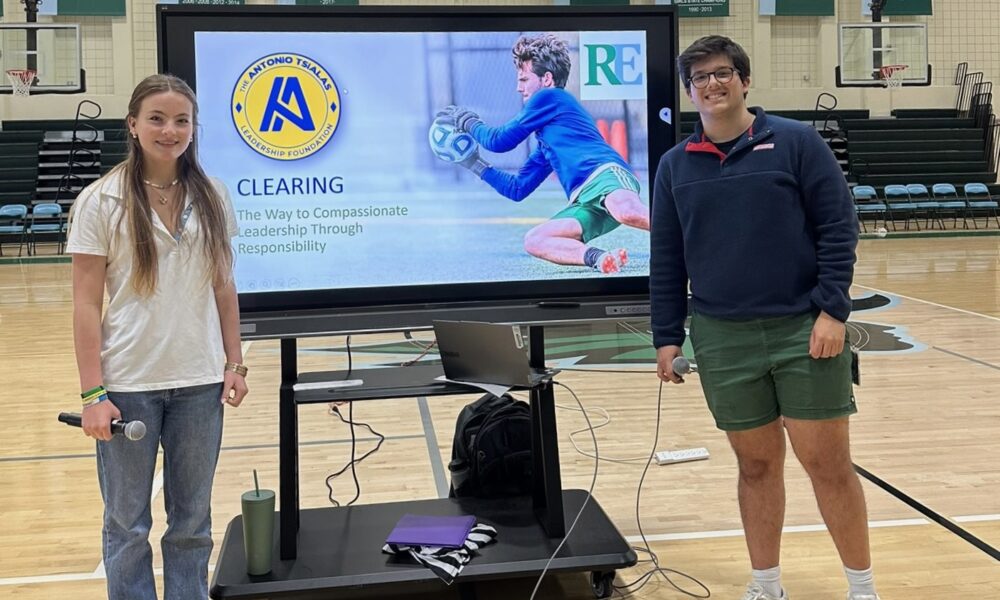
Christopher is the lead ambassador of the Antonio Tsialas Leadership Foundation’s (ATLF) Ambassador Program at Ransom Everglades School, the flagship initiative of the foundation launched by Antonio’s family a year after his death, in 2020.
The program, which has spread to 13 schools throughout the area, trains student ambassadors on the principles of “compassionate leadership,” using Antonio’s tragic story to help young people develop the skills and confidence to diffuse dangerous situations, for themselves and others around them.
At the heart of the program is this core belief: one person — stepping in and speaking up — can save a life.

“I often say that if there had been a compassionate leader with Antonio the night of his passing, he would still be here with us today,” Tomasello said.
At Ransom Everglades, Christopher and the other ATLF ambassadors lead seven workshops for the sophomore class throughout the school year, each focusing on a different pillar of leadership: collaboration, listening, empathy, action, accountability, inclusion, nurturing and gratitude. He also helps run a hazing prevention seminar for high school seniors.
“I feel like there’s a lot of grateful comments at the end [of the seminars]. A lot of people were unaware. They thought of it as something like, okay, well, I’ll deal with that when I’m in college. But they understood with what happened to Antonio, that this can happen to anyone else,” Christopher said.
Christopher’s personal experience helps shape and deliver his message. When he speaks to student groups, side conversations and phone distractions seem to fade. He can feel a shift among the audience.
“I think that vulnerability allows it to have more of an impact when we’re presenting because they understand the true effects, and they’re not just saying, ‘Oh, they’re just talking about something random.’ This actually happens,” he said.
The premise of compassionate leadership is a testament to Antonio’s character.
At Ransom Everglades, Antonio was the star goalkeeper and charismatic captain of the soccer team, part of the 2016 squad that brought the school their first and only boys soccer state championship. Among teammates he was known for coining the motivational phrase “‘till the lights go out” – a metaphor for pushing one’s self to excel until it was no longer possible.
And Antonio was a model sportsman. After every game, Antonio would cross the field to check-in and chat with the other team’s goalkeeper – win or lose.
“That was the legacy that he left at Ransom, and that’s the legacy that we’re trying to expand.” Tomasello said.
Antonio also excelled in the classroom. As a member of the math team, he often tutored Christopher, helping with math homework or a science project.
“He put others before himself,” Christopher said.
Antonio’s tragic death was felt deeply at Ransom Everglades. The following year the students dedicated their yearbook to Antonio and the school administration approved Tomasello’s plan to develop and implement a hazing-awareness program.
“This was just so tragic that the whole community came and embraced us, and I felt the love,” Tomasello said. “I just feel fortunate that Antonio went to Ransom Everglades, and Antonio was there in that community,” she said.
In addition to their leadership programs, the family sponsors two scholarships each year, at Cornell and Ransom Everglades, honoring leaders like Antonio. Tomasello also speaks at colleges and elementary schools – anywhere, she says, that wants to hear her message.
“Our intention, from the beginning, has always been to learn more, to educate others about the dangers of hazing,” Tomasello said.
The ATFL is not legislation-focused, but it did advocate for the Stop Campus Hazing Act, the first federal law to criminalize hazing, which passed Congress in December 2024. Antonio’s name is now a part of that law. It is also within the list of more than 330 people that have died as a result of hazing since 1838.
The list receives added attention each early autumn as the country recognizes National Hazing Prevention Week (NHPW), which this year runs from Sept. 22 to Sept. 26. Hosted by the Hazing Prevention Network, the week features several webinars and organized social media campaigns to spread the message.
This year’s theme, “Be the leader. Prevent hazing,” fittingly ties in with ATFL’s program philosophy.
The ATLF will be joining NHPW, presenting their work on how to push back against hazing culture over Zoom next Wednesday, Sept. 24. The event will be open to the public.
As the ATLF’s messaging expands to more schools locally and to the growing field of anti-hazing advocacy, Christopher, the last student connection Ransom Everglades has to Antonio, is filling out his college applications.
He, like hundreds of other students that have been introduced to the Compassionate Leadership Program, will carry Antonio’s story with him.