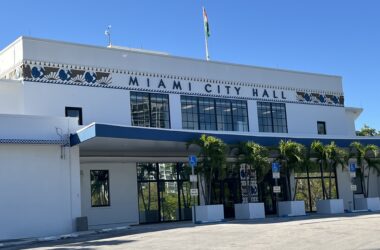
Miami’s first Cuban-born mayor is seeking to return to the office he first held 40 years ago (and replace his son Francis as Miami’s top elected official).
During a fiery debate two weeks ago between the six candidates favored to be Miami’s next mayor, the only person on the dais to have served three – almost four – terms as mayor somehow managed to avoid the fusillade.
As barbs flew over everything from campaign donations and public corruption to a failed attempt to move the city’s Nov. 4 election, Xavier Suarez stayed out of the fray. When the fighting escalated and turned to name-calling, Suarez sat mostly idle.
There were so many rebuttals – and so much crosstalk – among the candidates that it was nearly impossible to know whose turn it was to talk, or even the topic at hand.
So, an hour into the debate, when asked whether the city should pay legal bills for commissioners accused of misconduct, no one was sure if Suarez was confused or sarcastic when he asked, “Are we rebutting?” before responding to the question.
Suarez’s response was almost beside the point. But his ability to avoid the shrapnel during the rowdy debate was a telling moment for the life-long politician whose eight years as Miami’s mayor from 1985 to 1993 had been anything but quiet.
The nicknames he acquired while in office offer a window into his leadership.
Was he “Mayor Pothole,” the politician always willing to visit constituents and help fix a broken sidewalk? Or was he “Mayor Loco,” a moniker pushed on him after some of his questionable decisions made headlines?
Now, at 76, is Suarez the reserved bureaucrat he appeared to be during the debate? Or is his old outgoing – often eccentric – self bottled up inside? Some political observers were less than enthused by Suarez’s laid-back approach to the debate.
“It’s no knock on his experience or intellect, which are commendable,” said Democratic pollster and political observer Fernand Amandi. “But it seems the former (mayor) came across a little diminished. It wasn’t the towering and historic Xavier Suarez we’ve known for so many decades.”
When riots roared in Miami in the late 1980s, Suarez gained national attention by wading into an unruly crowd, climbing atop a car and demanding quiet and peace.
He never shied from small constituent gatherings, either, gaining a reputation as “Mayor Pothole.” He also found money to build schools in some of the city’s needier neighborhoods.
But Suarez also made headlines for some not-so-great moments.
He refused to meet with South African leader Nelson Mandela and tried to fire a police chief even though he didn’t have the authority.
As the city neared financial ruin, he insisted a $68 million budget gap didn’t exist.
And once, in a memorable encounter, Suarez visited the home of a woman who had sent him an angry letter, arriving late at night and without warning to ring her doorbell.
The woman armed herself against a suspected intruder, and only put down her gun after looking out her window and recognizing Suarez.
For that and other exploits, Miami Herald columnist Carl Hiaasen nicknamed Suarez “Mayor Loco.” The name stuck.
Suarez served three terms as mayor, and began to serve a fourth in 1997 after winning an election that was later overturned due to ballot fraud.
Although Suarez wasn’t implicated, 54 campaign workers were convicted on various charges. After finding that dead people and felons had voted in the election, a judge nullified the result and returned incumbent Joe Carollo to office.
Now, if Suarez wins the fourth term he was forced to give up nearly 30 years ago, the candidate says he will build more affordable housing, expand free public transportation, and most importantly, lower property taxes for homeowners.
“I want the best schools and the best law enforcement,” Suarez said recently during a lengthy interview at his favorite hangout, Berries in the Grove.
“I always wanted to change the world and make it better for everybody. At 76, I still have the ability to influence the entire citizenship of my city.”
A Crowded Field of Candidates
With 13 candidates competing to be Miami’s next mayor, November’s election is likely to end up in a December runoff. But which two contestants will make the runoff remains to be seen. No reputable independent polls have been publicly released.
It’s a stacked field. The list of candidates includes six political veterans.
Among them: Carollo, a combative and controversial former mayor and current city commissioner; Alex Diaz de la Portilla, a former state senator and city commissioner; former Miami City Manager Emilio Gonzalez; former Miami Commissioner Ken Russell; and Miami-Dade County Commissioner Eileen Higgins.
(Watch the September 30 forum featuring six of the 13 candidates here.)
Suarez, the oldest of the group, is the father of Francis Suarez, the city’s current mayor, who is term-limited.
The older Suarez openly admits his administrative skills differ from those of his son. He says his son delegates more, while he’s more of a do-it-myself micro-manager. And Francis Suarez is much quicker to trust and like someone, he said.
“Francis loves people when he wakes up in the morning,” Xavier Suarez said. “I have to have five cups of coffee before I even love myself.”
Father and son don’t always align politically, either. The younger Suarez was in favor of postponing next month’s election to 2026, which would have given him an extra year in office, while his father opposed the effort, which ultimately failed.
Suarez also told the Spotlight that fundraising has been difficult this time around. The latest campaign finance reports, filed last week, show Suarez has raised just $12,850 to date (find a complete list of candidates and their fundraising totals here.)
Miami’s First Cuban-born Mayor
Suarez, married for 48 years and the father of three daughters and a son, is a prolific, peculiar writer. He’s self-published 10 books about everything from the Big Bang theory and quantum physics to democracy in America.
He’s a graduate of Villanova University in Philadelphia who received doctorate and public policy degrees from Harvard University. He has 11 grandchildren.
He gained national attention in the 1980s when he was elected as the first Cuban-born mayor of Miami. He held the job for eight years. Today, Suarez points to his efforts to reduce ethnic tensions in the city and build more affordable housing as highlights of his three terms as mayor.
After the results of the 1997 election were overturned, Suarez went back to practicing law. He ran for a seat on the Miami-Dade County Commission in 2004 but lost to Carlos Gimenez, who is now in Congress.
Suarez ran again in 2011, after Gimenez gave up his seat to run for county mayor. Suarez won that race, and was reelected in 2016.
“I wanted to have a voice in government and an opportunity arose,” he said.
Now, Suarez is hoping to succeed his son and return to the city’s top post.
His main goal: Making Miami more affordable for police officers, teachers and other workers who have been priced out of the city’s housing market.
How he’s going to do that isn’t exactly clear. But Suarez knows what the first step should be: lower property taxes.
His initial goal is to raise the Homestead Exemption – the amount of a home’s value that is exempt from property taxes, as long as the homeowner lives in the house – from $50,722 to $500,000, something he said legislators in Tallahassee are considering.
“I love the people in my city and I think they all deserve to have a decent life,” Suarez told the Spotlight. “And I still have the time and the energy to do it.”