

With café seating spreading along a public pedestrian-only promenade in Center Grove, a looming redesign is raising questions about public access, permits and who decides how the space will be used.
On a typical ArtWalk afternoon, the pedestrian block of Fuller Street filled with painters, musicians and visitors from near and far drifting between easels and artists booths in the heart of Coconut Grove’s commercial district.
But in December, GroveHouseArtists pulled the plug on its recurring showcase of local artists along the one-block promenade, ending a small but lively arts presence on the street.
In a Facebook post, the group said it was “unable to proceed” with its monthly event because of the growing spread of outdoor café seating.
“Fuller Street has developed into an outside cafe lane and offers no possibilities for a cohesive stroll through the artists and artisans,” the post said. “We are grateful to all who participated previously and offer our thanks to The Coconut Grove Business Improvement District office for their support and efforts for the previous ArtWalks we enjoyed this year.”
The event’s demise may be the first casualty of Fuller Street’s transformation over the past five years from a narrow traffic lane with curbside parking to a de facto town square — and now increasingly to commercial space for the bars and restaurants lining the block.

“Fuller seemed like a perfect place for getting more art showcased in Coconut Grove,” GroveHouseArtists Director Trina Collins told the Coconut Grove Spotlight. “All of a sudden, everything has gotten so commercial that there really was no room.”
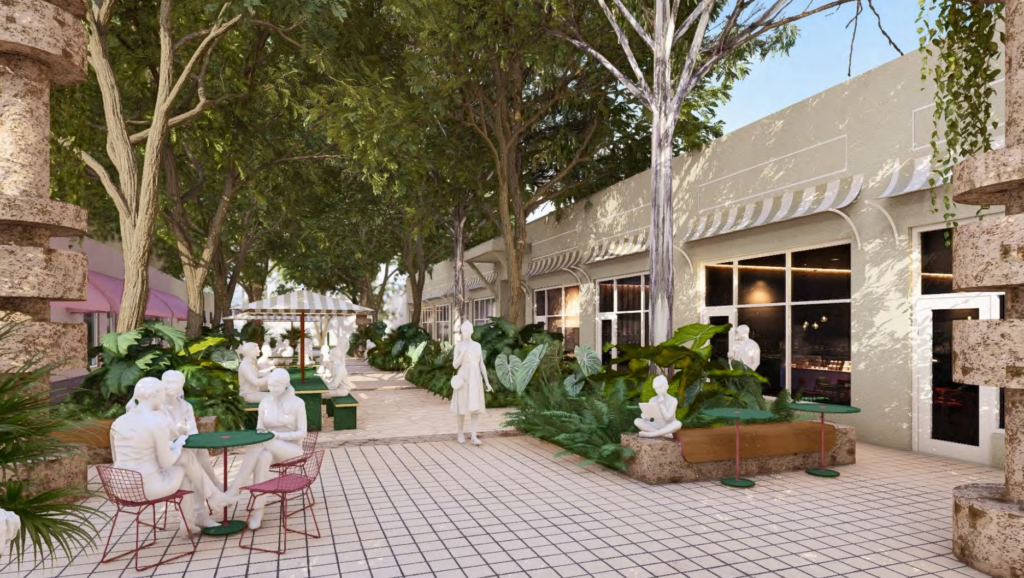
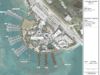
Together with Kirk Munroe Park, Fuller Street is slated for a $5 million makeover under a public–private agreement finalized earlier this year with Coral Gables-based developer Allen Morris Company.
The redesign will serve as the gateway to Ziggurat, the company’s five-story mixed-use development planned for the street’s western end, expected to break ground later this year, where luxury condos will be priced upwards of $8 million.
Allen Morris representatives and city officials will present updated renderings and gather community feedback Thursday at 6 p.m. during a meeting at Miami City Hall.
And as residents and company officials debate the look and feel of a Fuller Street makeup – landscaping, lighting, hardscape materials — one thing already seems clear: the restaurants are winning the space race, and the room for public gatherings may be shrinking.
Not everyone is thrilled.
“There should be a balance that includes public use of the street, and not just turning it into a giant, broad sidewalk with outdoor café seating,” said South Grove resident and Coconut Grove Village Council member Davey Frankel. “We have to make sure that this process truly reflects public sentiment and the public good.”
Like other residents who shared their views with the Spotlight, Frankel worries that how the space is used — not just how it looks — will have a dramatic impact on Fuller Street and could threaten its role as the village center’s informal town square.
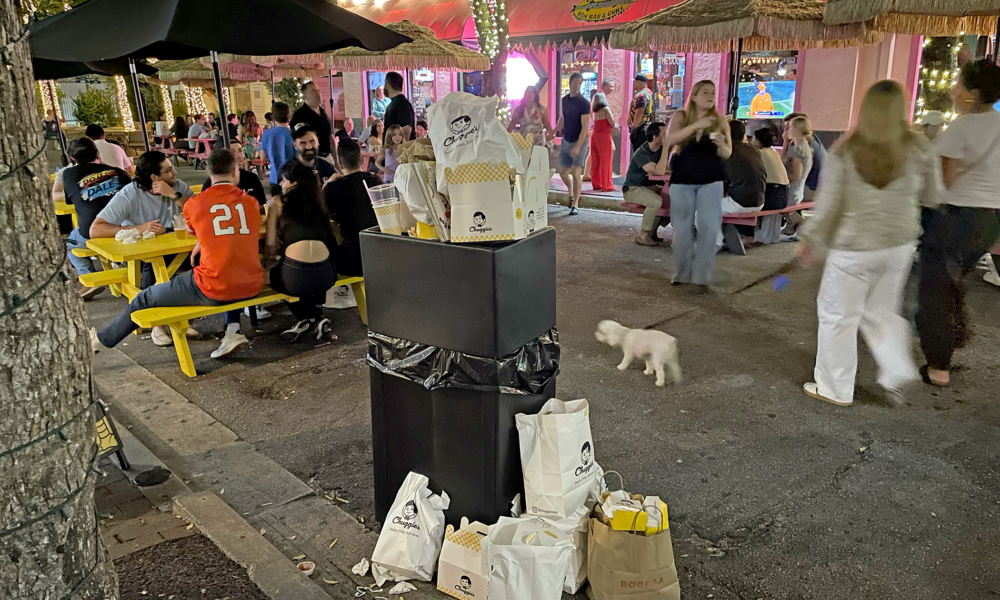
The outdoor seating squeeze on Fuller Street began last fall when two establishments — Chuggies and Grove Grocer — joined Barracuda Taphouse & Grill in securing city-issued permits to place tables and chairs outside their venues.
The city charges a permit fee of $13.50 per square foot of public space used for the seating, with permits up for renewal each September.
This year, Barracuda paid $13,156 for 572 square feet to place 12 tables and 72 chairs; Grove Grocer paid $6,210 for 270 square feet to accommodate 11 tables and 32 chairs; and Chuggies paid $2,484 for 108 square feet to have three tables and 18 chairs.
As with outdoor café fees elsewhere in the Grove, the revenue is split evenly between the city of Miami and the Coconut Grove Business Improvement District (BID).
But there are many more tables and chairs on Fuller Street, some without clear provenance.
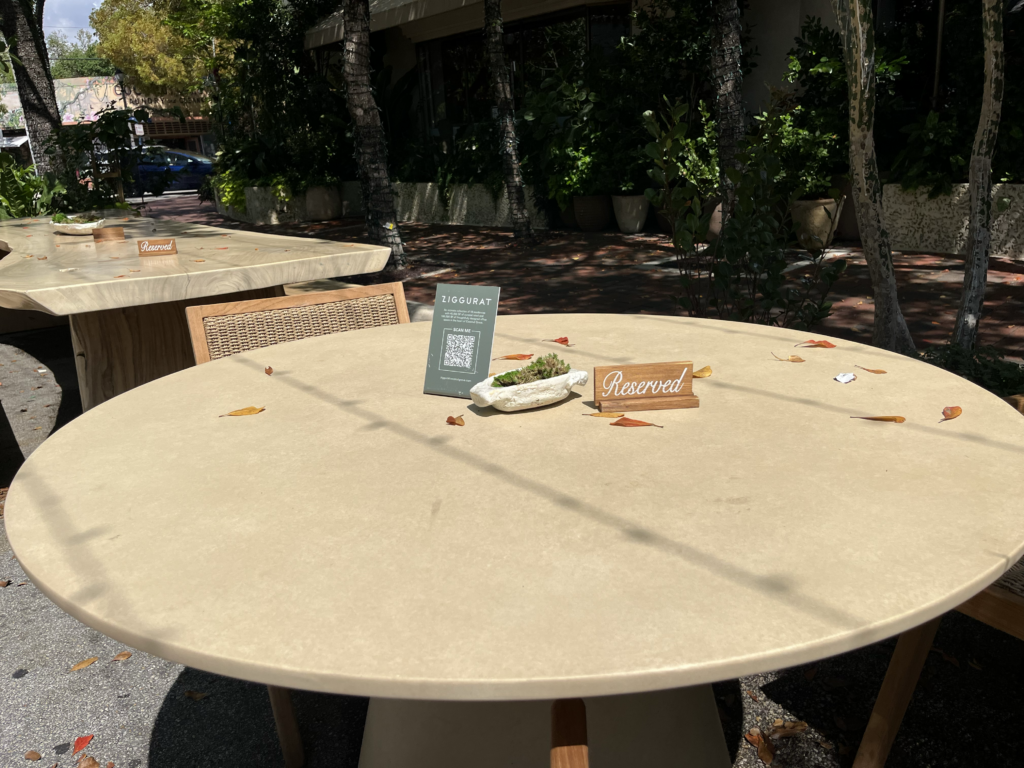
The upscale cheese and sandwich shop Chèvre, which operates from a retail space that doubles as the Ziggurat sales office, has set up a stylish cluster of hardwood tables and chairs near the intersection with Grand Avenue — each marked with a “reserved” sign, some beside a QR code for Ziggurat — for which it appears to be paying nothing.
Pressed by the Spotlight, city officials said they could find no tables permit linked to Chèvre’s address or either business, raising questions about the tables’ authorization.
Chèvre CEO Mario Naar did not respond to the Spotlight’s request for comment.
At the other end of Fuller, near Main Highway, eight picnic tables line the street, though city records show permits for only three. All linked to Chuggies.
Under city code, the tables and chairs that line Fuller Street and on sidewalks throughout the Grove are not restricted to paying customers of the establishments that provide them. Anyone can sit down, bring their own food or just linger there, free of charge.
It’s a provision rarely tested, contested or enforced, explained City of Miami Director of Resilience and Public Works Juvenal Santana. But if dining establishments are “not letting people who don’t consume sit there” and the city is made aware, Santana added, “we would address it.”
Barracuda owner Lee Kessler said he was unaware that city code explicitly requires outdoor seating to be freely open to the general public, but added that he has never taken a strictly proprietary stance toward his tables.
“If our tables are empty and someone sits down with their own lunch, I don’t see a problem,” he said. “We will ask them not to sit at the tables closest to our door.”
Barracuda staff are not always so accommodating, leading to the occasional confrontation and stinging online review. Not long ago, a Spotlight photographer was rudely told by Barracuda wait staff to vacate a table after arriving with a small group and a takeout pizza.
Whoever uses the tables, the added traffic is creating a bit of a “learning curve” for the businesses involved, Kessler said. “I don’t think it’s gotten too crowded. But there’s a little bit of a Wild Wild West going on.”
For one, Kessler added, the property owners and tenants have realized they must haul out more garbage, deal with trash that isn’t theirs and keep their zones clean even when they are technically closed.
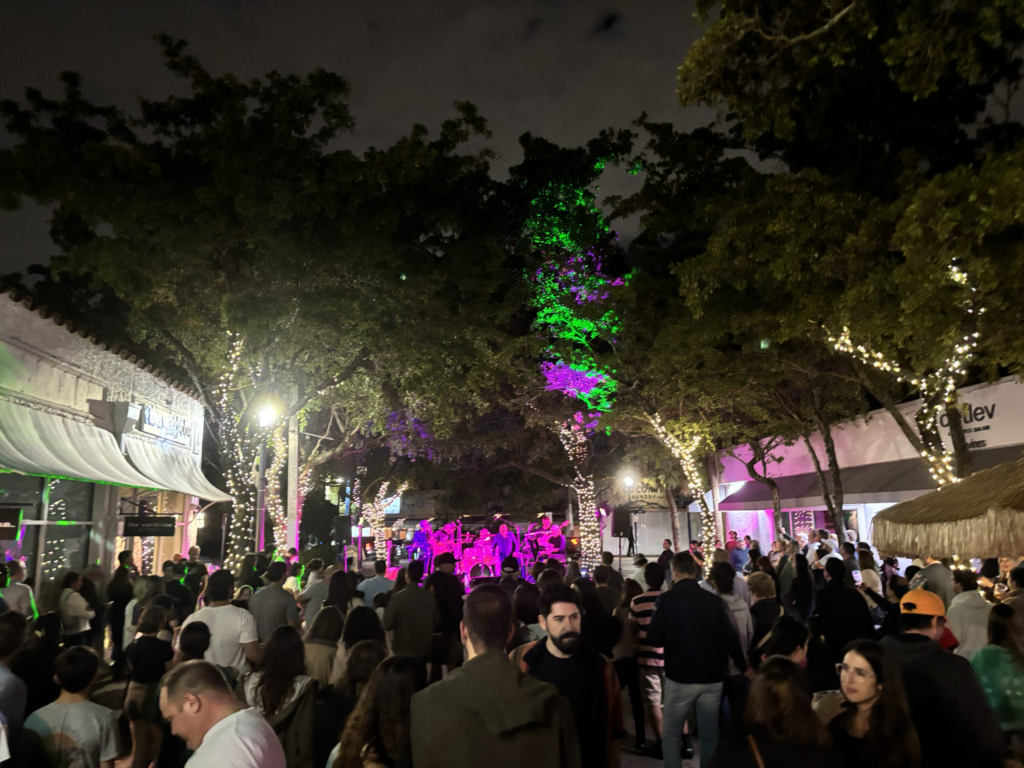
He said he was disappointed to learn the monthly ArtWalk had been canceled but believes outdoor seating and public events — such as the King Mango Strut afterparty and occasional evening block parties hosted by the BID — can coexist on Fuller Street.
“As long as they stick to their permitted area, I don’t feel like outdoor tables take up too much space,” Kessler said. “There should be some cohesiveness.”
Collins, the GroveHouseArtists director, is not so sure. “Lee [Kessler] was so friendly to us and provided tables for us to sit on,” she said “Then all of a sudden Fuller turned into a giant slew of tables. Now there’s not that much room for events because it’s just kind of hard to move.”
While the Coconut Grove BID supported the ArtWalk, its priority will always be the “businesses and restaurants” that make up its core constituency. The sidewalk café genie, Collins fears, will never go back into the bottle.
Mark Burns, the BID’s executive director, did not respond to multiple requests for comment from the Spotlight about Fuller Street
Perhaps the central unresolved question is whether Fuller’s makeover will restore a distinctly public realm or simply underwrite a tidier dining corridor.
Village Councilmember Frankel believes the renovation should incorporate maintaining the space as a town square, open to all, paying or otherwise.
“I think there can be some sort of strip of a public element that goes down the middle of the street,” he said. If they raise the street level, as suggested, “they can push the café seating right up to the windows of their establishments.” That, he argues, could preserve a “purely public use of the street.”
Allen Morris CEO Spencer Morris told the Spotlight that most of the community feedback he’s heard is that people “don’t want to see the character on Fuller Street change,” so his team eliminated elements such as a stage from the preliminary designs shown last year. And no one wants the corridor to drift toward a “Lincoln Road” model, with “cheesy out-of-town tenants” and no neighborhood identity, Morris said.
Amid the uncertainty over what a redesigned Fuller Street will look like and how it will be used, a deeper question remains: Who is actually calling the shots? Those interviewed for this article largely agreed that decisions — tables or no tables, events, open space, town square or something else entirely — would fall to an informal committee of three: the BID, the District 2 commissioner’s office and the city’s Department of Public Works.
And, for good measure, some residents added — with more than a hint of cynicism — whichever lobbyist manages to influence any of the above.
District 2 Commissioner Damian Pardo, who represents Coconut Grove tells the Spotlight that a final design is set to go before the City Commission for approval in July.
“We’ve been doing a lot of outreach the past few months,” he said. “There’s really a lot of opportunity for public input.”
While the outdoor seating configuration is unlikely to change, Pardo added, some element of public programming, through the BID, will also be part of the Fuller Street mix.
“The businesses are the ones who are most interested and they’re all supporting the project,” he said. “There’s no reason for any of that to change.”
Jenny Jacoby and David Villano contributed to this report.










Mr. Alvarado, thank you so much for including this: “Under city code, the tables and chairs that line Fuller Street and on sidewalks throughout the Grove are not restricted to paying customers of the establishments that provide them. Anyone can sit down, bring their own food or just linger there, free of charge.”
Here is the applicable section of the Miami City Code, worth printing out, just in case:
Sec. 54-229
(9) The sidewalk and/or street cafe shall be opened for use by the general public and such use shall not be restricted to patrons of the permittee.
It is the same story over and over again. Miami is only interested in the money, everything else is unimportant. Has the city of Miami said no to anything that will get them money?