
A proposed new home on one of Coconut Grove’s most historic streets goes before Miami’s preservation board Tuesday, the latest development dispute confronting Charles Avenue residents.
Residents of historic Charles Avenue have spent much of the past year fighting proposed restaurants and offices at the Coconut Grove Playhouse, construction traffic and, most recently, a temporary parking lot for workers building a new Ransom Everglades school building.
On Tuesday, another development question lands before the city: What should a new house on Charles Avenue look like?
Miami’s Historic and Environmental Preservation Board (HEPB) will consider plans for a new two-story home at 3448 Charles Ave., where city preservation officials say the proposed design does not sufficiently reflect the Bahamian and Caribbean architectural traditions that special zoning rules for the street are intended to preserve.
It will be the project’s second trip before the board.
HEPB reviewed an earlier version in June but deferred the application after board members and preservation staff raised concerns about its massing, porch, balconies, windows, shutters, roofline and other design elements. The city’s staff report described the earlier proposal as “a contemporary design with Bahamian-style ornamentation rather than an authentic Bahamian architectural expression.”
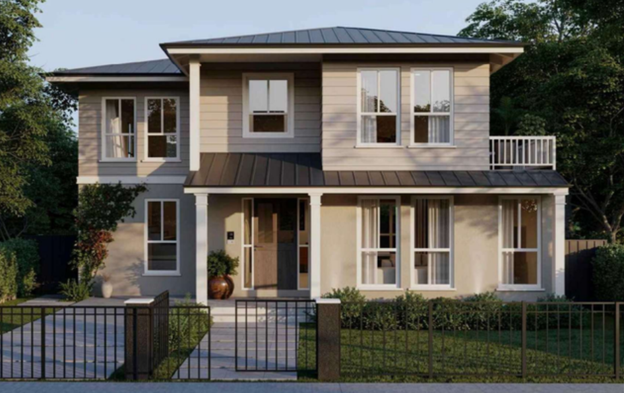
Revised plans have since been submitted on behalf of Rafael Cortez and Stephanie Conde, owners of the 5,000-square-foot lot. But the city’s Historic Preservation Office says the new version remains “substantially similar” to the original and is recommending denial.
The dispute comes at a particularly sensitive moment for residents of Charles Avenue, one of Miami’s oldest streets and a center of the Grove’s historic Black Bahamian community.
In recent months, residents have organized against several projects they say threaten the residential character of the narrow street.
Most recently, the city approved a temporary permit allowing Ransom Everglades to use two vacant Charles Avenue lots to park roughly 25 to 30 vehicles for workers building the private school’s new humanities center. The city limited the permit to 120 days, rather than the period through 2027 requested by the applicant, with any extensions contingent on feedback from neighbors.
Read more: Under Siege: Historic Charles Avenue Fights Back
The parking dispute followed a much larger fight over the redevelopment of the Coconut Grove Playhouse at the eastern end of Charles Avenue.
Residents formed Preserve the West Grove in part to push back against plans for restaurants, shops, offices and a parking garage at the playhouse site, arguing that the project could push commercial activity and traffic farther into their residential neighborhood.
Read more: Playhouse Neighbors Fear Loss of Their Community
Against that backdrop, the proposed house at 3448 Charles raises a different question — not whether development should occur, but what it should look like.
Charles Avenue is governed by special provisions of Miami’s NCD-2 Neighborhood Conservation District, including design rules specifically intended to protect the character of the historic street. The zoning overlay recognizes neighborhoods with a “defined character worthy of protection” and imposes additional regulations and design guidelines intended to preserve that character.
On Charles Avenue, those rules are particularly focused on the street’s Bahamian heritage.
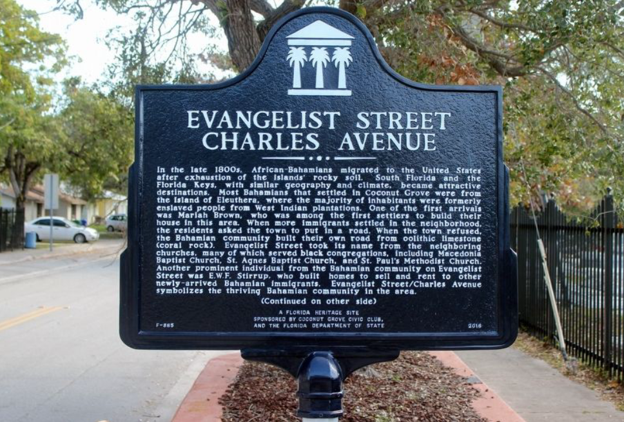
Originally known as Evangelist Street, Charles Avenue was settled by Black Bahamians beginning in the late 19th century. Families built shotgun houses and other modest homes adapted to South Florida’s climate, with features including pitched roofs, porches, sash windows and shutters.
One of the most important surviving examples is the Mariah Brown House at 3298 Charles Ave., built in 1890 for a Bahamian immigrant who was among Coconut Grove’s early settlers. Its original design included a broad front porch and windows positioned to take advantage of cross breezes.
Read more: The Long Sad History of the Mariah Brown House
The Charles Avenue design review does not focus on any single architectural feature. Instead, new construction is evaluated for compatibility with the scale, materials, roof slope, general form, massing and architectural details of the surrounding historic neighborhood. The guidelines are intended to reflect Caribbean Vernacular building traditions brought to South Florida by Black Bahamians.
That is where the proposed house has encountered resistance from preservation officials.
When the project first appeared before HEPB in June, board members urged the applicant to simplify the building’s massing, add a full-width front porch, connect a second-floor side balcony to the front façade and make other changes.
The applicant has since added a front porch and revised other features. But preservation staff says the changes do not go far enough.
The new porch, for example, is about three feet deep, which staff says is too narrow to be functional. Staff says the applicant also did not significantly reduce the building’s massing, connect the side balcony to the front façade or make several other changes recommended in June. Shutters included in the original design were eliminated rather than made functional.
Staff also remains concerned about the size and placement of windows and expanses of glass, saying they are inconsistent with traditional Caribbean Vernacular architecture. Despite the revisions, staff concluded that the current design “does not sufficiently demonstrate” the characteristics of the Charles Avenue conservation district.
The Historic Preservation Office is urging HEPB to recommend denial of the project. If the board instead recommends approval, staff is asking that a dozen conditions be imposed, including reducing the house’s massing, revising its window proportions, requiring operable hung-sash windows and functioning shutters, changing portions of the roofline and making the front porch deep enough to function as an actual porch.
For Charles Avenue residents, however, the hearing comes amid a much broader debate about whether the protections written into NCD-2 are actually preserving the character they were created to protect.
The street has seen some of its modest older houses replaced by larger and more expensive homes, including the modern white-box houses sometimes dubbed “sugar cubes.”
Anthony Vinciguerra, a Charles Avenue resident and member of Preserve the West Grove, said Tuesday’s hearing will be another test of whether the city — and the preservation board charged with reviewing new construction on the street — intends to enforce the protections already written into NCD-2.
Vinciguerra said the proposed house falls short on both its proportions and its architecture.
“It’s out of scale and size and massing,” he said. “The other question is the architecture. Does this match historic Bahamian vernacular?”
Vinciguerra said residents have watched other large contemporary homes win approval and rise along Charles Avenue despite the neighborhood conservation rules, creating precedents that developers can point to when seeking approval for subsequent projects.
“Our point is someone’s got to start enforcing the law,” he said.
Tuesday’s ruling will not be the final word. Under the special NCD-2 rules governing new construction on Charles Avenue, HEPB serves only in an advisory role, sending its recommendation to the city’s Planning director, with whom the final decision rests.
(Sinclair Holian contributed to this report.)