



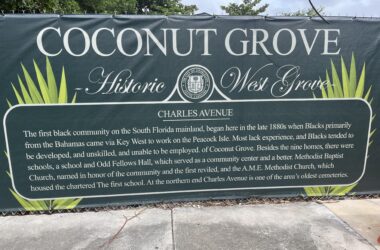

Miami-Dade County may soon approve a second large-scale development with 450 mixed-income apartments on publicly-owned land in the West Grove, within a short stroll of South Dixie Highway.
The Miami-Dade County Commission appears poised to approve a new high-rise development with 450 mixed-income apartments stretching across two city blocks of publicly-owned land on Douglas Road in Coconut Grove.
The proposed Eviva housing project would straddle a small residential street in the West Grove – Percival Avenue – with a high-rise apartment tower on one block and a smaller residential building on a second block immediately to the south.
Both buildings would back up to a residential neighborhood of single-family homes.

Judging by a project rendering provided by the county, the tower would climb 21 stories above street level, while the smaller building would top off at six stories. Integral Florida, the developer, declined to speak with the Spotlight about the project.
Eviva is the second large-scale development proposed for a short stretch of Douglas Road near South Dixie Highway. In February, the County Commission approved a 20-story tower with 345 apartments across the street from the new Aldi supermarket.
Together, the two developments will replace 89 existing homes and apartments built in 1982 and owned by the county, for a net gain of 706 new residences.
Both projects are mixed-income developments that combine market-rate apartments with subsidized housing reserved for low-income and working families.
Both projects will also take advantage of the county’s new Rapid Transit Zoning (RTZ) rules that allow developers to pack more housing into taller buildings within walking distance of Metrorail stations – in this case, the Douglas Road Metrorail station.
The new project was reviewed by the county’s housing committee on Tuesday of this week, without discussion, and forwarded with a favorable recommendation to the full commission. The full commission is expected to vote on the new project on June 3.
Miami-Dade District 7 Commissioner Raquel Regalado, whose district includes Coconut Grove, has been an advocate for RTZ zoning and a champion of the county’s housing redevelopment efforts in the West Grove. Regalado did not respond to an interview request from the Spotlight.
West Grove residents have expressed concerns about the height of the developments and the lottery system the county and its development partners will use to select tenants for the subsidized housing units.

That lottery system is open to all county residents, with no preference given to individuals or families from the West Grove, a neighborhood populated by African-Americans that is experiencing rapid gentrification and displacement.
Regalado has organized a series of community meetings to brief residents on the redevelopment effort, but none recently as the county negotiated with private developers over the size and scope of the new projects. Regalado said she wanted to wait until negotiations were complete before convening another meeting.
That has become a source of friction as well.
“The concern I have is the process,” Reynold Martin, the chairman of GRACE (Grove Rights and Community Equity) told the Spotlight this week. “You say you want community involvement, but you lock yourself in, and then you come to the community.”
If the $159-million Eviva project is approved, the county would enter into a development agreement and 99-year ground lease with Integral Florida for eight parcels of county land on Douglas Road between Oak Avenue on the south and Day Avenue on the north.
There are currently 24 two-story housing units on those eight properties, including 16 three-bedroom and eight four-bedroom homes. The county has said all current residents will have guaranteed housing in the new development.
“There will be no displacement of residents that currently live at the communities that we are redeveloping,” the county’s former housing director, Alex Ballina, said at a public presentation in September.
During Phase One of the project, Integral plans to build 300 units, more than half of which – 191 units total – will be priced to market.
The remaining 109 apartments will be priced below market, with 42 units priced for families earning 30% of area median income (AMI), six units priced at 50% AMI, 51 units priced at 120% AMI, and 10 units priced at 140% AMI.
The county’s AMI is $87,200. Half of that (50%) is $43,600, and 30% is $26,160.
Phase Two of the project will add another 150 units, of which 62 units will be priced to market. The remaining 88 apartments will be priced below market, for families earning 80% or less of area median income.
Both phases will include ground-level retail space fronting on Douglas Road. Construction is expected to begin in March 2027 and take approximately two years.
The 20-story Gallery in the Grove tower across from the Aldi market is being developed by Related Urban Development Group under a separate agreement with the county.
Altogether, the county is seeking to redevelop nine publicly-owned housing properties in the West Grove. To start the process, the county issued a request-for-proposal (RFP) in April 2023 inviting developers to compete for the right to redevelop the properties.
Related Urban and Integral Florida were chosen last fall to begin negotiations with the county for a redevelopment effort that will stretch across three blocks of Douglas Road.
The County Commission approved the Gallery in the Grove without discussion on February 19. The $148 million project is more than twice as tall as the Platform 3750 apartment building across the street.
Gallery in the Grove will replace a three-story building and 65 subsidized apartments. The new 20-story building will offer 111 apartments for seniors and 62 “workforce” units reserved for low- and moderate-income families. The remaining 172 apartments will be rented at market rates.

















20 story buildings are hugely out of scale and character with the surrounding Coconut Grove area.
The unspoken goal of the City of Miami / Miami Dade County appears to be infinite growth, regardless of the burden that places on infrastructure and degradation of quality of life for the current residents.
Spotlight May 16
I don’t quite know where to start so let’s just work our way down through this article:
1. “Both buildings would back up to a residential neighborhood of single-family homes.” Did the County ask any of these neighbors if they would mind if their one and two-story homes were now to be under the shadow of up to 21-story high-rises?
2. “Together, the two developments will replace 89 existing homes and apartments built in 1982 and owned by the county.” Were these existing homeowners ask if they’d prefer new small apartments high above the street over their old child and pet friendly street level homes?
3. “Both projects are mixed-income developments.” We shall see.
4. “The new project was reviewed by the county’s housing committee on Tuesday of this week, without discussion. ” Hmmm.
5. “West Grove residents have expressed concerns.” You betcha they have concerns as their historic community is being gentrified out of existence.
6. “That lottery system is open to all county residents.” And yet ALL of the families being displaced are existing Little Bahamas/West Grove residents.
7. “Regalado has organized a series of community meetings.” To which she sends a staffer (I’ve been to some) whose standard answer is “I’ll get back to you on that.”
8. “There will be no displacement of residents that currently live at the communities that we are redeveloping.” That is BS. Go on YouTube and watch the documentary “Razing Liberty Square.”
9. “Both phases will include ground-level retail space fronting on Douglas Road..”
The Neighborhood Conservation District 2 (NCD 2) recommends but does not require at least some consideration of Bahamian culture and taste.
10. Gallery in the Grove will replace a three-story building. If that building and the one next to it are the “Senior Living Apartments” that are well maintained, nicely landscaped and always full, well, something else may be driving this.
In summary, yes, we have an “affordable housing crisis” but as with shoes, one size never fits all. It appears to me that the County is betting primarily on high-rise apartment living for all because (a) it’s the cheapest per unit and (b) most profitable for big developers after the negotiated subsidies. But that’s the short-term answer. Long-term, history may show that more effort should have been put on low-rise, neighborhood-building alternatives. You know, with diversity and choices like at a shoe store. Read Jane Jacob’s classic “The Death and Life of Great American Cities” for starters. And always follow the money.