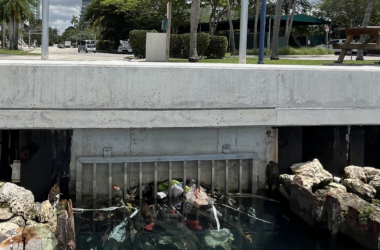

Volunteers at this month’s Derelict Trap Rodeo on Biscayne Bay removed 112 abandoned “ghost” traps from bay waters and another 782 pounds of marine debris.
Editor’s Note: This story was originally published by WLRN Public Media on July 16. The Spotlight is re-publishing this story under a partnership agreement with WLRN.
The sun shimmered over calm waters as a small Florida International University research vessel zigzagged slowly across Biscayne Bay on a hot and humid Saturday morning.
Aboard the boat, a team from FIU’s Institute of Environment scanned the horizon in search of a telltale round bob of a buoy. They peered through the shallow water looking for box-like shadows resting on the seagrass below.
Their quest: find and remove “ghost traps.”
After nearly an hour, someone finally called out: “Over there!”

Roughly ten miles east, an orange buoy with the letter “R” surfaced.
The team of five sprang up, with graduate student Nicholas Evan guiding the boat toward the discovery. With a long pole and a tug of muscle, they hauled up a barnacle-covered crab trap.
Inside, a large crab lay trapped and confused. The team gently released it back into the water before securing the derelict gear onboard — one of two traps they recovered that Saturday morning.
The FIU researchers were among a dozen boat teams and a large contingent of shoreline volunteers who participated in this month’s Derelict Trap Rodeo, a biannual environmental cleanup organized by Friends of Biscayne Bay (FOBB).
The goal was to remove derelict crab and lobster traps that continue to entrap and harm marine life long after they’ve been abandoned.
‘The problem arises when these traps are lost’
The traps are often made of heavy-duty plastic and are designed to catch crabs, lobsters, or other marine life. When they’re lost, forgotten or deliberately abandoned, they remain a danger to marine life.
“If they (the traps) are being used in a responsible way and they’re being regularly tended to by whoever the fisher happens to be, then the harm that they do is relatively minimal,” said John “Sisyphus” Ricisak, a coastal expert who is part of the Miami-Dade Department of Environment Resources Management (DERM).
“The problem arises when these traps are lost or intentionally abandoned by their owners, because the traps continue to do what they’re designed to do,” he said.
Ricisak said the material itself also poses a problem.
“Generally speaking, stone crab traps are made of high-density polyethylene plastic. Plastic is an enormous worldwide problem in the world’s oceans,” Ricisak said. “Plastic never goes away. It only breaks down, and gets smaller and smaller as it does.”
He said that while ghost traps are an issue across Florida, the scale of the problem differs depending on the region.
“Here in Miami-Dade County, it’s a big problem, but it’s a much larger problem down in Monroe County where the lobster fishery, in particular, is very large, much larger than here,” he said. “We’ve been making efforts to remove derelict traps from Biscayne Bay and off shore on the reef track, probably going on 20 years or so now.”
Friendly competition
By the early afternoon, volunteers had pulled 112 traps from the water and removed 782.6 pounds of trash from the bay and its shoreline. The traps varied in size and weight, some as much as 50 pounds while others were closer to 10.
The event was designed to be a friendly competition.
The DERM team won first place in the trap collection with 25 traps. At the shoreline, Frank Reyes, known by his nickname “Mangrove Sasquatch,” hauled in an impressive 365.8 pounds of trash on his own, earning him first place in that category.
‘All hands on deck’ to restore the Bay
Laura Reynolds, special advisor to Friends of Biscayne Bay and part of FIU’s Institute of Environment, said the rodeo is part of a broader effort to protect the bay by cleaning up the Biscayne Bay Aquatic Preserve.
“At one point the aquatic preserve was in such bad shape, we had sewage going into it, we had fish coming up with lesions, and that’s why we protected it 50 years ago,” she said.
“So, I want people to be inspired by what’s possible and what we can do today to sort of take action and that’s what our group is all about — Friends of Biscayne Bay — we work on making sure we do the best things for the bay.”
The Biscayne Bay Aquatic Preserve Management Plan, currently under review and set to be finalized in October, outlines long-term strategies to improve water quality, increase public education, reduce overuse at boat access points, and expand the removal of marine debris like ghost traps.
Once finalized, it will help guide state and local efforts to restore the bay’s ecosystem.
“Of course, we need people to try to make it stronger and better. So, all hands on deck!” said Reynolds.
To learn more about volunteer opportunities involving Biscayne Bay, visit VolunteerCleanup.org. International Coastal Cleanup day in Miami is Saturday September 20. Registration opens August 8.