Coconut Grove’s resilience projects are being put to the test this week as the seasonal king tides roll into Miami.
The highest predicted tide of the year will be rushing into Miami this week, when it is expected to raise water levels nearly two feet higher than usual.
The king tide event, which has the potential to bring flooding to some of Coconut Grove’s low-lying streets, coastal homes and parks, offers scientists a once-a-year opportunity to gauge how well South Florida is adapting to rising sea levels and increasingly intense rainfall.
This year a team of about 100 citizen scientists recruited by Florida International University will spread out across five locations, including Vizcaya Village, on Wednesday to document flooding during the annual Sea Level Solutions Day event.

“Because the king tide event is so short, so ephemeral, we can’t conduct the sampling without the support of citizen scientists,” said Tiffany Troxler, the director of the Sea Level Solutions Center at the Institute of Environment at FIU.
Armed with sample kits, volunteers will measure the reach and depth of the inland water, as well as the quality of the water itself, including the presence of bacteria, macronutrients such as phosphorus and nitrogen, and its salinity.
The data will be used to determine whether flood events are associated with pollution to Biscayne Bay and to verify computer-simulated flood predictions that provide necessary insight on where Miami infrastructure needs to be improved.
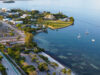
In Coconut Grove, the areas at risk of flooding stretch along most of the coast.
“There are a number of areas in Coconut Grove that are very high elevation, some of the natural highest elevation around Miami-Dade County. But they’re also a lot of low-lying areas,” Troxler said.
Water can often be seen pooling on portions of the pathway at the city’s David T. Kennedy Park and in the parking lot and sidewalks in Kenneth M. Myers Park.
During king tide events, regular flooding is intensified.
Storm drains are inundated and funnel water from the bay onto the streets — instead of the opposite — and outfalls are submerged by the high tide, making it increasingly difficult for water to drain back into the bay.
The latest period of heightened high tide began this week on Sunday and people quickly took to social media to share videos of Biscayne Bay spilling into the city.
On Monday morning at The Barnacle Historic State Park, about a foot of water had engulfed the park’s low-lying land with water stretching about 60 feet into the property, blurring the line between the bay and land completely.
On West Fairview Street, a mobile pump sucked water from a storm drain, draining it directly into the adjacent canal. The pump will remain in place through the remainder of the king tide period, according to the City of Miami Public Works Department.
In previous years, Troxler and her volunteer teams recorded a foot of king tide flooding in Kenneth Myers Park, at the Coconut Grove Sailing Club, and on East and West Fairview Street.
Many of these spots were originally submerged wetlands, but were reclaimed as Miami developed, Troxler explained. These reclaimed lands are typically expected to be the first spaces to flood.
Aaron DeMayo, chair of the city’s Climate Resilience Committee and an interdisciplinary architectural designer and urban planner, said coastal parks can act like a sponge during major flooding events, but that shouldn’t become their primary function.
“Utilizing parks for stormwater intervention is an option, but we also have to keep in mind that parks are an important societal infrastructure in themselves, so we can’t turn every park into a holding pond,” he said.
“Achieving balance means determining which parks may accommodate temporary water storage during storm events of a specific severity.”
A number of coastal resilience and drainage projects are underway in Coconut Grove to help mitigate the effects of rising tides and major rain events.
The city is currently finalizing plans on a $2 million Peacock Park shoreline stabilization project and just began construction on a $1.1 million stormwater drainage system upgrade on Glencoe Street, and surrounding streets. And on McFarlane Road, a county-led project installing new drainage structures is currently underway.
Monitoring the effectiveness of these projects is an important part of Troxler’s work.
“The sampling is not only about where the flooding is, but where it isn’t, and why, and (whether) our adaptation measures (are) helping to improve those conditions,” she said.
An East and West Fairview Street project appears to be one of those success stories.
A major $12.4 million investment is overhauling the area’s entire drainage system and installing a new stormwater pump. Pumps like these are needed especially during king tides to help alleviate the pressure on the gravity-dependent drain system. Phase One of the project was completed in 2020 and Phase Two is expected to wrap up in 2027.
Since the project began, seasonal flooding — up to a foot high in the past — has not been as bad, Troxler reported.
Yet another project is in the works, just a few blocks from the Fairview and Glencoe initiatives.
DeMayo and his firm, Future Vision Studios are redesigning a sliver of empty land on South Bayshore Lane between Vista Court and Crystal Court with a landscaped berm to act as a vertical barrier between the bay and the rest of the neighborhood.
“That area has low elevation, making it more susceptible to flooding from storm surge without additional comprehensive interventions,” DeMayo said.
The project is awaiting funding from the city to proceed with construction.
With a 4-inch rise in sea levels since 1994 and a two-foot rise expected in the next 30 years, the seasonal king tide offers a glimpse into what’s in store for South Florida.
“Maybe not the one we see this year, but king tide events that we have seen (in the past) are what the new normal looks like in the future,” Troxler said. “And then think about the king tide on top of that.”
The Sea Level Solutions event allows volunteers to experience this predicted future first-hand, with many volunteers having a “wow, this is happening” reaction as they watch the sea level rise in real time, Troxler said.
This year’s event will be held on Wednesday October 8 at Vizcaya Village from 8:45 a.m. to noon. While this is the predicted highest tide of the year, king tide events will continue through the first week of December, with another peak tide period anticipated for the week of November 2.