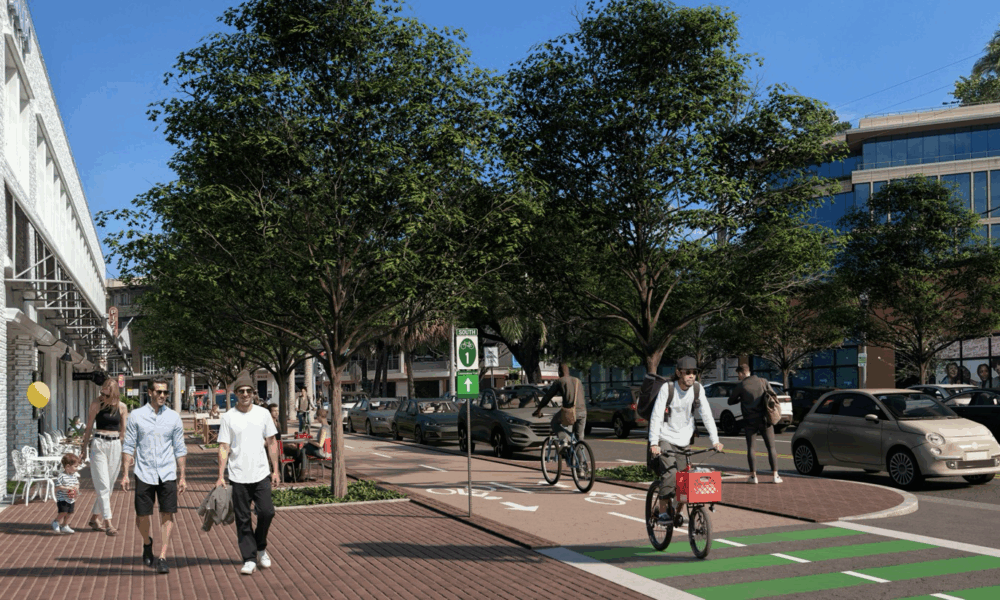



Miami once promised a safer, bike-friendly Grove. Seventeen years later, another master plan arrives — but will anything actually change this time?
Editor’s note: Hank Sanchez-Resnik is president of Bike Coconut Grove, co-founder of Friends of the Commodore Trail, and a member of the county’s Bicycle Pedestrian Advisory Committee. He was a leader of the group that advocated for the City of Miami’s first bicycle plan, adopted in 2009. He wrote this Community Voices piece for the Spotlight.
Is Miami ready to become a city where walking and bicycling — especially bicycling —are safe and convenient ways to move around?
We may get an answer to that question on Jan. 22, 2026. That’s when the Miami City Commission will consider a new Bicycle Master Plan.
A massive draft of the plan (254 pages), the first since the city’s existing bicycle plan was adopted in 2009, came before the City Commission on Nov. 20, 2025. It was deferred to get more community input.
People often say they’ve moved to Coconut Grove because it’s so walkable and bike-friendly. Yet others worry that even in the Grove, biking and walking are increasingly dangerous. The new plan may offer hope that bicycling in the Grove will be a priority. If that happens, it will be good for pedestrians, too. Traffic will be calmer, and there will be less of it. That’s a basic element of a bicycle-friendly community.
The new plan was a long time coming. Prior to 2009, Miami had no bicycle plan. Cities that prioritize bicycling usually update their plans on a regular basis. Common practice is to do that every five years. Assuming Miami’s new plan is adopted in January, it will be 17 years since the city last took a careful look at bicycle planning.
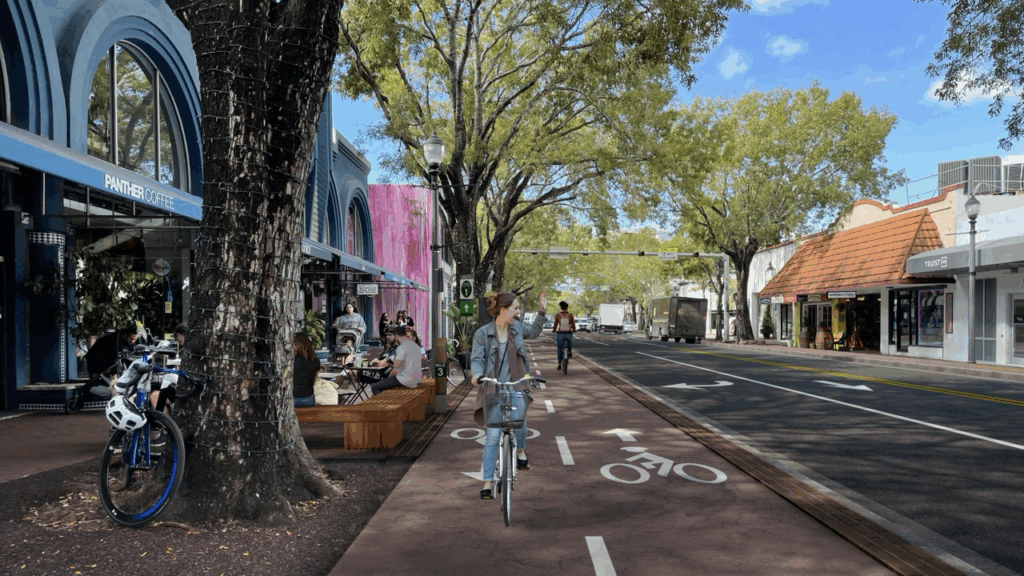
For Miami, the challenges are significant. The region evolved as a place where cars have priority over every other form of transportation. Now, with Miami’s recent explosive growth, traffic is one of its most serious problems. The need for alternatives to single-occupancy motor vehicles as the transportation default is increasingly urgent.
Many U.S. cities, faced with the same challenges as Miami’s, have embraced bicycling as a logical option. But for Miami, it’s not a natural or easy choice. The local culture is still heavily car-centric. Despite the county’s efforts to remedy the situation, public transit is still woefully inadequate. Something has to give, and clear priorities must be defined. Otherwise, we’ll have chaos. Many believe we have chaos already.
Critics say the revised bicycle master plan does not do enough to address the current challenges. Nor does it go far enough, they say, in helping local decisionmakers with tough choices.
On the plus side, the plan is comprehensive and detailed. It documents virtually every improvement Miami has undertaken to improve conditions for bicycling (and, to some extent, walking) since the adoption of the 2009 plan. It provides templates for bicycle-priority routes, roadway treatments that allow more room for cyclists, and illustrations of a variety of infrastructure options that promote bicycling.
The plan also offers a priority ranking system for bicycling projects. It contains a list of 249 projects rated on a set of criteria that include safety (number of bicycle crashes), population density, employment density, income, key destinations such as parks and schools, connectivity with transit, and city and county capital improvement schedules.
Despite the plan’s huge amount of information, or, perhaps because of it, critics agree its major problem is a lack of focus.
“It’s not a perfect plan, but it has been too long without an update. Miami is one of the most unsafe places to bicycle in the country,” says Cathy Dos Santos, executive director of Transit Alliance Miami, a respected nonprofit that has led efforts to improve mobility in Miami and reduce dependence on private automobiles.
At the Nov. 20 City Commission meeting, Dos Santos urged the commission to include an amendment prescribing specific next steps within the next six months, and ultimately the next five years, to ensure the plan will be implemented. Rather than adopt such an amendment, the City Commission opted for more public input.
Exactly how and when that input will be gathered and incorporated into a resolution to adopt the plan on January 22 is not yet known.
What is known, and what has been obvious for decades, is that the process of improving the city’s bicycling and transportation infrastructure is extremely complex.
For starters, Miami’s important streets are governed by both the City of Miami and Miami-Dade County — or, in key places, the county alone. In Coconut Grove, South Bayshore Drive, Main Highway, 32nd Avenue, 37th Avenue, 42nd Avenue, Ingraham Highway, and Grand Avenue, among others, are under county control.
If and when the city and county agree to work together on projects, careful coordination and collaboration are required. Yet for Miami’s huge bureaucracies, that’s not standard procedure.
Even when the governing agencies agree to work together, predictable delays are the rule. For more than a decade, a multimillion-dollar project to rebuild 1.5 miles of South Bayshore Drive, including improvements for cyclists, has languished.
When work on the project finally begins, it will take the better part of a year, and traffic on the busy street will be much worse than it is already. For those responsible, delaying the much-needed project is a great deal easier than confronting its challenges.
Just a cursory comparison of the 2025 plan with the 2009 plan reveals important weaknesses in the one before us now.
The 2009 plan lays out a multiphase program for adding projects to the citywide bicycle network at five-year intervals, culminating in a fully built-out bike route network by 2030. Now, five years away from that goal, very few of the projects have been implemented.
In Coconut Grove, completed projects from the 2009 plan include the bike lanes on Bird Avenue and 27th Avenue. Others that are still a long way off are a bike boulevard (bicycle-priority street) on Shipping Avenue, repairs to key segments of the Commodore Trail, and the South Bayshore Drive rebuild.
In contrast to the 2009 plan, the 2025 plan offers an exhaustive list of projects but leaves to others the hard choices about how and when to get them done.
Once the 2025 Bicycle Master Plan is adopted, what actions will city decision-makers take to prioritize bicycling projects, according to what timeline, and with what funding in these financially tight times?
The new plan scarcely begins to answer those questions. For bicycling in Miami, it’s likely to be a hard road ahead.