





Sixteen years after Miami adopted its first Bicycle Master Plan, safer streets for cyclists remain more promise than reality. As the city weighs a long-delayed update, a glaring omission — how to handle e-bikes — exposes the growing gap between policy and the dangerous realities on the ground.
Editor’s note: Hank Sanchez-Resnik is president of Bike Coconut Grove, co-founder of Friends of the Commodore Trail, and a member of the county’s Bicycle Pedestrian Advisory Committee. He was a leader of the group that advocated for the City of Miami’s first bicycle plan, adopted in 2009. He wrote this Community Voices piece for the Spotlight.
When my wife and I moved to Miami from Berkeley, Calif., in 2005, I thought it was for an experimental visit. One thing led to another and here we are, firmly ensconced in Coconut Grove, 21 years later.
For decades, beginning in New York City, I’ve been a strong advocate for safe urban bicycling. When we arrived in Miami, I considered giving up bicycling completely. Everywhere I went, people told me they were terrified of biking. The statistics justify their fears: South Florida is one of the most dangerous places in the country for bicyclists (and pedestrians).
I and many others in Miami were determined to change that. We conferred with community leaders and elected officials. We went to a lot of boring meetings. Finally, we convinced the City of Miami to adopt its first ever bicycle master plan, which was passed by the City Commission in September 2009. Bicycling Magazine later identified Miami as one of the most promising cities in the country for bicycling.
My bike remains my primary means of transportation, and Miami still has a lot of promise for safe cycling. But it’s a promise that, so far, remains unfulfilled. Now e-bikes are on the scene, making everything else a lot more complicated.
Sixteen years after the adoption of Miami’s bike plan, a new Bicycle Master Plan came before the City Commission in November 2025. It was deferred to the January 22 meeting in order to get more community input. It’s been deferred again to March. It has a lot of problems.
A main shortcoming is its lack of focus that would help policymakers identify projects that merit attention now, not years from now. To remedy that, local bicycling advocates have developed criteria for 10 high-priority projects that could — and should — be completed in the next five years. We’ve also called for a commitment from the City of Miami to update the plan every five years.
After the adoption of the 2009 bike plan, the city supported a staff bicycle-pedestrian planner position. Eventually, that position morphed into something else. Today, the closest Miami gets to a full-time staff member for bicycling is a “Transportation Planner” who’s responsible for multiple projects, among which the Bicycle Master Plan is just one.
A much more serious problem: The updated Bicycle Master Plan is out of sync with the evolving realities of urban bicycling. A lot more people are riding bicycles in Miami than in 2009, and, as a result of Miami’s relentless overdevelopment without infrastructure to support it, a lot more motor vehicle traffic is clogging our roadways.
The idea that our streets are for cars only is antiquated. Miami’s traffic congestion, among the worst of any city in the U.S., is testament to that. Miami will never have enough street space for all the cars competing for it. In addition to better mass transit, Miami needs to make space for “micromobility”—bicycles, scooters, and, yes, e-bikes.
In 2009, e-bikes scarcely existed. Now they’re everywhere, and concern about them has become part of a national debate.
Just weeks ago, an elderly Miami couple who live on Grove Isle were struck by an e-bike driven by a 15-year-old while walking on the Commodore Trail on their way into Kennedy Park. They were hospitalized for three weeks and will need four months for a full recovery. Previously, in Key Biscayne, a teenager on an e-bike collided with, and killed, an elderly woman on a pedal bike. Another teenager on an e-bike crashed into a middle-aged male bicyclist on the Rickenbacker Causeway, resulting in the man’s death.
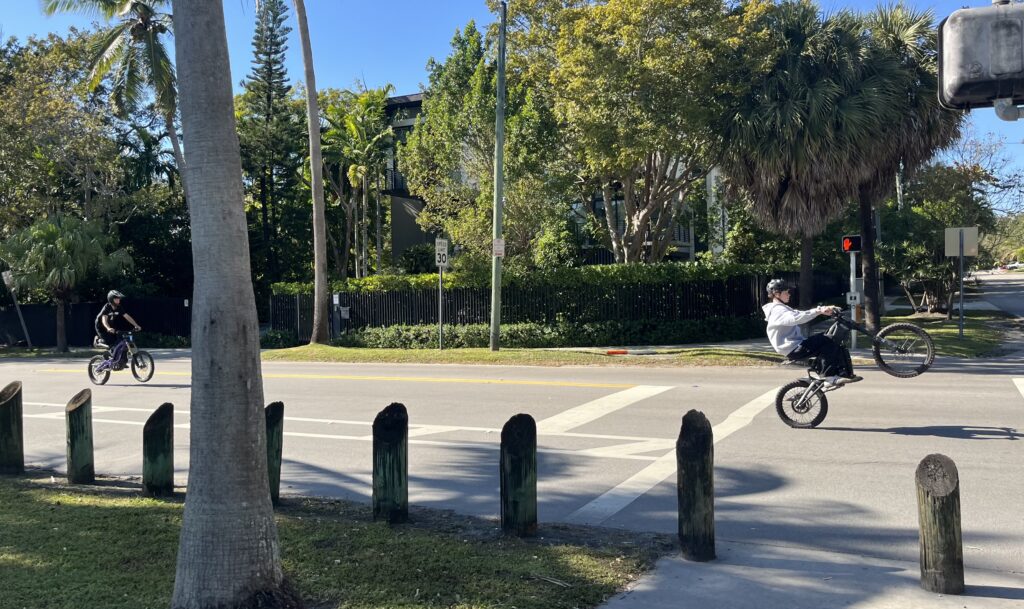
A key issue is how e-bikes are defined and how to deal with the different e-bike categories. The Coconut Grove and Rickenbacker incidents involved electric dirt bikes, which are much heavier, faster, and potentially more dangerous than bicycles with electric motors.
Policymakers everywhere are grappling with legislation that will take the different kinds of e-bikes into account and establish rules about which types are allowed on which kinds of streets or off-road paths, what the speed limits should be, and what rules should govern licenses, helmets, and age limits for e-bikes.
A consensus on these issues is beginning to emerge, but we’re still in the early stages of incorporating e-bikes into the overall bicycling and transportation mix. A key criterion is the power of the engine. E-bikes are generally defined as having motors below 750 watts of power. According to the Miami Police Department, the “dirt bike” that hit the couple on the Commodore Trail “is rated at 750W and had no pedals so…is not legal on our streets.”
What does the updated Bicycle Master Plan say about e-bikes? Not a word. When asked about that, Collin Worth, the city’s transportation planner, commented in an email that “By Florida statute, e-bikes are bikes.” In other words, according to Florida law, e-bikes are the equal of regular pedal-driven bicycles. But, clearly, they are not.
Worth also replied to the question about e-bikes with, “Do you have something in particular you would like to see?”
How about, for starters, an entire section of the updated plan on e-bikes, with some innovative ideas about ways Miami might address the issue? It will take time to develop that, but the City Commission could require an addendum to the Bicycle Master Plan with a strong and realistic e-bike chapter, and then adopt it when it’s ready.
In the meantime, the world around Miami is buzzing with concern about e-bikes. Other cities have adopted e-bike legislation, and a new e-bike bill is being reviewed in Tallahassee. E-bikes are here to stay, and they’re a distant, dangerous cousin of pedal bikes.
There’s still time for public input to the updated bike plan. For a web page devoted to the plan, click here. The page has several components, including both the existing plan and the proposed new plan, a community survey about bicycling, and an interactive ArcGIS map where users can pinpoint locations that need improvement and then add their comments and suggestions.
It’s not too late to get involved in promoting bicycle safety in the City of Miami. It will never be too late for that. But Miami should make it a major priority — and include e-bike-related safety in the discussion.


















“Miami’s updated Bicycle Master Plan does not address e-bikes or electric dirt bikes, despite growing concern among bicycling advocates about their speed, weight and use on city streets, such as this electric dirt bike on South Bayshore Drive.”
I am not sure that the City of Miami can regulate e-bikes or electric dirt bikes on South Bayshore Drive. Section 316.20655(1) of the Florida Statutes does allow counties and cities to adopt an Ordinance governing the operation of electric bicycles on county or city streets. The State bills addressing electric bicycles in the current legislative session wouldn’t affect this provision.
I would think that since South Bayshore Drive is a County road, perhaps only the County can adopt an Ordinance addressing e-bikes and electric dirt bikes on South Bayshore Drive. The Interlocal Agreement adopted in May, 2025 between Miami-Dade County and the City of Miami allows for specific traffic calming measures to be adopted by the City of Miami. Perhaps there needs to be an Interlocal Agreement between Miami-Dade County and the City of Miami that would allow the City of Miami to adopt an e-bike and electric dirt bike Ordinance on county roads that is more restrictive than the State law.
I should add that my understanding from a Key Biscayne Commissioner is that Key Biscayne tried to regulate e-bikes on Crandon Boulevard, but was precluded from doing so because Crandon Boulevard is a County road.
Florida House Bill 243 and Florida Senate Bill 382 have both unanimously passed 3 committees and are awaiting House and Senate Floor approval. The summary of these companion bills provide that:
“…a person operating an electric bicycle on a shared pathway that is not located adjacent to a roadway, including a shared pathway located in a park or recreational area, shall yield to pedestrians and shall give an audible signal when overtaking and passing a pedestrian. Any person operating an electric bicycle on a sidewalk or any other area designated for pedestrian use may not operate the electric bicycle at a speed greater than 10 miles per hour if a pedestrian is within 50 feet of the electric bicycle.”
It seems to me that the City of Miami could adopt an Ordinance providing more restrictive electric bicycle rules on the Main Highway and Kennedy Park bicycle/running/walking paths since these are under the jurisdiction of the City. Whether an electric bicycle could balance at a speed lower than 10 mph is an issue raised by a fellow neighbor. Another fellow neighbor indicated that studies show that a collision involving an electric bicycle traveling at 10 mph can cause traumatic injury. Public input on an updated Bicycle Master Plan, as Hank has suggested, will be most helpful in developing recommendations for City of Miami electric bicycle rules on shared pathways that are within its jurisdiction. Such comments will also be useful in developing recommendations regarding electric bicycles on County owned roads within the City of Miami.
I want to begin by stating that I strongly support safe bicycle infrastructure where it is truly needed—particularly on causeways, bridges, and in areas where cyclists have no reasonable alternatives. I also support the goals of the City of Miami’s 2025 Updated Bicycle Plan, especially its emphasis on safety, connectivity, and reducing serious injuries.
My concern is that the Plan appears to prioritize bicycle facilities on high-volume county collector and arterial roads. Miami already has a dense street grid with many parallel, lower-traffic routes that cyclists routinely and safely use for both east–west and north–south travel. This Plan emphasizes a low-stress bicycle network, yet concentrating bike lanes on congested commercial corridors seems inconsistent with that objective.
Routing bicycle traffic onto busy arterials while diverting automobile traffic into residential streets raises serious concerns about safety, noise, and neighborhood livability. These trade-offs warrant careful, corridor-specific analysis of crash data, vehicle speeds, turning conflicts, loading zones, and emergency access. To date, public materials have relied largely on low-resolution maps, without clearly presenting the supporting data.
I am also concerned that the Plan does not adequately address the growing presence of e-bikes and e-scooters. These devices travel faster and accelerate more quickly than traditional bicycles, which changes how bike lanes function—especially on narrow, curbside lanes shared with pedestrians, buses, and commercial activity. Without adequate width, separation, and design guidance, mixing conventional bikes, e-bikes, and scooters on major arterials may increase conflicts rather than improve safety.
Easy and cost-effective alternatives deserve more attention.
I used to ride my bike a lot. Never mind the e-bikes, there is a huge problem with cops parking in the bike path, trucks parking in the bike path, FPL trucks parking in the bike path. On top of that, it seems that some drivers actually try to hit you when passing you if you are on the road.
But then you have the opposite thing: groups of cyclists hogging the ONE lane going into the Grove at 12 mph and delaying traffic.
Cycling has become an aggressive, contact sport. Not fun anymore.