

A robust crowd of people turned out this week to participate in the public design process for Kirk Munroe Park and Fuller Street, but the choice of location and the lack of a formal presentation had attendees wondering what if any progress was made.
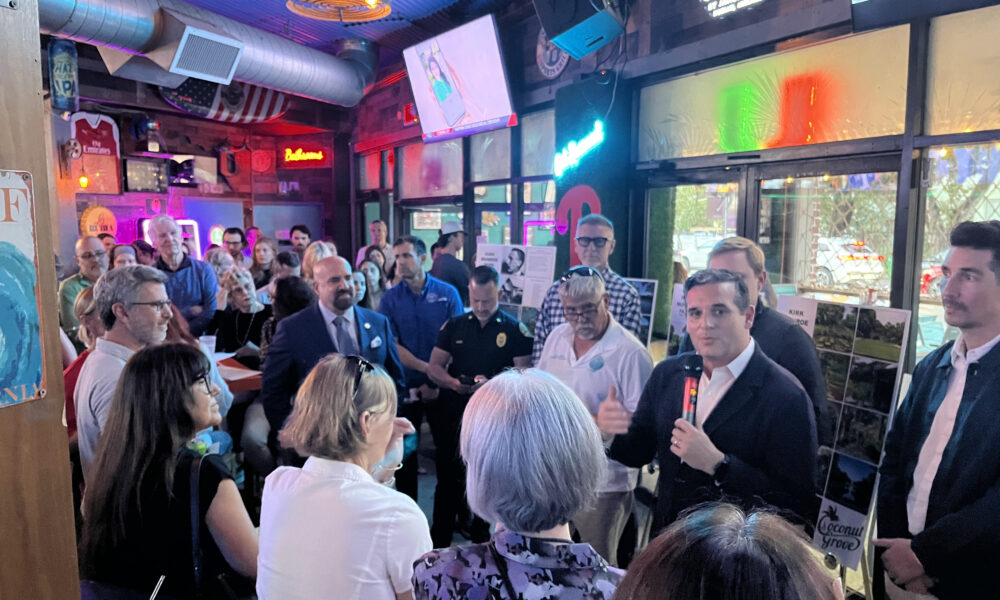
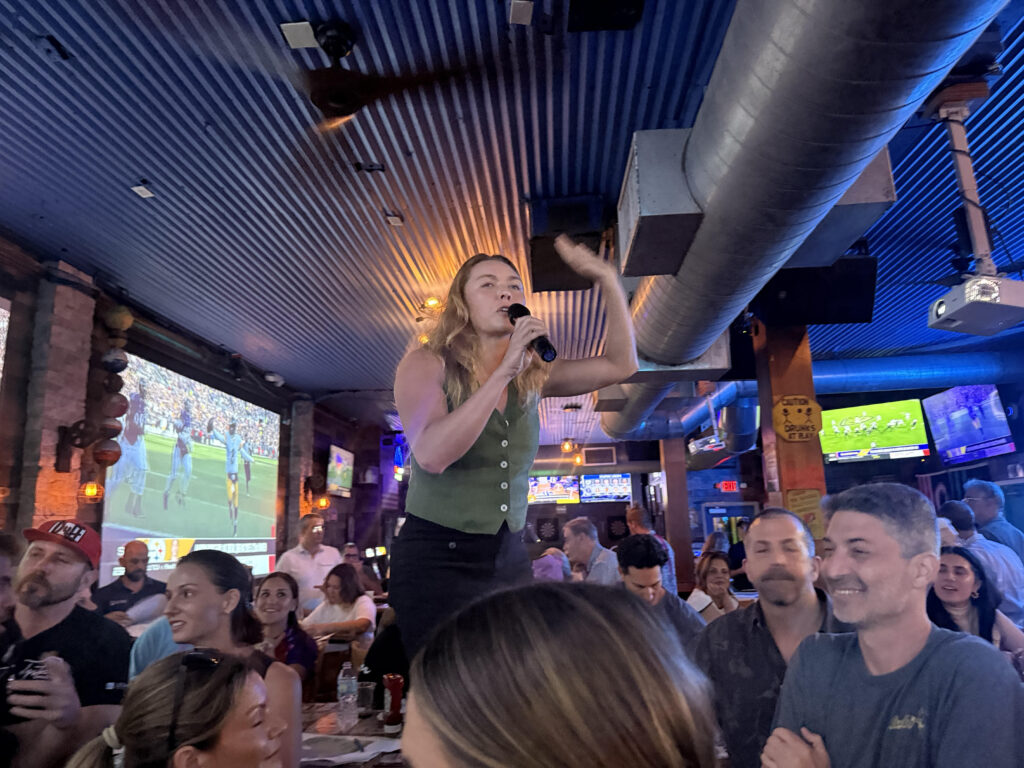
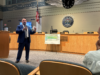
Under the dim lights of Sandbar Sports Grill with college basketball playing on large-screen TVs and chatter bouncing off the walls, a crowd of about 75 or so locals stood shoulder to shoulder this week awaiting a presentation on the proposed improvements to two popular public spaces in Center Grove: Fuller Street and Kirk Munroe Park.
But a formal discussion never came.
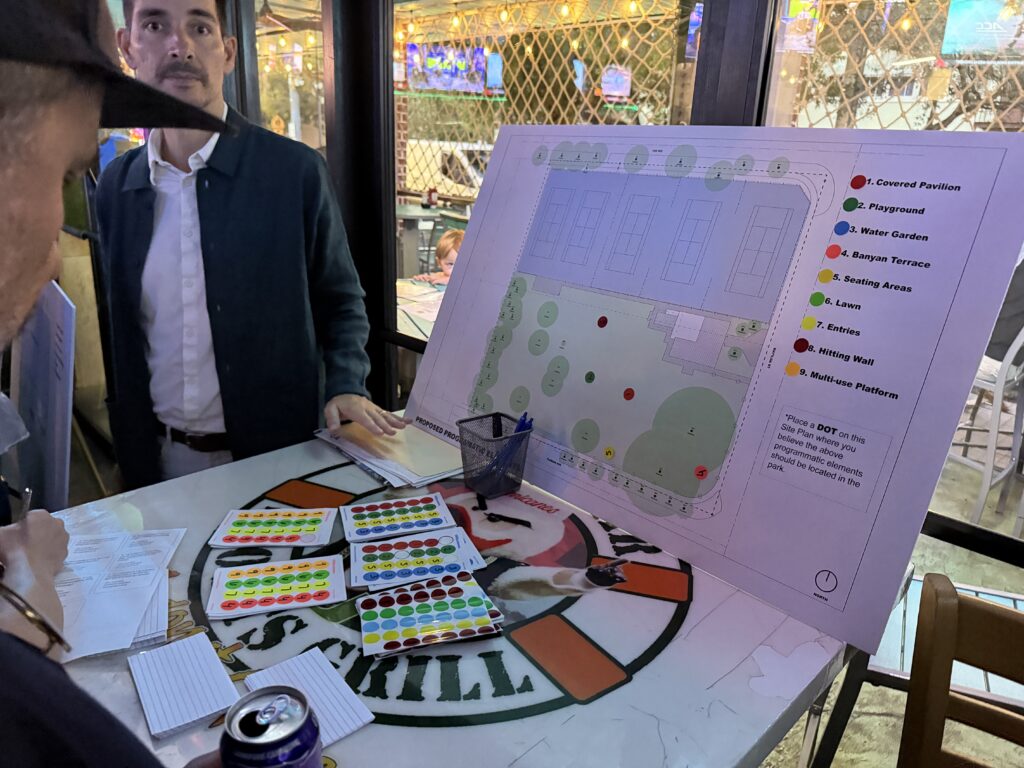
Instead, the Wednesday night crowd was asked to fill out surveys and comment cards and place stickers on preliminary design plans for one of those public spaces – Kirk Munroe Park – as they downed beers, munched on fries, and socialized.
Not everyone was down with that approach, given the occasion.
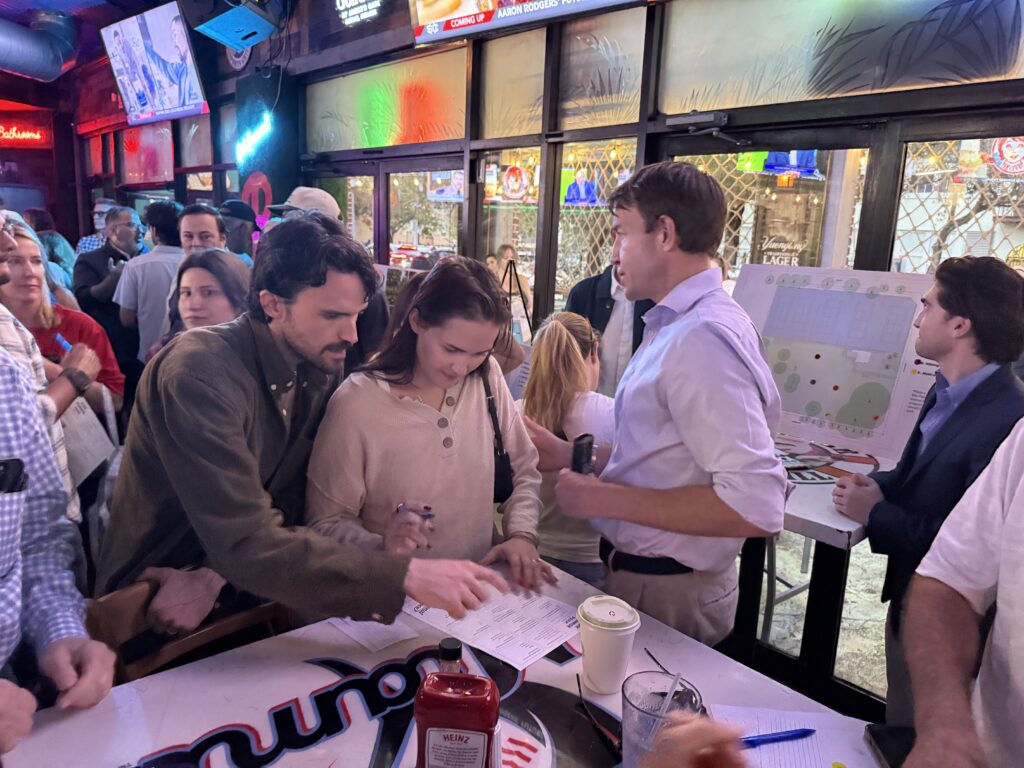
“It felt more performative rather than productive,” said Grove resident Elissa Margulies. “I really wanted to know where they were at [with the current design] and I didn’t walk away knowing that.”
The Wednesday event was the first formal meeting in a public design process that’s expected to last several months and result in a final plan for proposed improvements to both the park and the public square that Fuller Street has become.
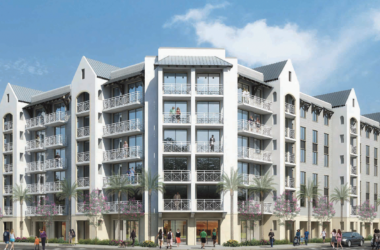
The design process is being led by Allen Morris Company, the developer behind the proposed five-story mixed-use Ziggurat development on Grand Avenue, with an assist from Miami District 2 Commissioner Damian Pardo and his staff.
The City of Miami tapped Allen Morris Company to lead the design and construction phases of the project, which will be funded with a $2 million contribution from the company and $3 million in public funding.
Under the terms of its agreement with the city, Allen Morris will consult with local stakeholders and the public before drafting the final design plans that will go before the Miami City Commission for review and approval.
Some say that represents an improvement over the way that things are often done.
“It’s relatively better than the other development processes in the Grove,” said George Da Guia, a Grove resident who works as a principal planner for Miami-Dade County.
But how effective this week’s meeting was remains to be seen.
Margulies, like others, had expected a presentation and public question-and-answer session this week, but feedback was limited to one-on-one conversations, a two-page survey, and hand-written comment cards.
“Who’s going to sort through all that?” she asked.
The two-page survey posed 24 questions, including two that asked “how important is increasing the number of trees in the park?” and “would you like a water garden?”
Emilie Wernick, a representative of the Coconut Grove Elementary Parent Teacher Association, said the PTA’s main priorities are a fenced perimeter around the park, public access to the park’s playground and tennis courts, and a phased construction plan that puts public safety first.
“It’s just our neighborhood park so I want it to stay really accessible for our kids, nothing too fancy where it’s impeding our kids playing,” Wernick said.
Javier Fernandez, an attorney representing Allen Morris, discussed the possibility of creating a website where the results of the surveys would be available for public view, but no such website had been confirmed.
Also missing from Wednesday night’s meeting: any discussion of the planned improvements to Fuller Street. The event had been promoted as a community meeting about both the park and Fuller Street.
Spencer Morris, the president of Allen Morris Company, said that was due to initial feedback that suggested residents do not want to see much change to the popular pedestrian-only street.
“From an actual execution standpoint, we’re going to get to the design of Fuller, but I think it’s going to be much simpler because of the feedback we’re hearing from the neighborhood,” Morris said.
Final design plans for Fuller will likely be limited to the addition of new pavers and mature trees where there currently are gaps, he added.
“We keep the string lights, we keep like the character, and it’s just where you meet people and where you have a beer or have a glass of wine,” Morris said. “I think it’s important that it doesn’t turn into a Lincoln Road, because Lincoln Road is like the worst expression of this idea.”
Possibly the biggest complaint about Wednesday’s meeting concerned the location.
“While we all love the Sandbar, it wasn’t the proper venue for a serious meeting,” Margulies said. “It was loud and chaotic.”
Da Guia echoed her sentiments. “It’s a terrible venue for this.”
Especially given the size of the crowd, which Margulies noted as a positive.
“The turnout was huge,” she said.
Asked about next steps, Morris said the developer will now review the public feedback gathered this week and make changes to the company’s initial design plans.
“We need the designers to take this feedback, go to the drawing board and create an actual design, and then present it to everybody, and then get feedback on that,” he said.
The next public meeting is tentatively scheduled for March, but no date has been announced.









I give them credit for at least involving the community. Community work can be chaotic, but ultimately it’s worth the effort. I just hope it’s not lip service. I think the best thing the developers and Allen Morris can do is take community members seriously. Treat them as if they were your legislators (because in the end, they are). Lobby them. Stop lobbying the individual legislators (who are human and even with the best intentions can end up self-dealing, instead of pushing to get residents’ needs met), and lobby the actual residents. What would it take to get them on your side? What would the process of finding that out look like?
The developers and legislators all run in the same crowds. They’re used to having cocktails together and hammering things out. How do we create that same feeling of mutual respect with a larger body? How do we create an atmosphere of generative conflict where a shared vision can emerge that benefits the ENTIRE community and not just those who can afford the units? Ultimately, a project that gets this right will be in huge demand and can be replicated. The developer that truly looks to be of benefit to their community is the next big winner.