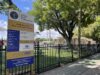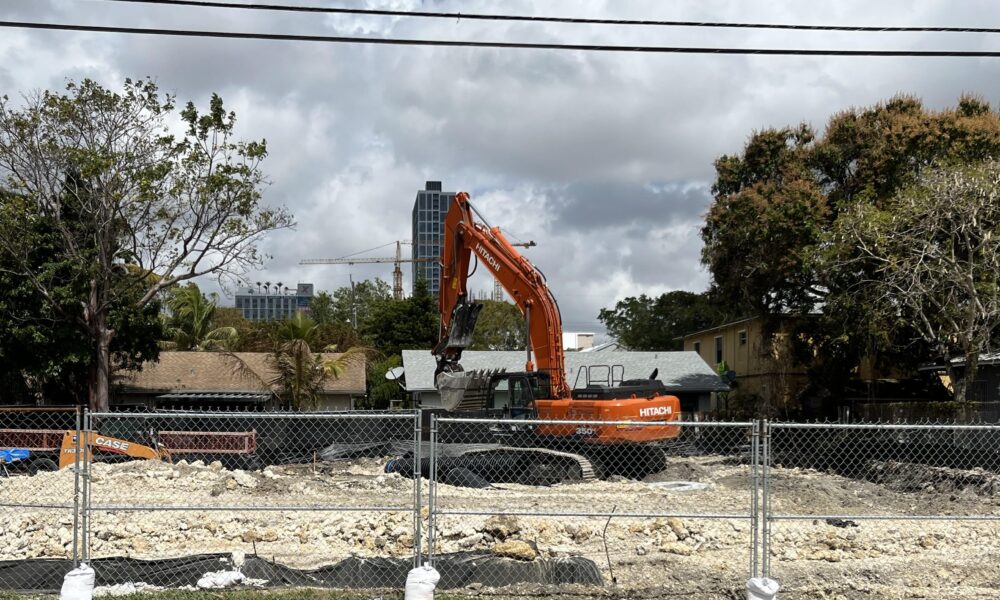


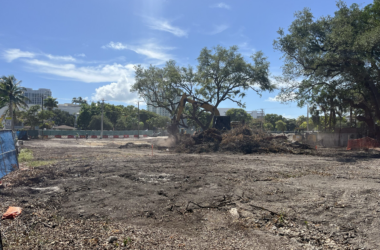
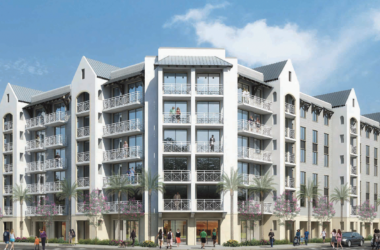
Construction has begun on the Ace Padel sports club planned for a stretch of property along Grand Avenue near Douglas Road where the Charles Barber Shop once stood.
A father-and-son company that has made a name for itself in the emerging sport of padel has broken ground on a new sports facility planned for Grand Avenue in the West Grove – the company’s first padel club in the United States.
Set to open later this year, the Ace Padel facility now under construction on the site of the former Charles Barber Shop, will include five padel courts, a 32-foot-tall canopy, a clubhouse with locker rooms, and other “wellness” amenities.
The project at 3793 Grand Ave. – a partnership between a Swedish father-son duo and Aventura Asset Management – is expected to cost just over $1.2 million, according to a building permit issued by the City of Miami.
But whether there’s an appetite for a facility like this in the West Grove, historically an African-American neighborhood with deep Bahamian roots, remains to be seen.
Tucked between Douglas Avenue and Brooker Street on an increasingly commercialized stretch of Grand Avenue, the sports club appears to speak to the “new Grove”, one that’s defined by a high-priced housing market and rapid gentrification – particularly in neighborhood known as Little Bahamas.
“I can think of better uses for land as we (Black residents) become scarce,” said Reynold Martin, the chairman of GRACE (Grove Rights and Community Equity), in a nod to the neighborhood’s lack of affordable housing.
“I don’t think it’s being constructed for our community, it’s being built for other people to come into the community, I guess, because I don’t know anyone who plays that (sport),” Martin added.
Padel, a hybrid of squash and tennis, has quickly developed a reputation as a luxury sport in Miami, with a limited number of courts in the area driving playing costs up and many facilities adopting a membership-based wellness experience.
The sport is played by teams of two on a court about half the size of a tennis court and enclosed by glass walls that allow for banking shots – making it more complex than pickleball, both in skill and court construction.
It’s the latest racquet sport fad to gain traction in the U.S. after gaining considerable popularity in Europe and South America following its creation in Mexico in 1969.
In 2025, there were more than 77,300 courts worldwide, but only 770 in the U.S, according to the International Padel Federation. Florida has emerged as the sport’s epicenter in the U.S., home to 41% of the nation’s courts and widely regarded as the fastest-growing state for padel.
Ace Padel hopes to capitalize on that trend. Coconut Grove is the company’s first U.S. location, with plans to open additional clubs in Denver and Los Angeles.
The father-and-son team – Elliot Carnello, a former professional tennis player, and his father, Peter Carnello – are seeking to position padel as more than just a game.
Because matches require four players, the sport includes a social element — something the Carnellos are hoping to build upon.
The father and son team, who declined an interview request from the Spotlight, previously have said the facility will include social spaces and food and beverage service, with the intention of encouraging players to arrive early and hang out after the game has finished.
Many of the logistical details of the sports complex – its hours, cost to play, and membership information – have yet to be announced, but if kept on par with other Miami clubs, it likely won’t be cheap. Getting in on the sport in Miami, and the social perks that accompany it, comes with a high price tag.
Ultra Padel Miami – a similar padel facility – charges $112 for an hour and a half of play on an outdoor court ($28 if split per person), while an hour of play at Reserve Padel in the Design District will set you back $125.
Many Miami clubs also include membership options. At Reserve Padel, which operates three Miami locations, a membership goes for $500 and gives you access to member-only clubs, reduced court rental fees, and other wellness amenities, such as steam rooms and cold plunges.
In a neighborhood that offers public pickleball and tennis courts either for free or at a nominal cost, that might be a hard sell.
“The reason I don’t play more padel is because they [the courts] are not close and they’re not inexpensive,” Grove resident and pickleball fanatic Josh D’Alemberte said.
In 2023, D’Alemberte helped establish “The Oak,” the first free, public-access pickleball-only courts in the Grove at 2975 Oak Ave.
A sizable number of Grove residents have tapped into D’Alemberte’s pickleball network since, with Grove Pickles – his WhatsApp chat – attracting more than 500 members.
Read More: Game On: Pickleball in the Grove
As for Ace Padel, D’Alemberte said, “The only concern I would have as a Grove resident… is the gentrification of the West Grove or the Bahamian Grove, right? But I don’t know, that’s been happening all the years that I’ve lived here.”
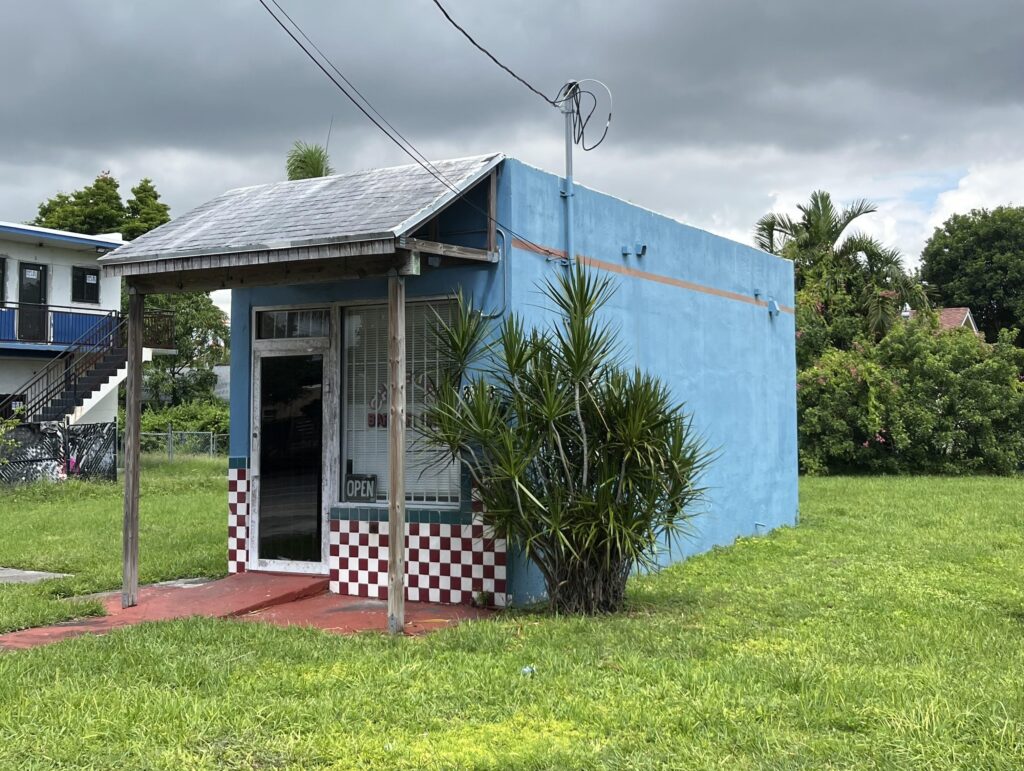
Construction of the Ace Padel facility required the demolition of Charles Barber Shop, displacing Charles Williams – who has been cutting hair in the Grove for 55 years.
Read more: The Last Days of a Black Barbershop in Coconut Grove
That may affect how local residents respond to the new sports club.
“It seems most people aren’t happy about it,” said Clarice Cooper, president of Village West Homeowners and Tenants Association (HOATA). Despite that feedback, though, Cooper said the facility could come with positives. “I don’t see anything wrong with it necessarily,” she said. “It gives people a chance to learn something new.”
In addition to Ace Padel, local developer Silver Bluff has announced plans to open a temporary racquet sport facility in the West Grove, with pickleball and padel courts just a few blocks to the east, on Grand Avenue between Plaza and Hibiscus Streets.
Read More: A Pop-Up Sports Facility for Grand Avenue
Silver Bluff principal Grant Savage said Ace Padel’s arrival won’t affect his company’s project, which is currently waiting on a building permit from the City of Miami.
“We feel there is enough demand to go around,” Savage said.