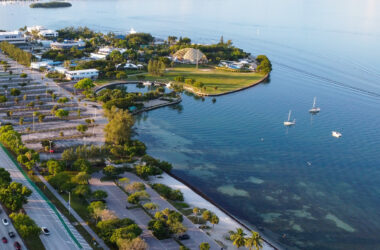
Finalized plans for Kirk Munroe Park are beginning to take shape, almost a year after developers first presented a redesign to the community.
After a rocky start to the public design process for an updated Kirk Munroe Park in Center Grove, residents and neighbors are inching closer to a final park design that prioritizes children and embraces the Grove’s natural beauty.
Residents and stakeholders filled City Hall last week for the second of four planned public design meetings, eager to see their previous feedback reflected back to them in the project’s new design iterations.
Unlike the first meeting at Sandbar Sports Grill, where the echo of drink orders and small talk overwhelmed formal conversation, attendees were able to publicly air their specific questions and concerns with the design team.
“The feedback has been really positive,” Spencer Morris, president of Allen Morris Company, told the Spotlight at the conclusion of Thursday’s meeting.
Allen Morris Company, the developer behind the proposed five-story mixed-use Ziggurat development on Grand Avenue, adjacent to the park, is leading the design and construction phases for both the park and nearby Fuller Street, in collaboration with Miami District 2 Commissioner Damian Pardo and his staff.
As part of its development agreement with the city, the company will contribute $2 million toward the cost of the $5 million project, and cover any cost overruns.
The company also agreed to work with local stakeholders and Grove residents to arrive at a final design for both public spaces that reflects community concerns and priorities.
As part of the process, the company’s design team asked residents on Thursday to vote between two different designs for the park, with slight variations in the placement of key features – a pavilion, a hitting wall, and a playground – oriented around a center lawn.
“The lawn is really the heart” of the park, said Andres Arcila, the founder of Naturalficial, the landscape design firm tapped by Allen Morris to lead the process.
Park features were finalized based on the results of the survey handed out at the first community meeting. Proposed amenities that did not make the cut include a concession stand and a water feature, both of which were suggested initially.
Instead, Arcila said Naturalficial is focused on drawing out the natural features already present, including the old-growth banyan trees that dominate one corner of the park.
“Those banyan trees are the most spectacular feature that you can find, and we happen to have them there in the park,” he said. “We want to create a better space to be used underneath them.”
Another priority: the children, many from neighboring Coconut Grove Elementary, who use the park daily.
Concerns about the visibility of kids throughout the park for parents and tennis instructors, along with the potential shift from a single entry to multiple points of entry and exit, were major issues aired during the meeting.
“As long as you’re looking at one checkpoint so to speak, kids are free to roam within the park knowing that there is a closed perimeter. So, there is a lot of value in keeping just the one entrance,” said Joseph Vergara, a neighborhood representative.
But fire safety codes may require additional exits, the development team said.
In addition to the public design process, an advisory board of four key stakeholders has been meeting to help shape a final design, which design team leaders expect to present to the City Commission in June.
The advisory board includes a representative of the Coconut Grove Village Council (Steve Capellini), a Center Grove neighbor (Vergara), a member of the Coconut Grove Elementary PTA (Emilie Wernick), and Carlos Santamaria with Neighborhood Tennis.
After a final layout for the park is chosen, the design team will work to refine park aesthetics and the choice of specific equipment for features like the fitness area.
For aesthetic inspiration, the design team said it would look to The Kampong, the national tropical botanical garden on Douglas Road in the South Grove. Morris said the Kampong’s natural beauty resonates strongly with Grove residents.
“At the end of the day, we’re designing for the community,” he said.
In the meantime, the design process has offered a window into neighborhood priorities.
Based on the survey responses to date – where people said yes to bathrooms and tennis court improvements but no to golf cart parking – it appears that residents prefer a park refresh rather than a complete overhaul.
That appears to be the case on Fuller Street as well, which once again took a back seat during last week’s public discussion.
Instead of reimagining the street that has become a popular pedestrian promenade since the COVID-19 pandemic, proposed Fuller Street improvements will focus almost exclusively on raising the street to be flush with the sidewalk and the addition of new trees, District 2 community liaison Javier Gonzalez told the crowd.
“It’s becoming very much a public works project,” he said.
That direction appears to follow feedback from residents who would prefer to see Fuller Street remain much like it is today, but design options for the street were not discussed publicly during the first two community meetings.
At least one resident who attended last week’s meeting said the project would benefit from more discussion about Fuller Street. “I think it would be great to continue this as also a process with the community because I think it’s a very public space,” said Davey Frankel, a member of the Coconut Grove Village Council.
The next public meeting is scheduled for Wednesday, April 15 at Miami City Hall, followed by a fourth and final meeting on Friday May 15.
Allen Morris Company expects to present a final design for both public spaces to the City Commission on Thursday, June 25.
To track the progress of the project and provide feedback, follow this link.