
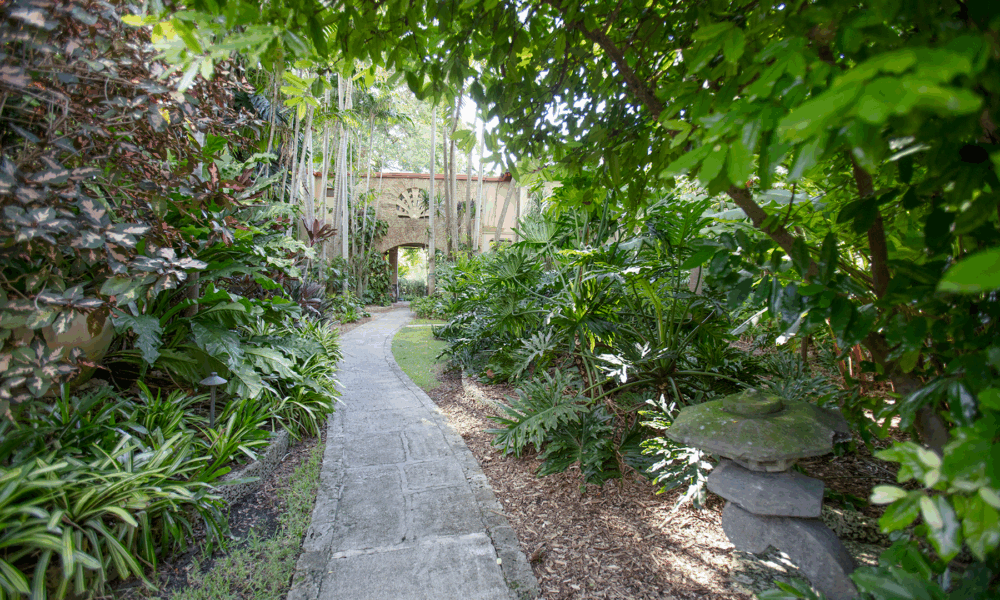

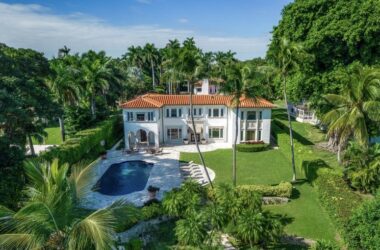
Once the private paradise of famed botanist David Fairchild, The Kampong is shedding its air of mystery — inviting visitors to explore historic gardens, rare plants, art installations, and a century of South Florida history.
For years one of the most storied homesteads in Coconut Grove has remained for many shrouded in mystery as deep as the lush vegetation that frames its ornate red gate.
Thousands of motorists drive past The Kampong sign on South Douglas Road each day, and many may well have wondered what happens on the property that runs from the roadway to Biscayne Bay.
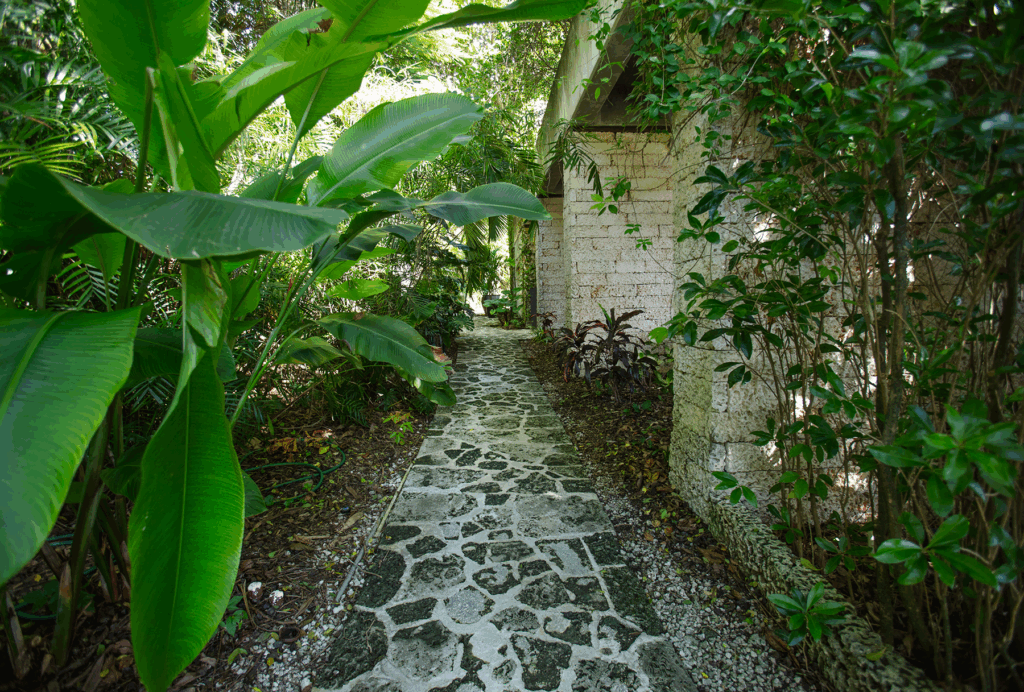
“The Kampong has had the reputation as being exclusive,” says Brian Sidoti, director of the botanical garden that was once the home of famed botanist and globe-trotting plant collector David Fairchild. “We’re being intentional about changing that.”
Plans to raise the profile of the historic house and grounds include hosting more community events – an upcoming Halloween party in October, for example – promoting lectures and art shows, holding plant sales and increasing the number of student groups who make use of the garden’s resources for research projects.
Also under consideration is opening the closed gate during the day – admission is now controlled by buzzing the office – installing a kiosk at the entrance and parking a food truck under a front-yard banyan tree to lure visitors.

“We are trying different things to attract a more diverse demographic,” said Sidoti. “We are known as a hidden gem. We want to be known as a gem.”
The Kampong is more than just the winter home of Fairchild, his wife Marian, their children and many of the exotic fruit trees, medicinal plants, and tropical ornamentals he brought to the U.S. from around the world.
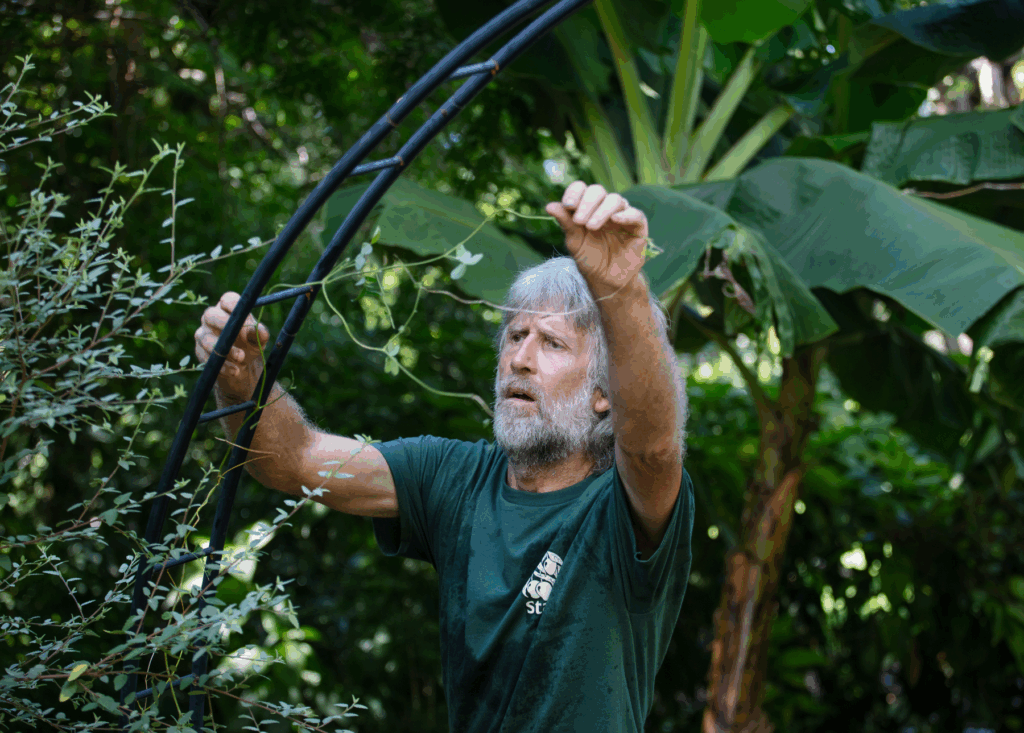
Fairchild is credited with introducing more than 200,000 exotic plants and varieties of established crops into the country, including soybeans, pistachios, mangos and nectarines.
During Fairchild’s residence, The Kampong also became a research center, and remains so through the work of the staff and as the home of Florida International University’s International Center for Tropical Botany (ICTB).
“The Kampong is an oasis, a unique place where people can see our history and the environmental challenges we face, from rising seas to threats to our tree canopy,” said ICTB director Chris Baraloto, a botanist who travels often to the Amazon and who himself has collected more than 5,000 herbarium specimens now in various collections.
“We have a fair number of faculty and students here working at the cutting edge of research,” he says. “And part of what makes us unique and worthy is that we are so close to an urban area.”

Joanna Lombard, an architecture professor at the University of Miami, calls The Kampong “a very rare place that reaches back 100 years and is the locus of the environmental movement in South Florida. It’s a place where you can begin to see… the interlocking issues of climate change and resilience. When you go and stand there, wow! It’s a really meaningful way to connect, from 100 years ago and maybe what we’ll be telling people 100 years from now.”
David and Marian Fairchild first visited the nine-acre property at 4013 Douglas Road in 1916. They were instantly smitten. “We’ve got to have this place, David,” Marian told her husband, as he recalled in his memoir The World Grows Round My Door. With money borrowed from her parents – telephone inventor Alexander Graham Bell and his wife, Nancy – they bought the place for $25,000.

Fairchild called the purchase “the most important event in our lives…”
In the nearly four decades that Fairchild lived at The Kampong – the Javanese word for little village – he brought to his home many of the thousands of plants he collected as an explorer for the U.S. Department of Agriculture. Those exotic plants turned The Kampong into a botanical wonderland.

(Fairchild also contributed many plants to Fairchild Tropical Botanic Garden in Coral Gables, opened on 83 acres in 1938 by attorney and businessman Robert H. Montgomery and named in honor of his friend.)
After Marian Fairchild’s death in 1962, The Kampong was sold to philanthropist Catherine Sweeney, who preserved it as a botanical garden and secured its listing on the National Register of Historic Places.
In 1984 Sweeney donated The Kampong to the Hawaii-based National Tropical Botanical Garden, which oversees its operations as a historic garden and research center.
In recent years, one of The Kampong’s major sources of revenue came from hosting gala events and lavish weddings. (The singer Pharrell Williams was married there in 2013.)
But the emphasis now is on recruiting donors while expanding research grants, school field trips, adult lectures, horticultural classes and art exhibitions, says Sidoti, a botanist who continues his own research on bromeliads.
Attendance is rising. Last year paid admissions topped 8,000, up from 3,500 in 2023, says Sidoti.

The history of The Kampong is rich. Amid the foliage stands a two-story limestone building that once served as the office and stable of Dr. Eleanor Galt Simmons (1854 – 1909), Dade County’s first female physician.
The office is the second-oldest building in Miami-Dade County standing on its original foundation. A brass doorbell plate at the entrance still bears her name.
On the second floor is an art installation that recreates Fairchild’s laboratory as imagined by conceptual artist Mark Dion. (Last September the lab and other property on the grounds were vandalized during what Miami police said was a break-in. The case remains unsolved.)
Next to the building is the outline of a yet-to-come medicinal garden that was designed by Lombard and UM colleague Rocco Ceo following a proposal by Lombard’s students.
In reflecting on his life at The Kampong, Fairchild wrote, “I wonder if any great mansion, any palace even, has meant so much emotionally to those who have spent their lives within its walls.”
In his memoir, he recalls the joys he and others have taken from being there, and credits the environment with helping encourage an appreciation of the world.
And then he ends the memoir with a question: “So what does it matter what happens to The Kampong after Marian and I have gone?”
Theresa Chormanski, a professor in the landscape technology program at Miami Dade College, has an answer. She is overseeing a project in which students are taking scions from avocado and mango trees, some of them planted by Fairchild up to a century ago and now decaying, and grafting them on to rootstock in order to preserve the varieties.
“The Kampong has been instrumental in educating us to the beauty and differences in the world,” she says. “It is a repository of these historic DNA, and if they don’t exist at The Kampong, they may be extinct. How boring would it be if there were only one type of apple, or wine?
“Being at The Kampong, noticing the interaction of landscape and house, you can almost imagine you were living there at that time in history. It’s a unique feeling,” said Chormanski. “I look forward to it being a more known entity of our Grove history.”
The Kampong is open daily, Tuesday through Saturday, from 9:00 a.m. to 4:30 p.m. Last entry is 3:00 p.m. Admission is $17 for adults, $12 for students, with some discounts available. Reservations are encouraged to assure parking availability. More information can be found here.






Not mentioned in his well-deserved tribute is the partnership the Kampong has established with the Coconut Grove Crisis Food Pantry. We are always excited to see Brian or Benoit and team arrive with crates full of freshly harvested produce for our grateful clients. From mangoes to avocados to herbs to exotic fruits, we are always excited to learn about these valuable donations. What could be better than finding a perfect avocado in your bag of groceries? David Fairchild would be so proud of the Kampong’s outreach to serve neighbors challenged with food insecurity. Thank you, Kampong!