
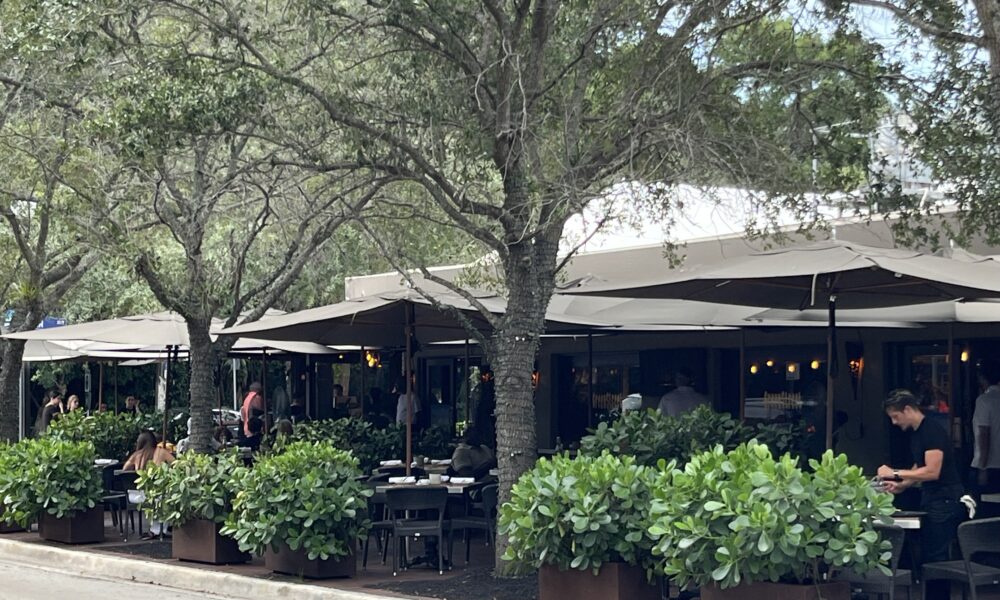

Outdoor dining is part of the charm of Coconut Grove, but pedestrians often have to negotiate narrow stretches of sidewalk to squeeze past restaurants that lease space in the public right-of-way.
On any given Sunday morning, a line of diners stretches down Commodore Plaza and Main Highway. They’re hoping to score an outdoor table for brunch at Greenstreet Café, a Coconut Grove institution.
For owner Sylvano Bignon, sidewalk seating has been synonymous with his brand since opening in 1990. “We have such a beautiful corner location that gives us great exposure,” Bignon tells the Coconut Grove Spotlight. “It is working extremely well.”
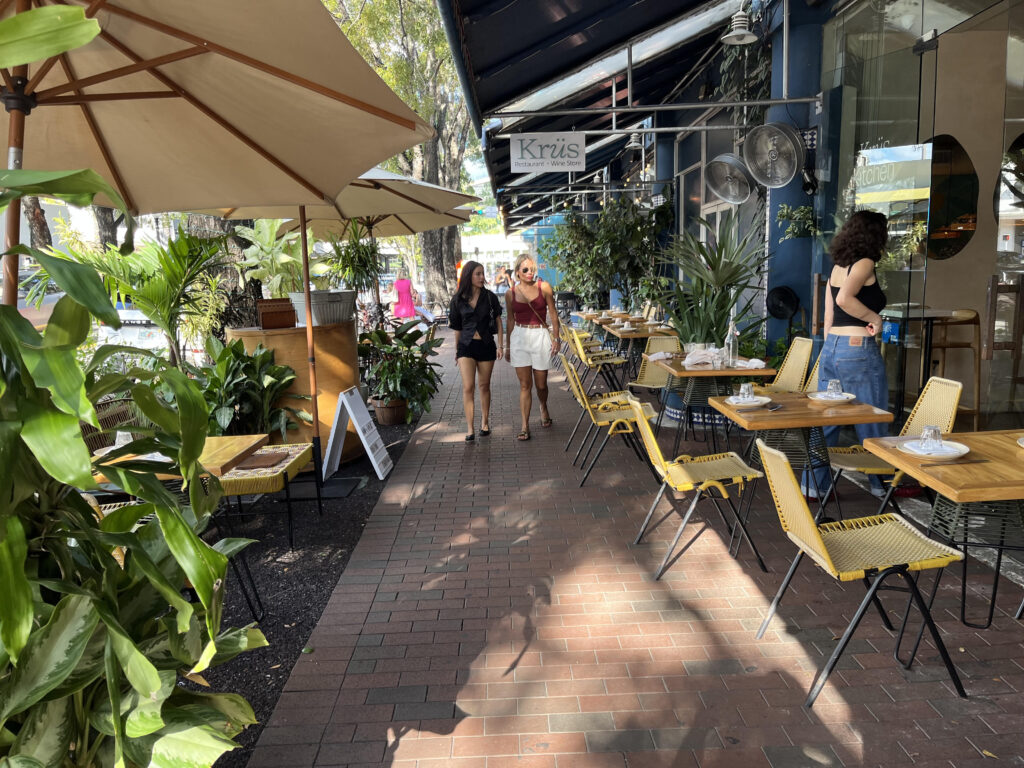
In fact, sidewalk cafes have become part of Coconut Grove’s identity as much as its tree-lined streets and brick-paved walkways.
For more than 30 years, restaurateurs have staked out patches of public right-of-way, turning sidewalks from mere pedestrian throughways into outdoor dining areas.
But how much of a good thing is too much? For some Grove residents, the outdoor tables, decorative planters, menu boards, and electric fans that accompany sidewalk cafes have become a nuisance.
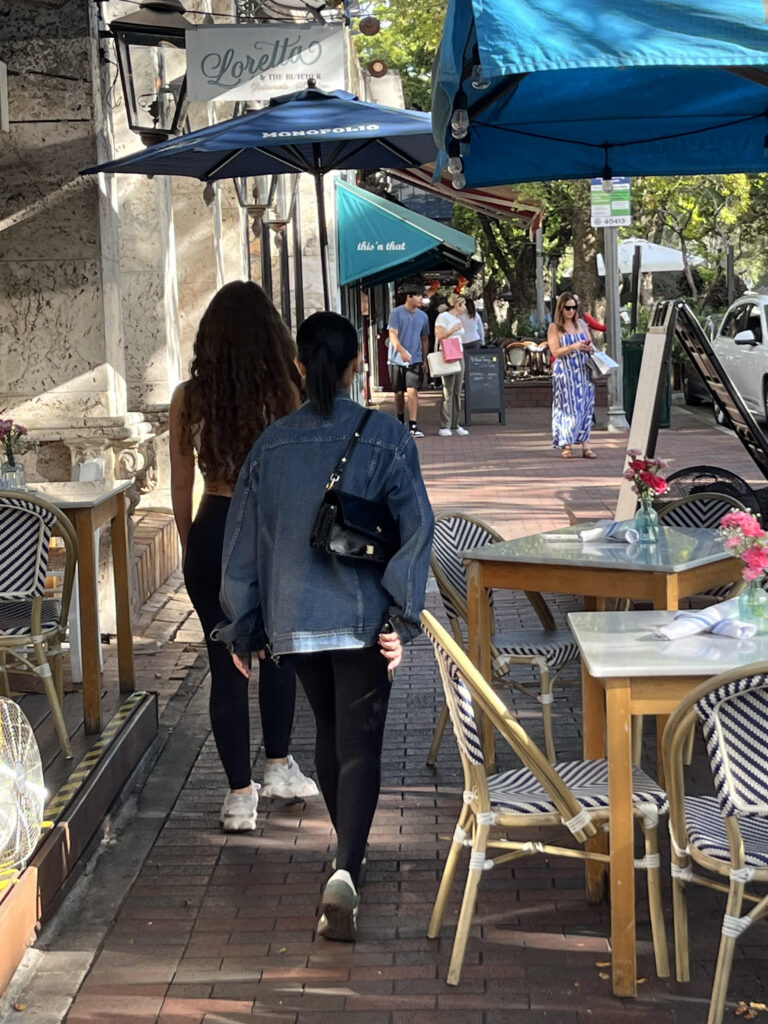
Several areas in the Grove have become pedestrian chokepoints, where passage requires stepping over a sleeping dog’s tail or dodging a tray of hot food, all the while hoping that no one backs their chair into the walkway.
Along Commodore Plaza, a new row of tables outside Strada in the Grove squeezes passersby into a narrow corridor that continues past Loretta & The Butcher’s sidewalk seating options. Around the corner on Main Highway, the sidewalk narrows again in front of Meraki Greek Bistro where blue and white wooden tables crowd the space.

The most troublesome bottleneck may be a stretch of shops and restaurants along the east side of Main Highway, a route regularly traveled by bikers and runners following the Commodore Trail.
From Panther Coffee down to Le Pain Quotidien – and especially near Los Felix Miami, where a tight turn in the sidewalk further restricts access – pedestrian travel feels particularly challenging.
And if you’re pushing a baby stroller or riding a bike? Good luck.
“For bikes, unless it’s first thing in the morning, you can’t pass. You have to get off or you have to go in the roadway against traffic. It’s a real problem,” Mary Munroe Seabrook, co-founder of the Friends of the Commodore Trail, said.
She, like many bikers, now avoids the area entirely, cutting through the back of Mr. C Miami – Coconut Grove, where cars have the right-of-way.

The encroaching cafes, she said, take away from the sidewalks’ intended purpose.
“I think people push the envelope,” she said. “I mean, I understand as a business owner you would. You want people to stop and you want as much of that sidewalk as you can.”
A business owner’s ability to place tables close to the curb is not guaranteed, however. It entails a layered and costly permitting process that has become as routine as renewing a liquor license.
According to City of Miami records, 29 restaurants and cafes in Coconut Grove held valid sidewalk café permits as of July 16. That’s up from 17 establishments with active permits during the 2022–2023 fiscal year. Some dining spots have also expanded the footprint of outdoor dining areas in the last two years.

The amount of revenue the city collects from these permits has risen accordingly.
In fiscal year 2022–2023, the city collected $40,422 in fees, according to Miami’s Department of Resilience and Public Works, which oversees sidewalk permitting.
The following year, collections ticked up to $47,771. And from October 2024 through July 16 of this year, fees ballooned to $70,892.
Every dollar collected from Grove restaurants goes directly to the Coconut Grove Business Improvement District (BID), which reinvests the funds into marketing efforts, events, and neighborhood improvements designed to draw more visitors.
Sidewalk seating is not just an aesthetic amenity. For many restaurants, it’s a significant revenue stream.
Steve Capellini, co-owner of Atchana’s Homegrown Thai on Commodore Plaza, credits his sidewalk tables for attracting more clientele than the interior space.
“For us, it’s actually more business from the sidewalk tables,” Capellini says. “Especially during the season from November to May.”
The City of Miami, like other neighboring municipalities, charges for the public space an establishment wants to take over. Restaurant owners apply for sidewalk permits online, and must pay a non-refundable $175 application fee and a $10 initial inspection fee.
Once approved, Miami leases the sidewalk space for $11.50 per square foot, cheaper than Coral Gables where businesses pay $15 per square foot.
The applications are handled by the Department of Resilience and Public Works, but other agencies such as code enforcement and planning and zoning also provide restaurant owners or their representatives with input, both Bignon and Capellini said.
“Every year, you need to apply for a brand-new permit and start from scratch,” Bignon said. “I think we are paying around $10,000 a year.”
City records confirm Bignon’s estimate is within the ballpark of what Greenstreet has paid since fiscal year 2022-2023, when the total fee was $11,766. For the two subsequent fiscal years, Greenstreet paid $10,677 and $10,465.
“To make it simpler, we try to keep our layout the same,” Bignon said. “We have to create a certain space between the tables to make sure it’s safe and people can cross the sidewalk.”
For many business owners, navigating the permitting maze is too time-consuming to handle, said Paulina Begliomini, a real estate broker and consultant who’s the go-to expert for sidewalk cafe permits in Coconut Grove. Her firm PB Restaurant Partners currently represents 20 Grove eateries, including Atchana.
“I’ll spend two or three hours a day working on sidewalk cafe applications until they’re all complete,” Begliomini told the Spotlight. “Just managing this application requires your full attention, and restaurant owners just don’t have that much time.”
Coconut Grove has the highest concentration of sidewalk cafes in the city due to the nature of the neighborhood, Begliomini said.
“The sidewalks are wider than other neighborhoods and the Grove is more walkable,” she said. “Since most of the restaurants have it, everybody wants some sort of representation of their brand outside.”
To accommodate pedestrians, the city requires restaurants and cafes to provide five feet of unobstructed space for foot traffic, a city spokesperson said.
But that five feet of space can quickly become crowded. Diners frequently park a baby stroller alongside their table, dogs rest by their owners’ feet and waiters stand in the walkway chatting to customers.
In tight areas, those small additional obstructions are often the tipping point that force runners or bikers to risk stepping into the street. “That foot or two makes a big difference, especially on that little narrow sidewalk,” Seabrook said.
Code enforcement is essential to keeping this outdoor dining atmosphere alive without compromising walkability, Seabrook added.
“In a perfect world, every staff member at each of these stores (should be) fully aware that they’re going to get ticketed if there’s a single issue of a baby stroller… parked next to the table,” she said.
For Bignon and Capellini, they can’t imagine their restaurants without outdoor seating.
“The sidewalk is part of Greenstreet’s identity,” Bignon says. “People want to enjoy eating outside with the weather and everything we offer here in Coconut Grove with the trees and the sidewalks.”
Capellini concurred.
“The Grove is known as a place to go for sidewalk cafes,” he said. “As long as the weather’s nice and it’s pleasant, people really seem to prefer sitting outside.”










Al Fresco Dining adds charm, ambience and enjoyment to any meal. It’s time that Commodore Plaza consider the success of Giralda, Lincoln Road and Espanola for inspiration on how best to establish pedestrian streets with Al Fresco Dining.
Isn’t it illegal to ride your bike on the sidewalk? We have bike lanes in the Grove. Please correct me if I am wrong.
Since the 80’s the charm of Coconut Grove has being his small village feel. Every world class city has an area that attracts local and tourists alike because is unique in every sense. I had an art gallery in the 80’s (Futon Gallery) and Coconut Grove was always the place to eat and enjoy a night life. Remember Cats, Reginas, Biscayne Babys, and world class restaurants and others. The first Sushi place was open in the Grove. If you are a world traveler and resident of Coconut Grove you should embrace our Village as is experiencing a renaissance. Bicycles should not be allow on the sidewalks.
How about we prioritize pedestrians over cars. Walkable communities encourage physical activity combating health and weight issues. It also reduces air and noise pollution. Increased foot traffic boost local businesses too. Designating large sidewalks and low-car zones fosters a more relaxed, social, and vibrant public space lost in a car-centric society. I’m guessing my ideas are too woke for Miami.