
The former Miami city manager and military veteran is promising to clean up City Hall and cut the budget if Miami voters choose him as their next mayor.
Emilio Gonzalez said he chose to resign as Miami’s city manager in 2020 because he refused to do Miami Commissioner Joe Carollo’s dirty work.
Almost six years later, the 26-year military veteran says he’s running for mayor to clean up – among other things – the commissioner’s mess. The election is Tuesday Nov. 4.
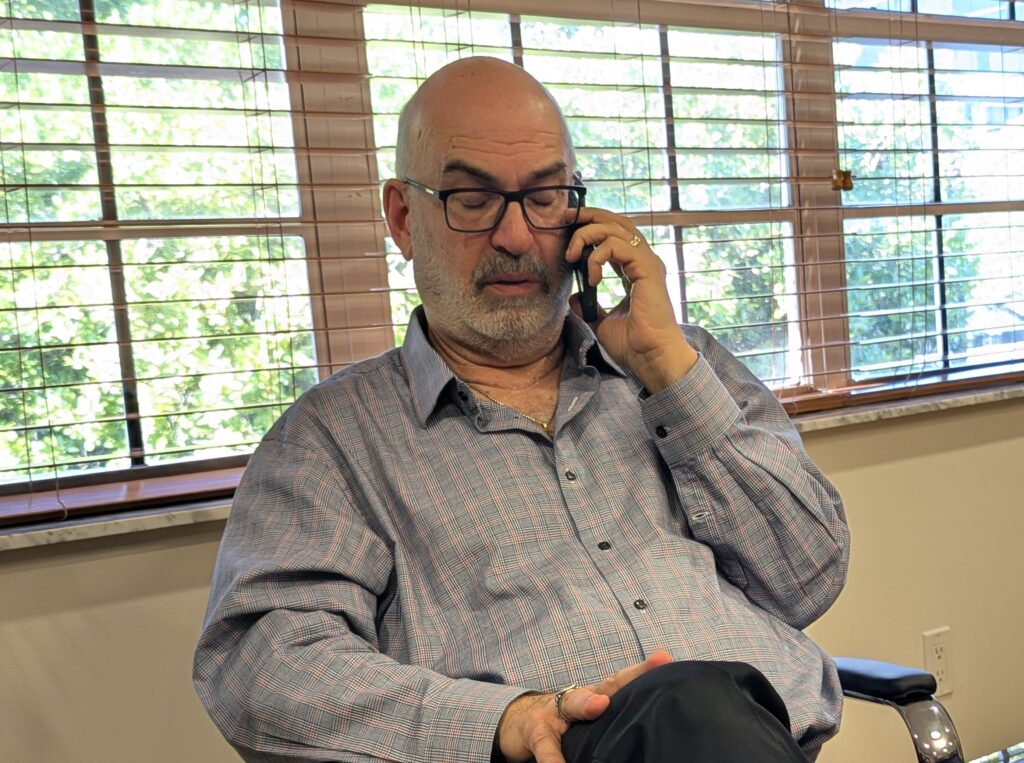
“Joe Carollo has been the most toxic official, possibly ever, in the City of Miami,” Gonzalez said. “And he’s portrayed a visceral hatred for me, for no other reason than I testified against him, and I refused to do his bidding when I thought it was unethical.”
That bidding, according to Gonzalez, involved siccing city code enforcement on Carollo foes William Fuller and Martin Pinilla, a pair of Little Havana businessmen.
The businessmen sued Carollo in return and were awarded a $63.5 million verdict two years ago by federal jurors who found Carollo had violated their First Amendment rights.
Now, almost six years after leaving City Hall, Gonzalez is in a heated battle to reach a likely runoff election in December – possibly against Miami-Dade County Commissioner Eileen Higgins, if political pundits and private polling are accurate.
“Conventional wisdom suggests what propelled him (Gonzalez) into the position of a possible runoff is that there would not even be a vote if it weren’t for him. And people have begun to realize that,” said Democratic pollster and political observer Fernand Amandi. “I think there’s a 40 to 60 percent chance he makes the runoff.”
Amandi was referring to a successful lawsuit filed this summer by Gonzalez that blocked the city’s effort to move the 2025 mayoral election to 2026 (and all future elections to even-numbered years), when voter turnout is greater.
The move would have given Carollo, Mayor Francis Suarez and Commissioner Christine King an additional year in office without a public vote, sparking outrage.
Thirteen candidates, including Carollo, are competing to become Miami’s next mayor, which is likely to splinter the vote and force a runoff election on Tuesday Dec. 9.
A recent poll undertaken by Citadel founder Ken Griffin’s philanthropic arm Griffin Catalyst found that only five of the 13 candidates are expected to receive as much as 10 percent of the vote. They are Gonzalez, Carollo, Higgins, former Miami Commissioner Ken Russell and former Miami Mayor Xavier Suarez.
Read recent Spotlight profiles of three other candidates: Ken Russell, Eileen Higgins and Xavier Suarez.
Though no reputable polling has been released publicly, Carollo has consistently attacked Gonzalez since the combative commissioner entered the race in late September.
Some candidates and political observers believe that’s because Carollo views Gonzalez as his main challenger to the runoff. The retired U.S. Army colonel and military attaché is a common target on Carollo’s daily hour-long morning radio show. And Gonzalez has had nasty attacks directed his way through a series of glossy fliers.
During a heated debate last month, Carollo went out of his way to blast Gonzalez’s fundraising, saying the former city manager would be beholden to the special interests who helped beef up his treasurer’s report.
Gonzalez is one of the contest’s leading fundraisers, having amassed more than $1 million in campaign fundraising and through a political committee called Miami Mission, according to the most recent filings in Miami-Dade and Tallahassee.
And most of that money – as much as $500,000 – came from a New York financial services company called RIA R Squared, the sister company of the Los Angeles-based asset management firm Ducenta Squared Asset Management, in which Gonzalez is a partner.
Also, two weeks ago Carollo admitted that staff members had removed Gonzalez campaign signs from swales in front of homes in his district. The commissioner chalked it up to removing clutter.
“Our city is going to become like a fourth-world country with signs everywhere… imagine if we would not enforce this,” Carollo told the Miami Herald.
Gonzalez, referring to the situation as “sign-gate,” said he found it highly suspicious that Carollo staffers and not code compliance officers were removing the signs during election season.
“We need better politicians,” Gonzalez said.
A Circuitous Path to Miami Politics
Gonzalez, 68, born in Havana, is married with two daughters and lives in The Roads neighborhood in Miami. The child of tobacco farmers, he moved to Tampa with his family in 1961 after a circuitous route on a Spanish merchant ship called the Satrustegui that took the family to Haiti, Colombia and Venezuela.
His father found a job with a cigar factory in Tampa’s famous Ybor City. Gonzalez graduated from the University of South Florida with a degree in international studies. After college he joined the Reserved Officer’s Training Corps (ROTC) and later became an artillery officer with the 25th infantry in Hawaii.
With Central America in turmoil in the early 1980s, he went to work with the Reagan administration, joining the Defense Intelligence Agency. He became a military attaché with diplomatic cover in Mexico City and also worked in El Salvador.
He later taught at West Point and worked at the U.S. Southern Command before joining Condoleezza Rice at the National Security Council in the early 2000s. Under the Bush administration he oversaw immigration and 17,000 employees.
Wishing to reunite with his family in Miami, he accepted a job running Miami International Airport in 2013 under former county mayor and now U.S. Rep. Carlos Gimenez. Then in 2017 Gonzalez received a call from Mayor Suarez, asking him to run the City of Miami as its manager.
Gonzalez testified during Carollo’s 2023 federal civil trial that not long after accepting the city’s offer, he went on a walk with the commissioner through Little Havana. On the stand, Gonzalez said Carollo made disparaging racist remarks, said there was foreign infiltration on SW 8th Street and demanded that he target Fuller and Pinilla’s business interests. Though Carollo consistently denied the claim, a jury found against him.
Still, Gonzalez remained with Miami for two more years until he turned on the television one evening as he was with his sick wife and watched Carollo blast him for a number of reasons, including putting an addition on his property without proper permitting. Finally, he had enough and resigned in January 2020.
“I wasn’t going to sit in that circus anymore,” he said.
Tokyo Trip Sparks Interest
Gonzalez, who has spent the past few years as a consultant with an asset management company, said it was a trip to Tokyo earlier this year that sparked his interest in Miami – again. “It’s a fabulous city. I thought, ‘Why can’t we have this stuff,’” he said.
Though a conservative Republican on board with many of Florida Gov. Ron DeSantis’s policies, Gonzalez’s goals for Miami sound a lot like a liberal wish list. He calls it “compassionate capitalism.”
The former city manager wants better public transportation and more affordable housing, particularly for the residents living west of the towering Biscayne Boulevard and Brickell high-rises. He wants improved childcare and he envisions all seniors qualifying for some type of senior assistance and health insurance.
Yet exactly how that would all be paid for isn’t exactly clear. Gonzalez said it can be accomplished while cutting property taxes on homestead properties in Miami – a plan being pushed statewide by DeSantis.
Gonzalez says the tax break he’s backing would only amount to a loss of about 10 percent of the city’s $1.2 billion operating budget, money that could easily be made up through spending cuts. Others, like his opponent Russell, say the proposed tax relief could limit the city’s ability to provide police protection and fire-rescue services.
“I’d like to see that math,” said Russell, who said he’s seen a recent “reliable” poll that had him in second place behind Higgins only two weeks from election day. “It’s much more devastating than they estimate.”
Gonzalez remains steadfast.
“Yes, eliminate all homesteaded property taxes. You trim the fat and only keep the must haves,” Gonzalez said. “You can’t tell me we can’t find 10% savings in a city with this budget. It’s called fiscal discipline.”