

The ordinance would formally allow historic buildings to operate as event spaces — a move that would eliminate the administrative gray area clouding operations at the controversial, city-owned venue along Coconut Grove’s waterfront.
City of Miami officials are proposing a new law that could pave the way for The Hangar at Regatta Harbour to function as a full-scale commercial event venue – a use critics say is neither in keeping with the operator’s lease obligations for the city-owned facility nor allowable under the city’s existing code.
The ordinance, set for review on Tuesday by the city’s Historic and Environmental Preservation Board, would codify “event venue” as a permitted use within locally designated historic structures like The Hangar.
The proposed change comes on the heels of a Spotlight investigation earlier this fall that questioned whether The Hangar has been operating outside its lease terms and zoning approvals — and whether the city has meaningfully enforced either.
Records show, for instance, that a certificate of use, or CU – a kind of city authorization that a property meets the zoning and safety conditions to operate a certain type of business – has not been issued for the facility.

The new law would provide the administrative foundation for issuing such a certificate of use.
While weddings, parties and other special events are not currently barred from historic structures within the City of Miami, the new designation would formalize event use as an allowable category rather than a conditional one, subject to case-by-case review — making future approvals for special event permitting easier and less subject to legal challenge.
In supporting documents, city officials have positioned the ordinance as a tool to support “adaptive reuse,” arguing that historic buildings may need flexible, revenue-generating uses to survive — uses which are already possible without amending the city code.
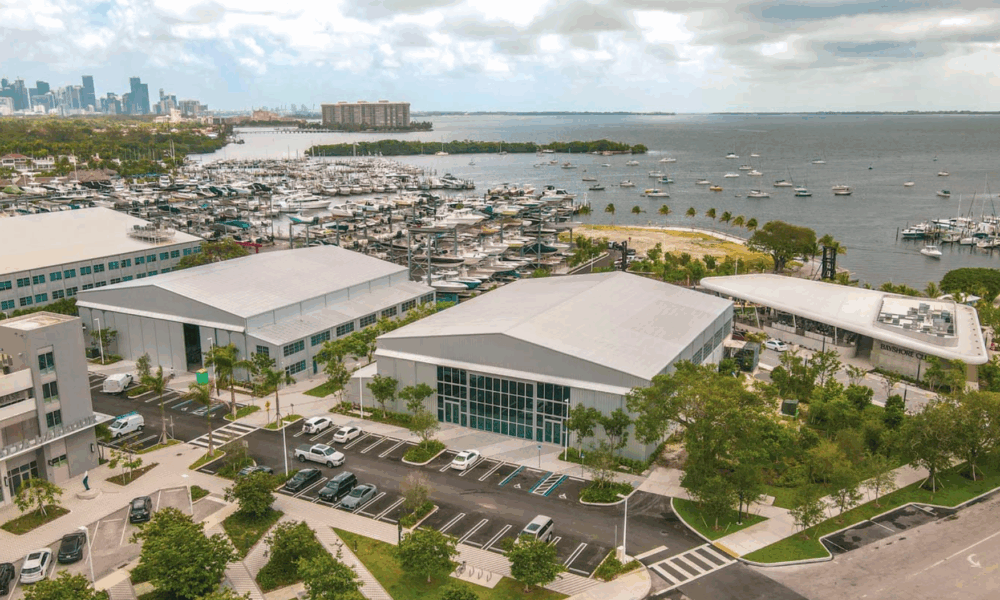
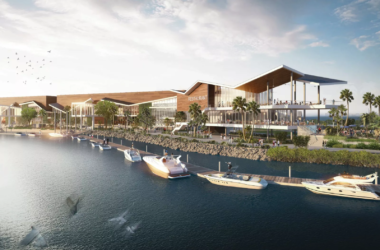
The Hangar, part of the Regatta Harbour entertainment complex operating on seven acres of public waterfront at Dinner Key, occupies a 1934 seaplane hangar that once served Pan American Airways’ Clipper fleet.
While other locally designated historic structures citywide could be affected – such as downtown’s Alfred I. DuPont Building, Edgewater’s Miami Women’s Club, and even Miami City Hall – The Hangar appears to be the most obvious beneficiary of the law, given that it already operates year-round as a large-scale commercial event space, but without the clear zoning or lease authority that the ordinance would now provide.
Among the events the venue has hosted this year are Montreux Jazz Festival Miami; a branding event for the luxury-goods brand Hermès; and a concert by Spanish pop stars Pablo Alborán and Melendi. From Dec. 4-7, as part of Miami Art Week, The Hangar will host the Latin American art fair Pinta Miami.
While the ordinance, if approved, could give The Hangar clearer argument to operate as an event venue, it doesn’t resolve the core issue: its lease explicitly limits what uses are permitted on the property — and “event venue” isn’t one of them.
The Historic and Environmental Preservation Board is a citizen-led panel that can make nonbinding recommendations on proposed laws before a vote by the City Commission, which in this case could come as soon as Dec. 11.
This is not the first time city officials have stepped in to help The Hangar.
In June, Miami District 2 Commissioner Damian Pardo sponsored a resolution to exempt the venue from a restriction, through the end of 2025, that limits special events at city-owned facilities to ten per year.
A handful of residents spoke in opposition. “When this area was originally conceived of and developed, it was not to be a large-scale event area,” Frederick Utley of Center Grove told commissioners. “These events lead to noise, traffic, garbage, alcohol, and drugs.”
Pardo’s resolution was approved unanimously — despite city records, obtained by the Spotlight, showing The Hangar had exceeded its 2025 limit in May, even before the vote took place.
Neither Pardo nor Miami City Manager Art Noriega responded to the Spotlight’s request for comment.
The privately held Grove Bay Investment Group operates The Hangar event space, an adjacent restaurant, an outdoor nightclub, and a dry-rack marina under a 80-year lease for the city-owned property.
Many longtime residents say the project has veered from the low-key, marine-focused makeover that residents supported, through a citywide vote, as is required in Miami for leases on publicly-owned waterfront property.
And notably, nowhere in the city’s request for proposals, Grove Bay’s winning bid, the presentations made to the public, or the final lease agreement is there any mention of a special-event venue.
Instead, city records describe Grove Bay’s commercial operations at the historic hangar as “marine retail” providing goods and services for recreational boaters and the liveaboard community.
Grove Bay CEO Francesco Balli did not respond to a request for comment from the Spotlight.















Quelle surprise. The only marine theme happening here is a bait and switch.
Thank you for an excellent article. Please note that I spoke on behalf of over 1000 residents represented by the South Bayshore Drive Condominium Association. These residents live in condominiums from Mary Street to Aviation Avenue and are directly affected by the hanger activities.