


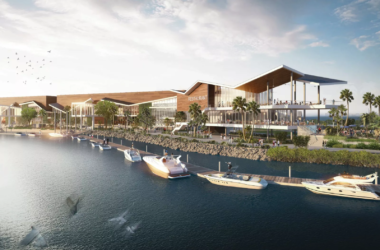

Opponents of the county’s plan to revive the historic theater as a smaller playhouse with commercial components are seeking to block Miami-Dade County from using bond funding to complete the project.
Now that the Coconut Grove Playhouse auditorium has been reduced to rubble and carted away, opponents of the county’s plan to revive the historic theater as a smaller venue are hoping to block the project by challenging a key source of funding.
Opponents went to court last year to stop demolition of the 1,100-seat auditorium, but were not successful. The judge assigned to the case did not intervene, and the playhouse auditorium was torn down, as planned.
That defeat did not end the litigation, however.
The lawyer representing members of Save the Coconut Grove Playhouse said he expects to be back in court this spring, where he hopes to stop Miami-Dade County from using voter-approved bond funding to construct a new theater.
“Everyone who voted for that bond wanted to see the playhouse restored,” not demolished, attorney David Winker told the Spotlight. “This is heading for trial.”
In November 2004, Miami-Dade voters approved $450 million in bond funding for cultural projects countywide, including the playhouse.

In the case of the playhouse, the county said funds would be used to “reconstruct the Coconut Grove Playhouse to restore its structural integrity and add to its performance and educational capabilities.”
Opponents say the county’s plan fails to live up to that promise, because the auditorium has been demolished, not restored, and because the new theater the county plans to build will be much smaller, with only 300 seats.
Winker says Miami-Dade Circuit Judge Mavel Ruiz is likely to agree. “I think I can stop them from using the bond money,” he said.
The county has approved $23.6 million for the project, including $15 million in bond funding from the county’s Building Better Communities bond program.
Opponents say the county should instead build a bigger theater – perhaps 700 seats – with fewer shops and restaurants. In response, county officials say a larger theater would be more likely to fail, while also creating traffic nightmares in Center Grove on performance days.
County officials did not respond to interview requests for this story, but in a recent court filing the county argued that Winker’s lawsuit should be dismissed.
The City of Miami “issued the County a demolition permit before this lawsuit was even filed, and the demolition work complained of has now been completed and paid for,” Assistant County Attorney James Kirtley wrote in his motion to dismiss in December.
“Accordingly, the relief the Plaintiffs seek is now moot.”
The bond funding in dispute was not used to demolish the auditorium, according to the motion. Still, the county has long described that money as a legitimate source of funding for the project.

The playhouse, which is owned by the state of Florida and leased to the county, closed in 2006 amid financial difficulties and has been shuttered since.
The county plans to restore the playhouse’s distinctive front building at 3500 Main Highway and replace the auditorium behind it with a new 300-seat theater, to be run by GableStage in partnership with Florida International University. The county plan also includes a new parking garage and commercial spaces with shops and restaurants.
The project, which is expected to cost upwards of $60 million, has fallen behind schedule after the partial collapse last year of flooring inside the remaining building.
When demolition began last year, the county said it expected the newly reconstituted theater to open in 2027, in time to celebrate the playhouse’s 100th anniversary. Now, county officials say the project won’t be completed until 2028.
“During the process of stripping drywall and stucco from the interior walls of the front façade, advanced deterioration was discovered, including significant concrete spalling, missing or corroded rebar, and areas of unreinforced masonry,” the county announced in September.
“The project’s structural engineer of record is preparing a comprehensive repair plan that will rebuild the façade walls from within while protecting the building’s ornate exterior. This work will require additional bracing and shoring potentially extending the Phase I timeline from one year to approximately two years.”
In an update provided to the Spotlight last week, the county said:
“Partial project completion is anticipated for the 100th anniversary in 2027, with full commissioning by 2028.”
The playhouse, built in 1926, opened to the public as a movie house in January 1927.
The next hearing in the court case is scheduled for May 21.


















What a disgraceful and totally unnecessary SNAFU. There has always been a reasonable compromise. It’s not about the number of theater seats. 300 seats is too small for a Regional (LORT) theater, while the original 1100 seats is too many in this congested location. That means there’s 800 seats worth of negotiation room.
The land is currently zoned Civic Institutional (CI) which requires any significant change to commercial use to give strong consideration to adjoining neighborhoods. In this case it’s the single-family zoned Little Bahamas district fka West Grove. Residents there have repeatedly said they are worried about commercial and traffic intrusion.
Obvious solutions include redesign of the long-planned parking garage to re-acquire the small vacant lot on Main Hiway where the “Bicycle Shop” once stood. Then we could make the current “alley” behind Commodore Plaza fully two-way.
That alley could then serve both the existing small “rear” Commodore garages already there, while the patrons of the new LORT theater – and a reasonable amount of supporting commercial activities – could successfully access it from Main Hiway, along with larger gatherings; e.g., Ransom School graduations. Just block the alley with bollards at its northern end to preserve the residential neighborhood.
In sum, what we have here is a failure of imagination. At least we still have the façade of one of our most historic buildings to work with. Just imagine how mostly proud most of us could be with a little give and take.
Works for me!
Here’s an idea: Tear the entire structure down. Then rebuild, incorporting the best that contemporary construction and development can offer, BUT design the new facade in imitation of the original = best of both worlds. Old time charm with modern infrastructure and improvements (or am I taking crazy pills?).
So many newcomers in our village do not understand the significance of this property. Here’s an interview that can with that: https://www.youtube.com/watch?v=4jlbXb30DBY