

After sitting empty for nearly a year, a Grand Avenue storefront has reopened as Garin Art Caffé, blending food and art while advancing its owners’ hopes for a Bahamian-inspired revival of the corridor.
After sitting vacant for nearly a year, a long-empty storefront on Grand Avenue has a new tenant. Garin Art Caffé has opened in the space, ending the vacancy on a stretch of the street where few businesses remain.
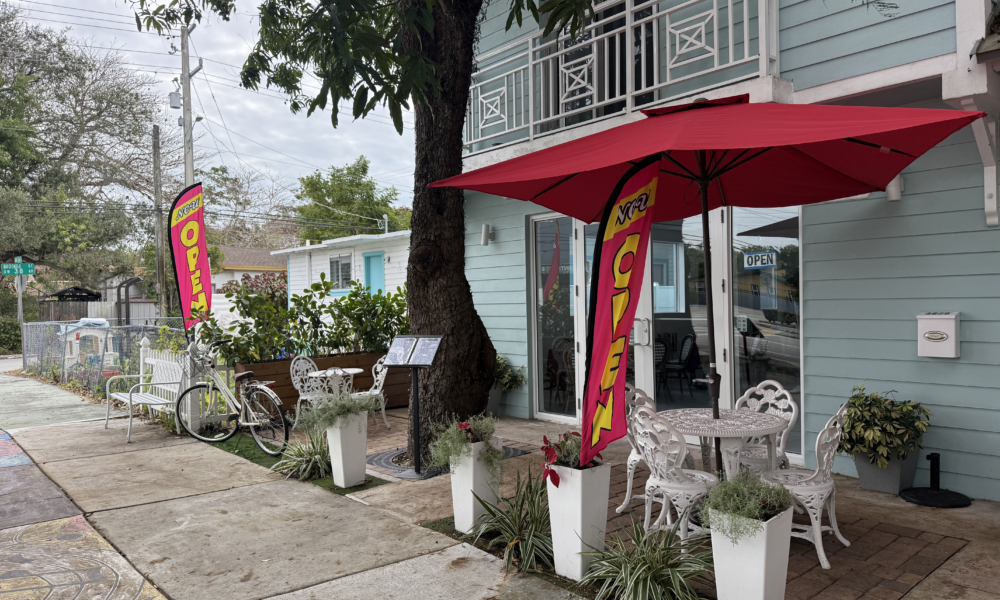
The new cafe offers a little bit of everything — coffee and matcha, tapas and burgers, wine and mojitos — set amid art-lined walls and a shaded outdoor patio beneath mature oak trees.
But for its owners — an artistic, construction-savvy Coconut Grove couple — the cafe represents more than a new restaurant. It is the first step in a broader vision to revive the south side of Grand Avenue, between Douglas Road and Esther Mae Armbrister Park, as a small-scale business and arts hub rooted in the Grove’s Bahamian heritage.
Carlos Garin and Clara Garcia, Cuban immigrants who have lived in Coconut Grove for 25 years, say they have long hoped for an opportunity to help revive Grand Avenue’s once-thriving commercial corridor.
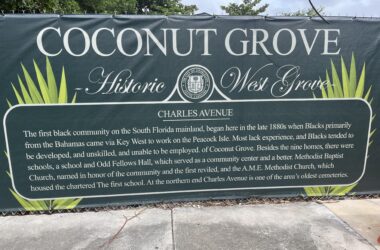
For much of the 20th century — particularly during the segregation era — Grand Avenue was a vibrant business district and social hub for the West Grove’s predominantly Black community, lined with locally owned shops, services and gathering places.
Garin said that history has largely faded from public memory but remains central to his vision for the corridor’s revival.
“If you review the history of Coconut Grove and Grand Avenue, Grand Avenue was a business street,” Garin said. “It was the main street in the Grove.”
Garin Art Caffé, housed in the blue, Caribbean-style building at Grand Avenue and Brooker Street shared with Lux Hair Salon, is intended as the first in a series of developments the owners hope will help reenergize the block.
Garcia, an architect and construction manager who designed and built the two-story building at 3870 Grand Ave. that houses the cafe, has also completed a pastel-yellow building next door, which she envisions as an art gallery with residential space above.
Garcia said she is also partnering with about 10 other property owners along Grand Avenue, with plans to develop several additional mixed-use buildings in the same Bahamian-inspired style over the coming years, zoning permitting.
“I think it’s very important to create this kind of [business] pathway, because it’s the only way to support small, mom-and-pop businesses,” Garcia said.
The goal, she said, is to create a new commercial hub away from Center Grove.
“It will be more comfortable, more human, more relaxing on those two blocks than CocoWalk,” Garcia said, referring to the upscale, five-story mixed-use complex of offices, shops and restaurants in Center Grove
That vision begins with Garin Art Caffé, which opened to the public two weeks ago.
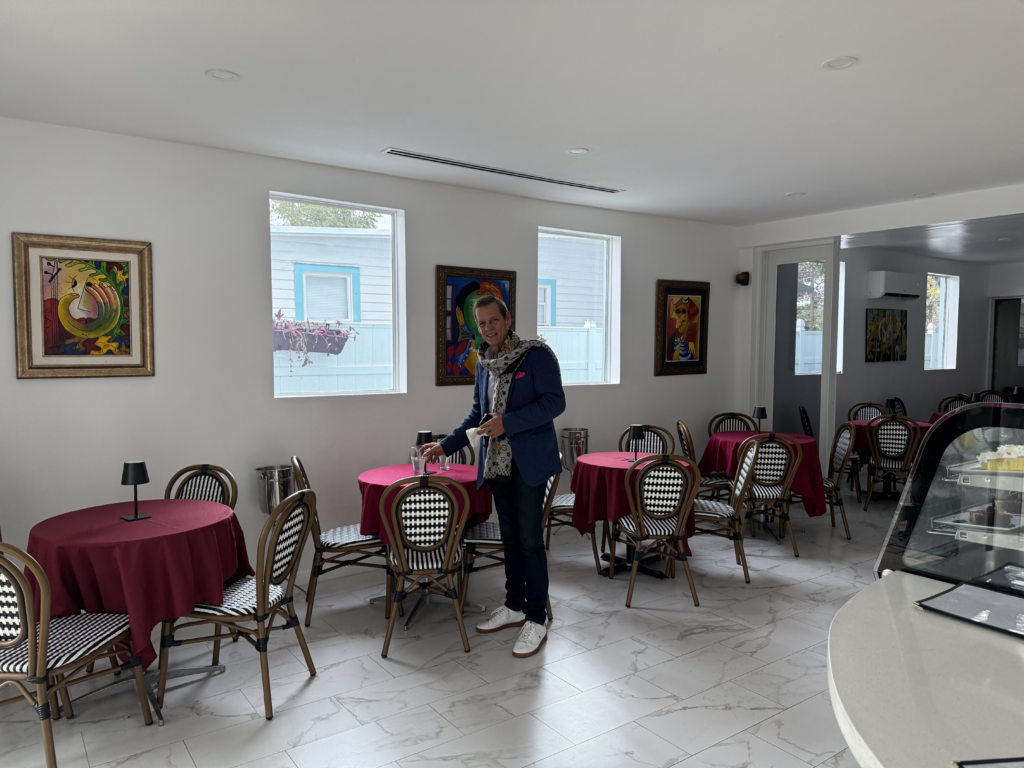
Named for its owner, the café reflects Carlos Garin’s passion for the arts as much as his homegrown recipes. Original artwork — including several of Garin’s own paintings — lines the walls, giving customers something to linger over as they sip coffee.
“Everything here is original,” Garin said. “The idea, the design, the construction, the recipes — everything.”
An artist, actor and former Miami-Dade County mayoral candidate, Garin runs the cafe’s day-to-day operations and serves as its primary chef.
This marks Garin’s second attempt at a restaurant in the space. He previously operated Garin Art Sushi Café there. After it closed, he leased the storefront for two and a half years to Judith’s Market, a café and gourmet boutique that abruptly shut its doors in February 2025.
Read more: Business Dispute Shutters Grand Avenue Café
So far, the new restaurant is getting good reviews.
“As repeat customers, we give it a thumbs up,” said local resident Debbie Dolson who’s dined a couple times already with her husband. “To me, it’s a perfect place if you’re going to have a small business meeting or even just meet friends for lunch or breakfast. It really is a great spot, I think, away from the hubbub of Center Grove.”
Garin’s plans include live music on Saturday evenings, paired with tapas, and the return of live painting sessions on the sidewalk outside — an effort to draw people together around food, art and conversation.
Garin said the cafe is intended to add to a dwindling list of neighborhood gathering places — a space where people can connect over food and art. Like many longtime Grove residents, he and Garcia have watched as small businesses, cultural spaces and artistic life have steadily disappeared from the community.
The planned series of developments, rooted in the area’s Bahamian traditions and architectural style, represents their effort to reclaim what the neighborhood has been losing.
“We are very involved in the community, and we feel sorry that they are trying to gentrify it. If we don’t keep the tradition strong, all of Grand Avenue is going to be modern style,” Garcia said.
Whether the couple will be able to fully carry out that vision remains an open question. While Garin Art Caffe and the neighboring salon are allowed to operate as commercial uses, most other properties along the street are limited to single-family residential use, effectively barring businesses from opening there.
Developers say those restrictions have held the corridor back.
“The problem is the zoning is wrong,” said Marcelo Fernandes of Grove Properties, the developer behind the proposed Grove Landing development on the southwest corner of Douglas Road and Grand Avenue. “Single-family residential on Grand makes it impossible to do anything.”
City officials are discussing changes that would allow small-scale commercial activity on parts of Grand Avenue within the nascent Little Bahamas Business Corridor. According to Miami Commission District 2 Coconut Grove liaison Javier Gonzalez, about 29 properties are expected to go before the Planning and Zoning Board in coming weeks to seek approval for those changes.
Gonzalez shared the information Monday night at a meeting of the Coconut Grove Village West Homeowners and Tenants Association (HOATA) but did not respond to the Spotlight’s request for details on which properties would be included.
The possible zoning shift could mark the long-awaited opening Garcia and Garin have been waiting for.
Without it, Garcia said, their plans would have to be scaled back to single-family homes — a disappointing outcome after spending two decades hoping to realize a vision centered on small businesses, art and community life.
The project began in 2006, when Garcia purchased the property that now houses the café. Then a single-family home, the building remained occupied for more than a decade. Garcia waited until the tenant — a longtime Grove pastor — moved out before demolishing the structure and rebuilding from the ground up 11 years later.
In designing the new building, Garcia drew inspiration from Coconut Grove’s early architectural traditions and her own Cuban roots, echoing the proportions and street-facing character of the shotgun-style homes that line the opposite side of Grand Avenue.
“The rules of my career are to restore and keep the history,” she said. “We are motivated to keep the original style right.”
That commitment is rooted in a deep attachment to the neighborhood — one she has walked, worked in and raised her children in for more than two decades.
For Garin, the undertaking is a labor of love, as it gives him a chance to shine a spotlight on authentic, local artists.
“The people of Grove have no idea about the cultural potential here in the town. They don’t have an idea, because nobody promotes the culture, the history, and the artists,” he said.
He’s already transformed the sidewalk into an homage for the arts, with several of the squares filled with custom paintings.
J.S. Rashid, a West Grove developer involved in the construction of the five-story Gibson Plaza housing project a few blocks east on Grand Avenue, has long advocated for creating a West Grove–based cultural hub.
He applauds Garcia and Garin’s plans as a step in that direction.
“We should never give up the essence of what we are,” he said. “We should treasure that, we should codify that.”