

This week’s election results in the City of Miami gave a boost to the reform agenda pushed by Miami District 2 Commissioner Damian Pardo and others.
City of Miami voters embraced change this week, shunning three City Hall veterans in the race for mayor, propelling two other reform-minded candidates into a December runoff, and voting overwhelmingly to impose a lifetime term limit on serial politicians.
Miami-Dade County Commissioner Eileen Higgins came out on top in the mayor’s race with 36% of the total vote. She’ll face former Miami City Manager Emilio Gonzalez in a Dec. 9 runoff election. Gonzalez came in second, with 19.5% of the vote.
Voters in Coconut Grove backed Ken Russell, their former commissioner, but it wasn’t enough to earn Russell a spot in the runoff. He came in third, behind Higgins and Gonzalez, with 17.6% of the citywide vote.
Joe Carollo, Xavier Suarez and Alex Diaz de la Portilla – three City Hall veterans whose political careers date back decades – ran a distant fourth, fifth and sixth in the polling. Carollo captured 11.5% of the vote. Suarez and Diaz de la Portilla each won 5%. Seven other candidates split the remaining 5% of the vote.
More than 37,000 Miami voters cast a ballot in the election, about 10,000 more than voted in Miami’s last mayoral election in 2021. Still, only one in five voters (21.67%) chose to participate in an election that promised change.
Higgins and Gonzalez have both pledged to clean up City Hall, to root out corruption and make Miami government more efficient. In that sense, Tuesday’s vote was a win for those, like Russell, who have pushed a reform agenda.
“The appetite for reform is there,” Russell told the Spotlight after the election.
Miami voters also backed change at a more fundamental level on Tuesday, by voting to enshrine three proposed reforms in Miami’s city charter, while rejecting a fourth proposal, which would have made it easier for the city to sell or lease public property.
By margins of 76% or more, voters agreed to impose lifetime term limits on politicians, establish a citizen’s redistricting committee to prevent gerrymandering, and empower a charter review commission to propose changes to the city’s charter every 10 years.
The referendum on lifetime term limits passed with 79% support, a significant victory for Miami District 2 Commissioner Damian Pardo, who championed the proposal.
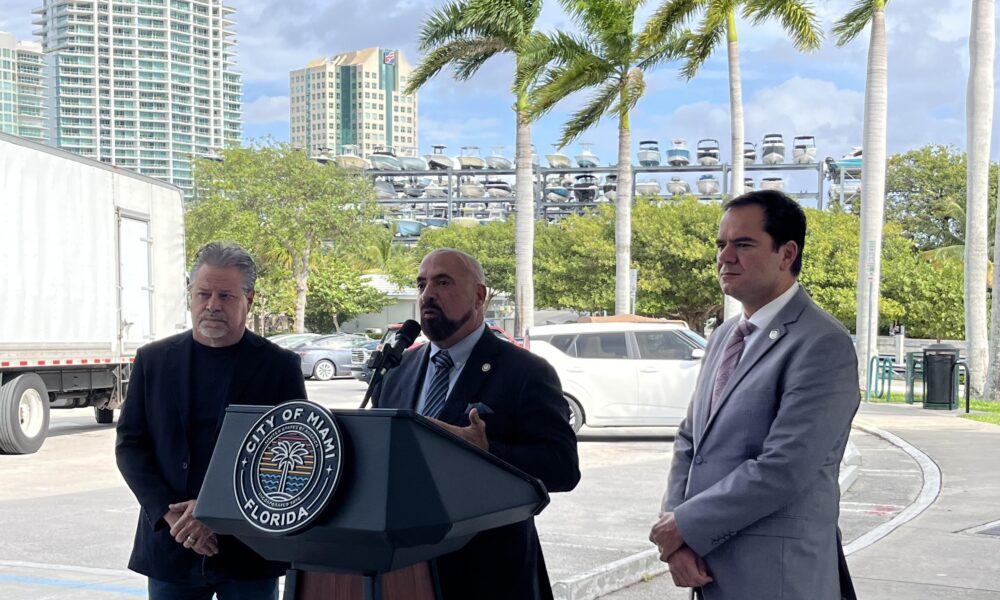
“What this does, it puts an end to any kind of entrenched politics,” Pardo said the day after the election at a City Hall news conference, where he was joined by Miami City Commissioners Miguel Gabela and Ralph Rosado, both of whom supported the reform.
“It opens the door for new ideas, new faces, more perspectives,” Pardo said.
The first test of that may come next month, when voters choose a candidate to replace Carollo, who must give up his District 3 commission seat after serving two terms.
The frontrunner to replace him – Frank Carollo, his brother – won 38% of the vote on Tuesday, and now faces a Dec. 9 runoff against a second candidate, Rolando Escalona.
But Carollo’s brother has already served two four-year terms on the city commission, which would make him ineligible for office under the city’s new lifetime term limits.
Three Miami voters went to court late Tuesday to bounce Frank Carollo from the runoff election, according to WLRN Public Media. Pardo said he didn’t know how that challenge might play out. But, he added, “the people have spoken.”
Like Russell, Pardo said Tuesday’s vote showed Miami voters have an appetite for change. “I believe it shows very strong support for the reform agenda,” he said.
Pardo said his next priority would be to change the city’s election calendar, so future elections are held in even-numbered years, to coincide with state and federal elections, when turnout is higher. The change would need to be approved by voters.
Pardo and his fellow commissioners sought to move this year’s election to 2026 without voter approval, but the move backfired spectacularly, with the public and in court.
Rosado said he would push to change the election calendar as well, but Gabela expressed reservations, saying the move could make city elections more partisan and more expensive, which would make it harder for a candidate running a grassroots campaign to compete.
In this year’s mayor’s race, where some candidates raised $1 million or more, Russell said his campaign was clipped by a lack of resources.
Although Russell won 39% of the vote in Coconut Grove’s precincts, finishing just ahead of Higgins, he narrowly missed the runoff, losing to Gonzalez by roughly 700 votes.
On Wednesday, Russell said he was pleased with the impact he made in the race, pushing a reform agenda, but in the end was outspent by better-funded opponents.
“I’m really at peace that we did everything we could. We simply didn’t have the resources to amplify what was really a great campaign,” Russell said. “The resonance of my message was good.”
As for what’s next, Russell said will support the Stronger Miami petition drive to expand the city commission from five to nine members, and move elections to even-numbered years. Organizers are gathering signatures to place those issues on the ballot in 2026.
“I’m going to double, triple down on the Stronger Miami campaign,” Russell said. “I want to push both candidates (Higgins and Gonzalez) to be on that platform.”
Asked if he planned to endorse either Higgins, a fellow Democrat, or Gonzalez, a Republican, Russell said no, for now. “I’m not endorsing at this point,” he said. “I haven’t been asked and I think that this race has very little to do with me now.”