



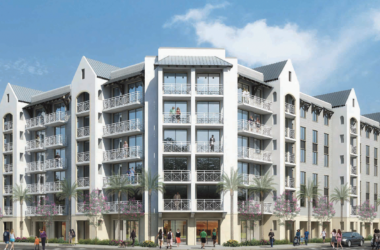
A proposed zoning overhaul would constitute a major citywide upzoning by allowing multifamily housing — with minimal affordability rules and no public hearings — on churches, schools, nonprofits, hospitals and government-owned land.
A sweeping zoning overhaul headed to the Miami City Commission on Thursday could trigger a broad upzoning across the city by allowing residential development — without public input or review — on hundreds of civic, religious, school, nonprofit, and government-owned properties.
Under the proposed ordinance, any property zoned “Civic Institution” (CI) and owned, controlled, or legally affiliated with a religious institution, nonprofit, school, or government entity would be allowed to build multifamily housing “by right,” meaning absent any requirements for public hearings or community review typically needed for projects of this scale.
The allowable number of residential units per acre would match the most restrictive density of any zoning district that touches the CI property; in cases where a CI parcel abuts single-family neighborhoods, the site would default to T4 density — 36 units per acre — even if higher-density zones also border the property.
Miami has 668 such CI-zoned properties, ranging from churches and private schools to hospitals and government entities.
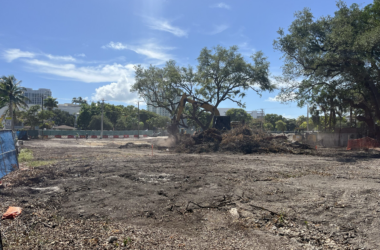
In Coconut Grove, they include, among others, Mercy Hospital and Immaculata-La Salle School on South Bayshore Drive, the Coconut Grove Playhouse, the Miami-Dade Water and Sewer Department on Le Jeune Road, and Ransom Everglades School’s South Bayshore campus and its abutting land holdings.
The item — PZ 13 on Thursday’s commission agenda — will be up for the first of two required votes before it becomes law.
City officials, without explanation, told members of the city’s Planning Zoning & Appeals Board (PZAB) last month that the proposal, which is sponsored by Miami District 4 Commissioner Ralph Rosado, will help the city “better align with state law” on unlocking unused land to ease the affordability crisis.
But the affordability requirements outlined in the legislation are negligible, simply requiring that projects provide some units at a “minimum Workforce Housing AMI level,” without prescribing how many as a percentage of the total must be built. Nor does the proposed laws stipulate for how long in the future the units must be priced at such levels.
Under city rules, workforce housing is defined as those attainable for households earning between 100 percent and 140 percent of Area Median Income. In Miami-Dade County, that range spans roughly $86,800 to $121,500 for a single person.
Nothing within the proposed law would mandate the construction of lower-priced “affordable” housing — defined as attainable for those earning between 60 and 80 percent AMI, or about $52,000 to $69,000.
A developer could meet the ordinance’s requirements with only a handful of workforce-priced units while building the remainder at full market rate – a common complaint in Miami, voiced by city commissioners at a recent meeting.
While the proposed measure was approved last month by PZAB, the draft language up for vote at Thursday’s commission meeting includes a small but potentially far-reaching change from the version reviewed by the board.
The original version limited development rights to properties “owned or controlled” by a religious institution, nonprofit, school, or government entity. The updated draft adds a new category — properties “affiliated by legal instrument” with those institutions — a phrase that could allow private developers to obtain the new residential allowances simply by entering a ground lease, joint venture, or management agreement.















This is insane.
Once again the City of Miami shows it is a government of developers, for developers, by developers.
If you’re not outraged you’re not paying attention.
HIGH-RISES (with apologies to Joyce Kilmer)
I think that I shall never apprise
A building as “lovely” as a high-rise.
A high-rise whose greedy developers press
Commissioners zoning changes to bless.
A high-rise that blocks the breeze all day
For unfortunate homes that fall under its sway.
A high-rise that claims to be “affordable”
Providing nests for the Wealthy and Absentees: Deplorable!
Upon whose votes should the blame fall?
The State? the County? the City? ALL.
Poems can be bad or good as can high-rises,
But God help us all if we don’t have choices!
“Without public input or review.” Why not? Because they know the public doesn’t want this.
Dictator
/ˈdikˌtādər/ (noun)
A dictator is someone who has absolute power — or who at least behaves as if they do by bossing others around.
In government, a dictator is a ruler who has total control over a country, with no checks or balances to prevent abuse of power
Seeing as we have a new Mayor, who will be appointing a new City Manager, I think any and all zoning changes should be paused. We as a city need to have a philosophical discussion about who we are and where we’re going. Right now it feels like we’re adding more speculation to dig us out of the speculative hole we’ve dug ourselves into. What is going on? It’s so chaotic.
THIS IS CRAZY. Civic Institution (“CI”) zoning exists to serve the public good. Currently almost any use, besides clearly cultural / religious uses, need a public waiver, notice, hearings, etc. To change this – and allow housing “by right” – would make the zoning meaningless.
Here in the Grove this means that the Coconut Grove Playhouse property could just become full of luxury housing. (It’s bad enough that the County is proposing to put more than 52,000 sq-ft of commercial on the site – but at least it needs public hearings and review).
Commissioner Pardo should hear the Grove’s concerns over this – and ensure that civic properties serve the people’s – not just developers’ – interests.