

An affordable housing project on Mundy Street in the West Grove will deliver eight new apartments on two separate lots while preserving a 1926 coral rock home on one of those lots.
Dragonfly Investments staged a ground-breaking this week for an affordable housing project on Mundy Street in the West Grove that promises to deliver eight new rental apartments for low- and moderate-income families in a neighborhood experiencing rapid gentrification.
Each three-bedroom apartment will be priced for families earning 80% or less of area median income (80% of AMI is $89,200 for a family of three in Miami-Dade County).
Dragonfly Investments is partnering with the City of Miami to build the $4.4 million Mundy Street project, which is within easy walking distance of an Aldi grocery store, a major bus line and the Metrorail station on Douglas Road.
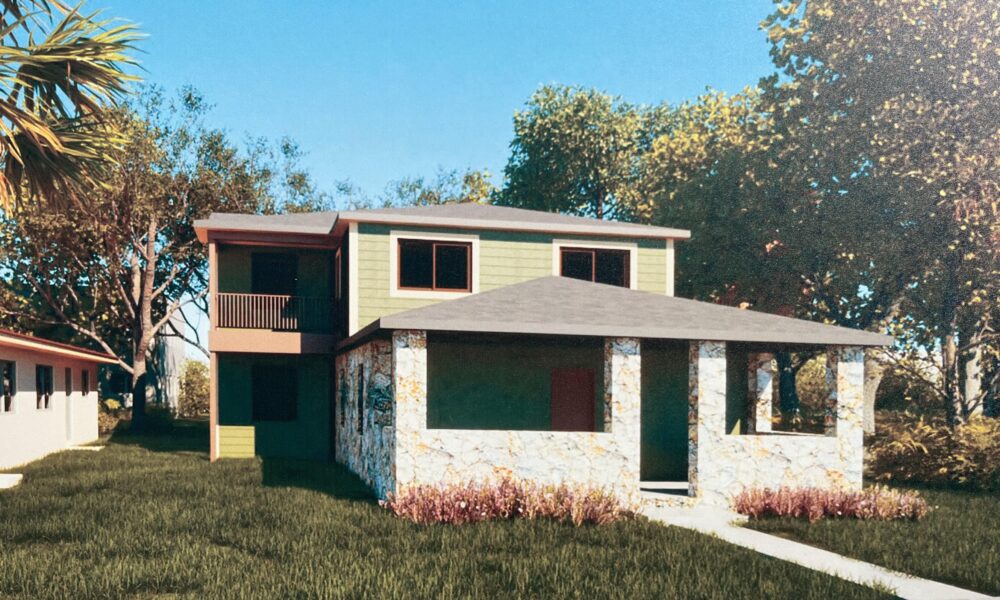
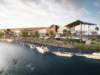
As part of the development, Dragonfly plans to restore a 1926 coral rock home on one of the project’s two construction sites. The home at 3173 Mundy St. will function as the entrance to four of the apartments, which will be built behind the historic structure.
A few doors away, Dragonfly plans to construct a second building at 3121 Mundy St. with four other apartments. That two-story building will feature a broad veranda with decorative trim, in a nod to the neighborhood’s Bahamian style and culture.

The Dragonfly project provides a sharp counterpoint to recent development trends in the neighborhood, where large two-story cube homes are replacing modest bungalows, and where two high-rise developments with 795 apartments are coming to Douglas Road.
Read More: Second High-Rise Tower Approved for West Grove
Miami District 2 Commissioner Damian Pardo highlighted that difference before joining Dragonfly executives at Wednesday’s event to toss a ceremonial shovel of sand.
“I think for our office it has been a top priority to make sure that we are preserving the character and the identity of our neighborhoods, and that we are accomplishing big goals like affordable housing,” he said.
“When you think about affordable housing, you often hear about these major projects with thousands and thousands of units, or hundreds of units, that are being added, and I want to emphasize these (Dragonfly) projects, which are about the neighborhood, with the neighborhood, that maintain the character, the historic qualities, the things that people really care about in the neighborhood,” he added.
The Dragonfly project also represents something of a Hail Mary pass by the city, which was in danger of losing $2 million in federal funding when an earlier plan for a housing project on the block collapsed.
Read More: West Grove Affordable Housing Project Moves Forward
As a for-profit developer, Dragonfly will be required to make the 1,200-square-foot apartments available by lottery to families across Miami-Dade County, according to Amanda De Seta, the company’s head of development.
That has been a sore point for community leaders, who say West Grove residents should have preference, given the development forces that are pushing Black families out of the West Grove.

De Seta acknowledged that concern, saying the company’s intent will be to rent locally, to families that currently live in the Grove or that have been displaced. That intent could be accomplished through targeted marketing, she added.
The eight new apartments on Mundy Street will rent for $1,600 to $2,600 a month, with the final price determined by family size and income, De Seta said.
Dragonfly expects both building to be substantially complete by the end of the year. Neither will have parking. The parking requirement was waived for this project because of its proximity to public transportation. De Seta said the project would not have been feasible logistically without that waiver.
After negotiating the partnership deal in December 2024 with the city, Dragonfly and Arko Architecture on Coral Way completed the design plans and applied for building permits in August of last year.
Although critics of the city’s permitting process – including Mayor Eileen Higgins – describe that process as a lengthy nightmare, De Seta said the Mundy Street project was “surprisingly easy” to permit. She credited Ana Pedraja, an employee in the city’s building department, for helping to move the project forward.
Although final permits for both buildings are still pending, De Seta said she expects to have those permits in hand within weeks.
With construction poised to begin on Mundy Street, De Seta and Dragonfly are making progress on another affordable housing project in the West Grove, in partnership with Greater St. Paul AME Church.
Since celebrating the restoration of twin 1939 cottages on Hibiscus Street in September, Dragonfly has completed two other homes, De Seta said. Six more are planned on William Avenue.

Read More: A Neighborhood Celebrates a Restoration Project
At Wednesday’s event, one of De Seta’s colleagues at Dragonfly pointed to the Mundy Street project as an example of the company’s commitment to affordable housing.
“This project reflects thoughtful development and strong collaboration, paired with our deep commitment to expanding affordable housing opportunities in our city,” said Julie Quittner, the company’s executive vice president.
“We are especially proud to help bring much-needed affordable housing units to the Grove, creating quality housing that remains accessible to Miami residents,” she added.









I love this!!! This is exactly the solution. I also love little courtyard apartments, like the ones that used to line Grand Avenue. Imagine if instead of being greedy and buying them all up and land-banking, developers and the City had actually worked together to renovate them modestly, put in some pretty landscaping and made them nicer for people to live in without pricing them out. It doesn’t take that much! So nice to see this happening.
Congratulations are due to Dragonfly Investments, the City of Miami, and District 2 Commissioner Damian Pardo. These 8 rental units check a lot of boxes, including: preserving a historic coral rock structure, Bahamian-style architecture in this “Little Bahamas” neighborhood, designed for families with kids at 80% of AMI, and built (with public subsidy) for $550,000/unit. Well done! Let’s see how many West Grove residents take occupancy since it was developed with Federal money requiring residency be open to all.
Looking forward, what else can be done to slow down the “extinction through gentrification” which I define as people with more money displacing existing residents with less in desirable locales like the Grove. It’s hard to do without public subsidies for such controversial remedies as ADU’s (“granny flats”) even with re-sale restrictions to prevent making existing homes even more desirable to outsiders or Airbnb investors.
Zoning changes allowing more contextually designed low-rise apartment buildings in areas now zoned strictly for single family homes — there are at least a half-dozen scattered unobtrusively throughout the whole Grove — would also be controversial until skeptical residents say, “Why didn’t we do this before?” Before what? Before succumbing to nothing but anti-family, neighborhood-destroying, seen-one-seen ‘em-all high-rises as the only solution to the housing shortage. They are not!
I imagine that any developer can build soulless high rises, but look what can be done with a little ingenuity, a good design, and a lot of effort.
The Preservation of both the character and integrity of the neighborhood, everything we’ve been asking for.
Congratulations and a big thank you to all those that made this possible!